• Quick note - the problem with Youtube videos not embedding on the forum appears to have been fixed, thanks to ZiprHead. If you do still see problems let me know.

Calling all geologists

Hamradioguy

Pyrrhonist
Joined
Feb 6, 2005
Messages
2,297
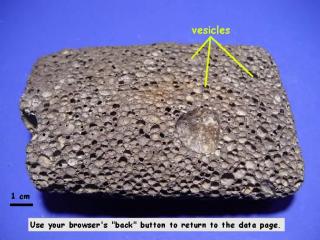
Attention savvy JREF Forumites. Even if you're not a geologist you are invited to identify this odd rock. (The "Ironwoman" at MIT could do it in a flash I think, but she's busy with e-mail problems lately.)

This was found in a streambed in Bucks County, PA many years ago. I first thought it was a meterorite although it's way too light- 75 grams. A geologist at the Trenton, NJ State Museum identified it but I long ago forgot what he said it was. I DO remember that he insisted it could not have come from Pennsylvania as it was something found only in the far west of the USA. (So how did it get in a streambed in the east then?) Anyhow, here it is- make your guesses:
 

Attachments

  • Mystery rock-1.jpg
    Mystery rock-1.jpg
    91.5 KB · Views: 25
Looks like pumice.

Some of the guys I work with found an unexploded anti-tank round in a creek, many miles from the nearest place artillary had ever been fired. People tend to drag all kinds of things around with them, then toss those things into the nearest creek when they get tired of dragging around.
 
So true Fishbob, neolithic people traded and hauled stuff all over the place. Seashells and the like end up very far from the source. As one of my instructors said tounge in cheek "You would think they were wearing rollerskates when you see how far this stuff travels."
 
the vesicles look too large to be pumice. if it's pumice, however, i do believe that it should float in water?

i'm terrible with estimating weights-- i have no concept of how dense it would feel given the size and weight you've mentioned-- but from the overall look, i'd suspect it to be volcanic, based on the vesicles, which suggest gasses were escaping during the time that it cooled.

given that you mention it to be light weight, i'd start to think of scoria-- pre oxidation, based on the color-- but the texture doesn't appear glassy enough, and the vesicules appear too "orderly".

from looks alone, i'd guess it to be a very vesicular basalt, or a vesiciular andesetic basalt. i'd expect it to feel somewhat light, regardless, just based on the fact that it is dominated by vesicules.
 
I'd vote for pumice. It's airborne igneous formation, I suspect. And 75g is VERY light for it's size.
 
I'd vote for pumice. It's airborne igneous formation, I suspect. And 75g is VERY light for it's size.

pumice should consist of very fine vesicles, and should be glassy.

at least in the picture, i can't make out any fine vesicules, and the texture appears too "dull".
 

That sure does look very similar indeed. It's not pumice- although it's really light: 3 ounces for something baseball sized. I sure wish I could remember just what that museum chap said it was- a rather long unpronouncible name to a 10 year old. I may have to track down another museum type locally and see what they think.

The stream bed I found it in was pretty close to some houses, so it MAY have been tossed there. It certainly stood out from all the other typical stream bed rocks.
 
The pics remind me of a commercial product. Some kind of abrasive/cleaner/scrubber about the size of a brick, with a plastic handle stuck on the back side. I wears rapidly, and keeps a fresh, sharp surface. Possibly used in restaurantes to scrub the griddle, or maybe in metal shops for surface finishing. I always asumed it was some kind of industrial slag that somebody had found a use for. Maybe it is a mined product?

All of the pumice I've found was light colored, almost white. Mostly like upholstery foam, with some bigger voids. But I found it at high tide line along the Sea of Cortez, so maybe it's from different volcanoes.


ETA, Google "griddle stone"

http://www.don.com/catalog/productd...rill+Bricks%2FPads%2FScreens_RACC&prodid=K487

It reminded me that the last one I saw was for my BBQ. The rough black one, like the sample in question.

Sooo, I'd say the sample found in the strream was a remnant of a household cleaning implement. Or maybe them roller skate wearing natives used it to scub off their callouses?
 
Last edited:
Cool! You will most likely be right, of course. I think the mineralogy of the sample will have to be the decider...

Meanwhile, pumice comes in a variety of wizzo colours and textures!

pumice.jpg
 
I don't know much about rocks, really, but having grown up in Nortwestern Connecticut, the first thing I figure one ought to rule out is slag.
Sorry. Can't help this as a response... ;)

nydg10601300831.widec.jpg
 
Attention savvy JREF Forumites. Even if you're not a geologist you are invited to identify this odd rock. (The "Ironwoman" at MIT could do it in a flash I think, but she's busy with e-mail problems lately.)

This was found in a streambed in Bucks County, PA many years ago. I first thought it was a meterorite although it's way too light- 75 grams. A geologist at the Trenton, NJ State Museum identified it but I long ago forgot what he said it was. I DO remember that he insisted it could not have come from Pennsylvania as it was something found only in the far west of the USA. (So how did it get in a streambed in the east then?) Anyhow, here it is- make your guesses:
You haven't provided enough information.

Does a magnet attract it?
Are the holes merely indentations where something eroded out or are there vesicles throughout?
How hard is the surface?
Does it dissolve in an acid?
What is the streak color?

You can look here for some simple tests. You don't have to perform them all, but do the ones you can and give us more to go on.

It still appears volcanic (igneous). Not everything is called pumice.

It doesn't look like metamorphic rock. That isn't likely to have vesicles since it 'morphs' under pressures of the crust.

Sedimentary rocks that have eroded can look pockmarked which is why I ask if it is vesicular or just eroded on the surface.

From the density, I'd say it was indeed vesicular. It is unlikely to contain metal. If it were identified previously and you just can't remember the name it is unlikely to be slag, not to mention slag generally has some metal content.

If it is from the West Coast then volcanic origin is possible. Also, there are variations of pumice that a geologist could have given another name to.

You need to consider how the surface got that way. With magma, trapped gases create the vesicles. The alternative is erosion where wave action or flowing water resulted in the indented surface. Without more information, the uniformity suggests trapped volcanic gases.

The weight and appearance pretty much rule out it being a meteorite. Meteorites are very dense and the indentations don't look like that at all. Rather meteorites have Regmaglypts
thumbprint-like depressions on a meteorite caused by the uneven flow of air during passage through the atmosphere and the consequent surface melting and ablation.
 
Last edited:
Cool! You will most likely be right, of course. I think the mineralogy of the sample will have to be the decider...

yes, mineralogy would tell us a lot. unfortunantly, given the picture, we can't even tell if crystals are visible in hand sample. it looks aphanetic to me, but that's just a best guess based on the picture.

Meanwhile, pumice comes in a variety of wizzo colours and textures!

pumice can have many looks, but it's generally defined by its glassy texture and many tiny vesicules. i don't see either characteristics in the photo posted, but then again, it's just a photo, and may look completely different in hand sample.
 
Are the holes merely indentations where something eroded out or are there vesicles throughout?

that's a good question.

many minerals simply aren't stable at the earth's surface, and erode much more quickly than the host rock. in this case, for example, we could be looking at an olivine basalt from which the olivine has been oxidized out, leaving behind the pitted texture.

however, i'd expect to see some olivine present still, especially as the clast is worn down and new olivine exposed.

It still appears volcanic (igneous). Not everything is called pumice.

it looks volcanic to me, and it doesn't look like pumice to me. pumice requires a glassy texture. from the photo, i think this is aphanetic. then again, i could be wrong. it's not like judging a photographic is very reliable.

It doesn't look like metamorphic rock. That isn't likely to have vesicles since it 'morphs' under pressures of the crust.

also, it then would probably be either visibly foliated and aphaneitc, or phaneritic or even porphoritic and sporting micas or amphiboles-- again, not like i should necessarily expect them to show in a photograph, but going on what we have...
 
... pumice requires a glassy texture. ...pumice can have many looks, but it's generally defined by its glassy texture and many tiny vesicules.
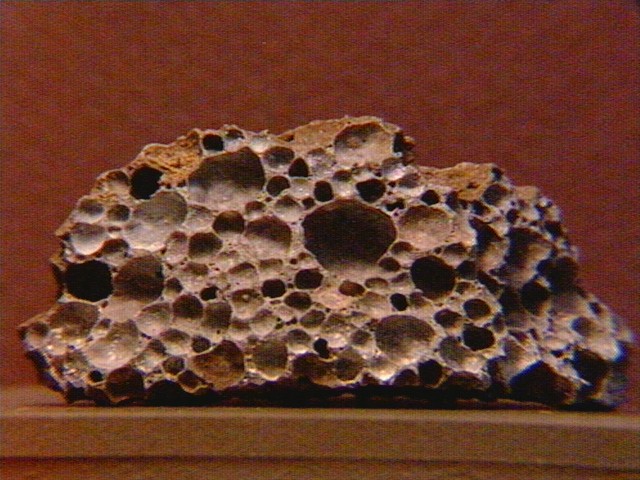
I have some volcanic specimens with vesicles as large as the rock in question.

Large vesicles form a separate population which defines a power law distribution with fractal dimension D=3.3 (range 3.0-3.5). The large D value, coupled with textural evidence, suggests that the large vesicles formed primarily by coalescence

Glassy texture would be important to know. Some pumice isn't as obviously glassy when it forms from real frothy magma, but when the vesicles are large, it is always glassy I believe.

From the picture, it just doesn't look glassy or volcanic. It look more like cement texture. Did we find out yet if it floats?
 
Last edited:
I have some volcanic specimens with vesicles as large as the rock in question.

when you said volcanic, did you mean pumice? regardless, i'm sure that pumice can have large vesilces, but its matrix should still be porous and glassy.

if you have an extrusive igneous clast with larger vesicles and without a porous matrix, then you may have a scoria. again, it's going to come down to texture; basalts and other lavas tend to be aphanetic, porphorytic or even phaneritic, while scoria is partly glassy and partly crystalline.

Glassy texture would be important to know. Some pumice isn't as obviously glassy when it forms from real frothy magma, but when the vesicles are large, it is always glassy I believe.

the problem here is that i don't expect most folk to be able to determine the texture of a rock. if hamradioguy was able to do this, i'd suspect he'd have been able to identify the rock himself.

From the picture, it just doesn't look glassy or volcanic. It look more like cement texture. Did we find out yet if it floats?

it looks very volcanic to me-- but that's just a picture. i've collected a few basalts that look quite similar are texture and color, and are nearly equally as vesicular, though they've not had such uniform vesicularity. i've seen other lab samples that are similar as well, but nothing exactly the same. but with rocks, that how it goes-- i just collected a number of serpentinite clasts today that are largely blue, which is something i'd never seen before!

regardless, it's a cool rock. those uniform vesicles make me think of the surface of the moon or something. sexy! i'd have stuffed it in my pocket as well.
 
I have quite a few samples of all kinds of magmatic rocks from Pele's hair to obsidian. The one I'm referring to is glassy, and not scoria. Scoria is more like rough holes, not the rounded texture like in the photo. I'll have to dig the specimen out to see how porous it is. I don't recall it being porous like pumice is.
 
If this was a democratic process (and it isn't), I'd vote for vessicular basalt. Regardless, it doesn't seem like the kind of thing you'd find in Bucks Co., PA.
 

Back
Top Bottom