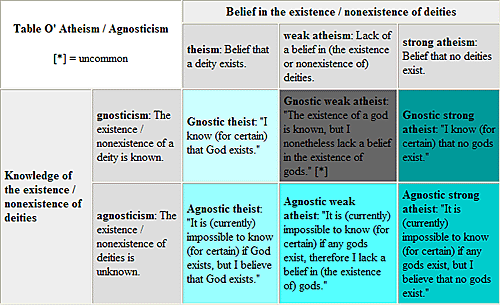
I would say that statement one applies to me, where statement two does not. I feel the concept of gods as usually stated is unfalsifiable, therefore it is equally meaningless to believe and believe not. There's just no way to have any evidence either way, so it's pointless.
Yes, but at this point, I point out that the modern concept of God is really a corner into which He's been shoved by logic (and a healthy dose of my-god-is-tougher-than-your-god one-upsmanship over the millenia).
Modern God has the curious property of infinite power, and hence could hide infinitely well from modern, finite mortals. And he has the even more curious property
of wanting to do this.
Many propose He values, for some strange reason,
belief in Him without proof. As if this has some supreme metaphysical importance.
As if doing something for a reward, or to avoid punishment, or both, is acceptable
only if you do it without proof it's going to actually happen. Is this a true value, or just an ad-hoc rationalization of the fact this "behavior" is really just a stretch trying to explain it, piling an ever-more-thinly-stretching reason on hypothisized God-behavior, when in fact, He just isn't there? And it's finally reached the level where the behavior matches simply not existing
with complete mathematical precision. Curious that, and evidence of absence if you ask me.
I should point out, though, that this type of behavior (doing it because of a promise of reward, or avoiding punishment) really isn't very high on most ethicists' scales of ethical behavior rationales. It's considered better to do good things
when people, including a hypothesized god, are not watching. It's better to do them because helping others helps you. Some, which I do not agree with, add in full-blown altruism, where you do it without any desire for a kickback benefit, although that does seem to be almost a meme-like reproduction taking precidence over a selfish gene.
Ahh, too much thinking. Where's the chocolate hot fudge and strawberry ice cream?