Doubt it, he probably admires the country that produced Hitler...Shall we count down to when Trump remarks that Australia is a hotbed of rape?

Doubt it, he probably admires the country that produced Hitler...Shall we count down to when Trump remarks that Australia is a hotbed of rape?

Derived from the Apollo Guidance Computer with 32kb.The Voyager spacecraft each have 64K of memory. That's not a typo

Well the AGC used magnetic core memory rather than IC.Considering that they both launched in the mid 1970s, I wouldn't expect more than that. For the time, that was probably a lot. Apple II computers which were sold around the same time had room for up to 48K of memory.

What do all these strange radio antennas do?



 retractionwatch.com
I did start a thread some time back called Fake science is out of control, but it has fallen out of the first page in this forum.I guess this kind of fits here. Anyone else follow RetractionWatch? Most of their content isn't all that interesting, but this one caught my eye. I think you know why.
A peer-reviewed paper claimed a researcher was an expert in sex robots. He’s not.
3dalia/iStock What would you do if you discovered your name in a list of experts on sex robots despite having never studied sex robots? That was the situation for one rather panicked research…
Last year, 10,000 sham papers had to be retracted by academic journals, but experts think this is just the tip of the iceberg
“The situation has become appalling,” said Professor Dorothy Bishop of Oxford University. “The level of publishing of fraudulent papers is creating serious problems for science. In many fields it is becoming difficult to build up a cumulative approach to a subject, because we lack a solid foundation of trustworthy findings...

About any object people encounter is slightly radioactive. If it contains carbon, then some of that would be carbon-14, which is radioactive.Here are a variety of things, although not all are scientific:
It's a lazy 'listicle' article. The fact that sharks evolved before trees is kinda interesting. It wasn't a big secret, just something not everyone knows. Trees and flowers are relatively recent. (Relative to a few things, like sharks.) The earliest plants were simple things like algae, lichen and moss. Trees came much later. Flowering plants even later. Flowers wouldn't even evolve without pollination and pollinators.About any object people encounter is slightly radioactive. If it contains carbon, then some of that would be carbon-14, which is radioactive.
List like that are generally one of my pet peeves on the internet. They are often lists of things that most anyone who cares about such things already know. This one isn't so bad though. Some things I didn't know that are moderately interesting. And although I knew that the Aztec Empire wasn't nearly as old as it seems like it should be, I'm moderately surprised every time I see it compared to other old things. Same for the Inca. The Maya on the other hand.It's a lazy 'listicle' article. The fact that sharks evolved before trees is kinda interesting. It wasn't a big secret, just something not everyone knows. Trees and flowers are relatively recent. (Relative to a few things, like sharks.) The earliest plants were simple things like algae, lichen and moss. Trees came much later. Flowering plants even later. Flowers wouldn't even evolve without pollination and pollinators.

It's a lazy 'listicle' article. The fact that sharks evolved before trees is kinda interesting. It wasn't a big secret, just something not everyone knows. Trees and flowers are relatively recent. (Relative to a few things, like sharks.) The earliest plants were simple things like algae, lichen and moss. Trees came much later. Flowering plants even later. Flowers wouldn't even evolve without pollination and pollinators.

Correction: Algae and lichens are not plants.It's a lazy 'listicle' article. The fact that sharks evolved before trees is kinda interesting. It wasn't a big secret, just something not everyone knows. Trees and flowers are relatively recent. (Relative to a few things, like sharks.) The earliest plants were simple things like algae, lichen and moss. Trees came much later. Flowering plants even later. Flowers wouldn't even evolve without pollination and pollinators.
 www.sciencenewstoday.org
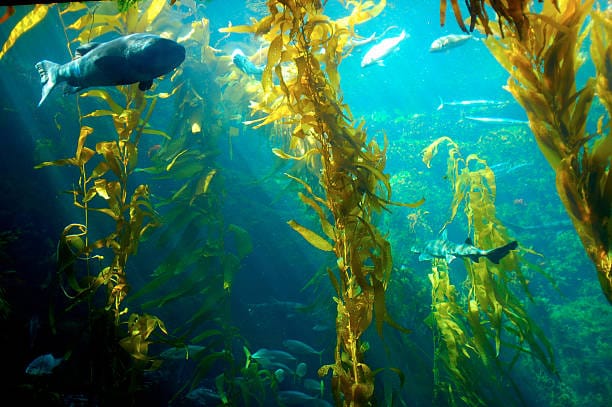
Beneath the rippling surface of our planet’s oceans lies a realm that pulses with unseen life. The salty tides cradle not just whales, fish, and coral reefs, but something far more ancient and fundamental—algae. These often-overlooked organisms, drifting in the currents or clinging to rocks, play a role so vital, so immense, that without them, life in the oceans—and indeed, on Earth itself—would collapse into silence.
Algae are not plants, though they photosynthesize. They are not animals, though they can move, hunt, and interact with their environment in surprisingly dynamic ways. They belong to a diverse and complex group of life forms known as protists—a category defined more by what it isn’t than by what it is. Within that definition lies a world of stunning biological creativity. From microscopic diatoms encased in glassy shells to vast blooms of green seaweeds stretching across coastal shelves, algae paint the oceans with color, fuel the food web, and shape the very atmosphere we breathe.

A lichen (/ˈlaɪkən/ LIE-kən, UK also /ˈlɪtʃən/ LI-chən) is a hybrid colony of algae or cyanobacteria living symbiotically among filaments of multiple fungus species, along with bacteria embedded in the cortex or "skin", in a mutualistic relationship. Lichens are the lifeform that first brought the term symbiosis (as Symbiotismus) into biological context.
I don't know anything about this, but I am not sure about it: Before there were dead trees there were dead plants, and presumably microorganisms had developed to take advantage of this source of nutrition. Trees didn't suddenly appear, but evolved gradually from other plants, and presumably the microorganisms evolved with them.It always amuses me that the microorganisms that causes dead trees to decay didn't evolve until some time after trees appears. This means that, for quite some time, dead trees just lay there, taking up space. (And eventually became coal, I think..)
I don't know anything about this, but I am not sure about it: Before there were dead trees there were dead plants, and presumably microorganisms had developed to take advantage of this source of nutrition. Trees didn't suddenly appear, but evolved gradually from other plants, and presumably the microorganisms evolved with them.
I would think that likely there were some organisms that could cause the proto-trees to decay that evolved along with trees to cause trees to decay. There was probably no point at which trees wouldn't decay at all. From what I understand, coal likley comes from bogs where an anaerobic environment is what prevented full decay.It always amuses me that the microorganisms that causes dead trees to decay didn't evolve until some time after trees appears. This means that, for quite some time, dead trees just lay there, taking up space. (And eventually became coal, I think..)

That's my understanding too.I would think that likely there were some organisms that could cause the proto-trees to decay that evolved along with trees to cause trees to decay. There was probably no point at which trees wouldn't decay at all.
From what I understand, coal likley comes from bogs where an anaerobic environment is what prevented full decay.