• Quick note - the problem with Youtube videos not embedding on the forum appears to have been fixed, thanks to ZiprHead. If you do still see problems let me know.

2016 Arctic Sea Ice Thread

Ah, the claim that Arctic sea ice will be gone in 3-4 years from the prediction date. That chestnut just never gets old. What will we be up to by 2020 then - successful prediction of 7 of the last 0 ice-free summers? Priceless.
It's looking low enough that you can tell us about another sea-ice recovery next year, if that's any comfort.
 
Ah, the claim that Arctic sea ice will be gone in 3-4 years from the prediction date. That chestnut just never gets old. What will we be up to by 2020 then - successful prediction of 7 of the last 0 ice-free summers? Priceless.

Not terribly original though... http://www.internationalskeptics.com/forums/showpost.php?p=7198083&postcount=21

The year is not that important. Changes in the Arctic are driving a lot of changes worldwide.

Peter Wadhams from Cambridge University explains
https://www.youtube.com/watch?v=p-qdbICw2f8

If the following quotes are not verbatim so refer to the presentation for clarity if needed.

20:17 What Arctic warming is doing to the planet

27:26 Ice loss well ahead of climate models

29:00 Global Albedo
Fresh snow reflects about 90% of the solar radiation back into space
An open sea reflects only about 10% and 90% is absorbed.
This adds about another 1/4 to the amount of warming from greenhouse gasses.

36:20 Arctic sea ice volume is about 1/4 of what it was in the 1980's

53:31 Loss of snow around the Arctic also adding about another 1/4 to the amount of warming from greenhouse gasses. Combined with
the warming from sea ice albedo loss this adds about 50% to the warming effect of greenhouse gasses.

People can read your little squabble about what year sea ice finally disappears or they can look at the science and easily understand why this is such a threat to our civilization. It's great to have you on record as a climate change denier when the science is very clear.
 
Last edited:
Yes it is! Once again, I am starting to believe that my dream of establishing the first Banana Plantation on the shores of the Arctic Ocean may become a reality. Along those lines, I have been researching government programs that would fund school job programs that would teach the local Innuit Populations to speak Spanish and how to pick Bananas. (I figure if the Innuit are to be hired to pick Bananas, then they should at least speak the same language of the Guatamalen Task Masters whom I will put in charge of them).

As far as the Polar Bear goes....well, that's just going to be tough luck for the Polar Bear in the Northern hemisphere. Perhaps we could ship a few bears to Anarctica and let them hang with the Penguins.

As far as the Caribou are concerned: screw 'em. Caribou are ugly and I don't care if they overheat and die. Same goes for the Musk Ox.

Also, now that the Ice is dissapearing from the Arctic Ocean, I think we should drill the hell out of it. There's got to be a lot of oil down there and because the area is so remote, we really don't have to be too careful about the environment.

Is it OK to email this post to Dr. Phil?
 
It's looking low enough that you can tell us about another sea-ice recovery next year, if that's any comfort.
I used the advanced search and found that I have not used the word "recovery" on any AGW thread at all, let alone with regard to Arctic sea ice. (This exact comment excepted, of course). So I'll leave you to roll around with that little strawman on your own.
 
The year is not that important.
Just to be clear. The Arctic has been ice free many times in the past. Almost certainly most of the year during the PETM. Very likely ice-free in summer during the Eemian. Driftwood proxies show Arctic ice to be far lower than today during the Holocene Climatic Optimum. (Oh, sorry, Holocene Thermal Maximum, we're not supposed to call warm periods "optimum", are we?)

Given that the Arctic has been ice-free in the past, and it will be ice-free at some point in the future (whether influenced by man or not), the timing of the prediction of an ice-free Arctic is the *only* distinctive part of that particular prediction. And every one of these Arctic sea ice threads comes with a new wrong prediction. Seriously, kudos to Ben for continuing to post these threads, they have provided me with a great source of entertainment year on year. "Skeptics" making predictions with the same razor sharp accuracy as astrologists, what's not to like?!?

Peter Wadhams from Cambridge University explains
Peter Wadhams?

:dl:

Hopefully he is back at Cambridge studying the Arctic again after his brief foray into believing that nefarious fossil fuel companies were bumping off his colleagues using lightning. In credibility terms, Wadhams is about on a par with Piers Corbyn.
 
More gish gallop from the pretend neutral guy. :rolleyes: Your paymasters cut the denier funding again??? :rolleyes:

meanwhile in the world that matters...

N_stddev_timeseries_thumb.png


January hits new record low in the Arctic
February 4, 2016
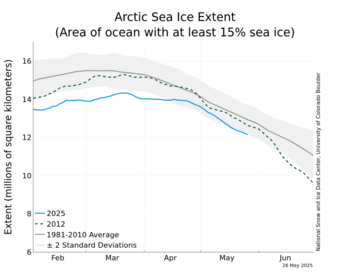
January Arctic sea ice extent was the lowest in the satellite record, attended by unusually high air temperatures over the Arctic Ocean and a strong negative phase of the Arctic Oscillation (AO) for the first three weeks of the month. Meanwhile in the Antarctic, this year’s extent was lower than average for January, in contrast to the record high extents in January 2015.
https://nsidc.org/arcticseaicenews/

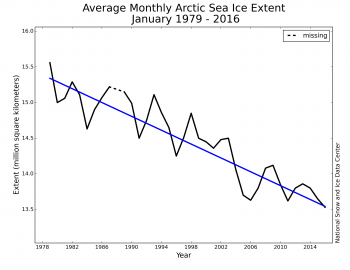
pretty solid trend line that...

monthly_ice_01_NH-350x270.png


The Holocene optimum was 8k years ago when the Milankovich cycles favoured a warmer northern hemisphere....it WAS getting cooler...then we came along. The Eemian was 115k years ago and the optimum was a different orbital configuration with sea levels 6-9 meters above current.

Why are you comparing current temps driven by human induced CO2 increases to optimums diven by orbitals ????/are you perhaps trying to mislead ....surely not. :rolleyes:

This thread is about 2016 Arctic Sea ice volume and extent....not a soapbox for your AGW denial campaign. :mad:
 
Last edited:
When I first started following the climate change issue at the turn of the century, most estimates of when the Arctic would become ice free in summer were around 2080. They've certainly come down since, the last time I checked around 2040 seemed the most common estimate.

Of course it's possible, if circumstances conspire to produce the right conditions, that we might get a year with a dip to zero considerably sooner, maybe even in the next decade, but it would be a one off. It could be another decade or more to the next one, and it will probably be at least a century before the Arctic is ice free in summer more often than it isn't.
 
Last edited:
It doesn't seem to have happened for the last 37 years. Could you explain what you means by "normal for a pre-recovery period"?
I was being facetious. Any period between record lows is celebrated as a recovery period in denier circles, so any record low is necessarily pre-recovery in those terms.
 
I was being facetious. Any period between record lows is celebrated as a recovery period in denier circles, so any record low is necessarily pre-recovery in those terms.
Likewise, any local downturn is used by climate activists to claim that the Arctic is in a death spiral and will be ice-free typically in 3-4 years. As we've already seen.

Both of these are hysterically unscientific, although notably your blinkers only allow you to see one of them. C'est la vie.
 
More gish gallop from the pretend neutral guy.
I never claimed, pretended or otherwise to be neutral. So that's one fail right there. Oh, and you should learn what a gish gallop is, because you have no idea:

Gish Gallop
Note in that discussion, the written form of the gish gallop:
Cite a giant wall of text, or a three hour long [Y]ou[T]ube video
Indeed, it wasn't me that posted the long rambling youtube video, it was "Warmer1" who did that which utterly failed to address the point being made, but instead brought up a bunch of different issues (which confirms it as a gish gallop) by Wadhams who has little credibility. Notably, you also failed to address the point, which should have been both trivial and obvious to anyone who has scientific training.

My responses addressed one thing and one thing only: the claim that the Arctic would be ice-free in 4 years time. That's a nice claim, because it is both testable and not that far away in time. So we can test it. Testing a prediction about an observational data set is particularly nice because we don't need to know anything other than the data set. So your statement here:

Why are you comparing current temps driven by human induced CO2 increases to optimums diven by orbitals
Shows an astonishing ignorance of science. The prediction is simple: that the Arctic be ice free in 2020. To test a prediction - which is what I was talking about - we don't need to know anything about the cause. We just need to measure the ice in 2020. If it's gone, then Warmer1's prediction is correct. If ice remains throughout 2020, Warmer1's prediction is wrong. It really is as simple as that, and your oddball attempt to insist the reason for observation somehow affects our ability to test whether the prediction happens or not simply underscores your lack of scientific knowledge.

This thread is about 2016 Arctic Sea ice volume and extent....not a soapbox for your AGW denial campaign. :mad:
Ben makes it clear that Arctic sea ice predictions are acceptable in this thread and that is all I've talked about. I do wonder if Ben might change that in the future, since it is a tad embarrassing to have the pseudoscience "ice-free in three or four years" that climate activists can't help spouting out.

 
Possibly ignorant question: the 'retreat' of the ice seems uneven, much greater at some locations than others.

To what extent is it understood why there is such a difference?
 
Likewise, any local downturn is used by climate activists to claim that the Arctic is in a death spiral and will be ice-free typically in 3-4 years. As we've already seen.

Both of these are hysterically unscientific, although notably your blinkers only allow you to see one of them. C'est la vie.

The entire Arctic and average global sea ice both decreasing is not "local." Repeatedly breaking record low ice extents and never breaking record highs over a period of more than a century is not a "downturn."
 

Back
Top Bottom