
• Quick note - the problem with Youtube videos not embedding on the forum appears to have been fixed, thanks to ZiprHead. If you do still see problems let me know.

1st computer discovered?

The Curta is a marvel, wish I could afford one. (I collect old calculating gear.) Curt Herzstark invented it while a prisoner in Buchenwald concentration camp. When WWII ended he had Contina AG of Luxembourg manufacture them, and they kept making them until 1970. I know of nothing else similar. Magnificent piece of design and engineering.
I SO want a Curta for my very own! What a delightful object...

We do have one in our computer museum collection, of which I'm (acting) president.

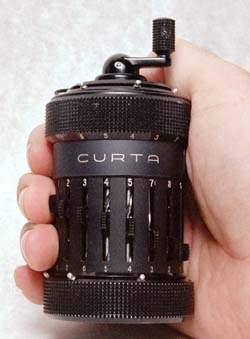
For those who don't know, a Curta looks like this:
Curta_5.JPG


As to the calculator/computer divide, it would probably be reasonable to define the computer as a general-purpose calculator in which you could store and make it perform a program of steps, including control of the sequence of those steps, i.e. it performs an algorithm. Whereas, a calculator operates by means of an external action (you put stuff in by hand, and you manage the algorithm, not the calculator).
 
That would be logarithmic scales, great things but different. Napier's bones were a clever way to multiply long numbers by a single-digit number by laying down selected strips of ivory or wood (the bones) to make the multiplicand, each of which represents one column from a multiplication table, taking the row corresponding to your multiplier, then reading across adding up the carries from adjacent bones to get the product.
 
Sorry, I was incorrect and you are right! I was thinking of another variant of scales from slide-rules. However I'd still call them "a calculator", as it produces a singular result in one "operation" given one set of input.

PS. I still want a Curta... It's a gorgeous thing... :)
 
Last edited:
I don't really make a distinction between calculators and computers. The "stored program" touchstone is a good one, but since I consider calculating machine and operator to work as a team there can be gray areas even there. No matter, it's a designation of convenience merely.
 
True. Think of the Jacquard loom. It produced a result over and over mechanically, but could be "reprogrammed" to produce a different result. Stored program, algorithm, everything... ;)
 
True. Think of the Jacquard loom. It produced a result over and over mechanically, but could be "reprogrammed" to produce a different result. Stored program, algorithm, everything... ;)
I was thinking of the Jacquard in connection with this thread earlier today. Good example of a stored-program device that's not a computer. Hollerith knew a good thing when he saw it.

Jacques M. Lemieux was a character I used to play in the game "Furcadia," a fin-de-siecle Parisian anthro cat, fine artiste when he could afford supplies, baker and cook when money was needed more quickly to avoid having himself and his ornate steam-powered all-mechanical computer thrown out of the apartment. I worked out a good deal of said machine's layout -- assorted cabinetry in designs from French provincial to art nouveau, chauffe-eau et porte de chauffage (with ornamental isinglass window), le jacquard (yup, you guessed it), le moulin (the arithmetic and logic unit), le flic-flac (a crude display, which made a riffling shuffling noise, hence the name Lemieux gave to it), and so forth.

Wish I'd had the time and skill to make a 3-D rendering of that machine. =@.@=
 
I don't really make a distinction between calculators and computers. The "stored program" touchstone is a good one, but since I consider calculating machine and operator to work as a team there can be gray areas even there. No matter, it's a designation of convenience merely.

My understanding is that the hallmark of a true computer is the stored program with conditional branch. A real computer, while working on a problem, is able to do one calculating step if a certain condition is met or something else if it's not, as freely defined by the stored program, in such a way as to allow it to solve any problem the programmer knows how to completely define.

The ENIAC, often cited as the first electronic computer, had to be reprogrammed by rewiring, so it was really a reconfigurable electronic calculator, not a true computer in the modern sense of the word. The British seem to deserve the prize for first true computer for their EDSAC.

That being said, the Antikythera mechanism was most likely a calculator (with a hardware-defined fixed task or limited set of tasks) rather than a computer (able to solve any definable problem).
 
It certainly wasn't general purpose. :-) <-- the Antikythera device, that is

I think Konrad Zuse has a good claim for inventing the first electronic computer by the definition you're using. I'm awfully glad the German government and military all but ignored his work.
 

Back
Top Bottom