• Quick note - the problem with Youtube videos not embedding on the forum appears to have been fixed, thanks to ZiprHead. If you do still see problems let me know.

there is a law inside the alphabet

This reminds that it is generally believed that black, blank, and blanco are all cognates. That is, all derived from the same root. Prot indo european that probably meant something like empty.

As to the op, no idea what you are on about to be honest, sounds a bit like my bipolar sister when she was manic, Theres a word for when folks make connections between things that aren't really there.

Also, the latin alphabet is phonetic, sure, its pretty inconsistent in English but that's what happens when Germanic language gets most of its words from Latin partially via Norman French.

ETA: Regarding Dog, there is the german substrate hypothesis. That is that German is kind of a hybrid with a non indo european language. Perhaps dog is a word retained from that but only in england? Probably not.

ETA: What's up with the Irish? Its like they took letters from Latin and said, everyone else thinks they make this sound, to hell with that, its going to make a totally different sound here. I mean, I can read most Latin and German languages and get the sound pretty close sure, accents might be in the wrong place and it maybe a series of sound we don't normally put together in English, but not Irish, not even close with Irish.

When you start down the why-are-these-words-related rabbit hole you can end up in some weird places. I asked someone more fluent than me why the signpost to the pass I wanted to cycle said "ceum" and not "slighe". In my book ceum is a degree, as in a university qualification. We started on the basic concept being a step, and a few minutes later connected "degree" and "graduation" with a sort of mutual light-bulb moment.

And you try coaching a (mainly) English monoglot choir through a Christmas carol in Gaelic like I should have been doing last night except I was sick. I await next Sunday to find out what sort of a hash they're making of "dh'fhuling" and "truailleachd". (They can think theirselves lucky I vetoed the (I think archaic) spelling of cruthear in one version - cruthfhear - even though it makes the derivation of the word so beautifully clear.)

The OP reminds me of the guy who came on here blowing up jpeg files and declaring that the compression artefacts were actual devils. Those were the days! I wonder what happened to him?
 
Last edited:
If you have a MacBook with the little display bar above the function key row, holding down a key on the keyboard populates that display bar with all the possible diacritical variants of that letter. You just tap the display bar for the one you want. IPhone has a similar feature.
 
My Android phone has the same thing, but I'm talking about my PC keyboard. In Windows 10 the Gaelic keyboard had accents going both ways, in Windows 11 the "acute" has been lost.
 
And you try coaching a (mainly) English monoglot choir through a Christmas carol in Gaelic like I should have been doing last night except I was sick. I await next Sunday to find out what sort of a hash they're making of "dh'fhuling" and "truailleachd". (They can think theirselves lucky I vetoed the (I think archaic) spelling of cruthear in one version - cruthfhear - even though it makes the derivation of the word so beautifully clear.)

My father in law runs a choir of mainly very elderly people high in the French Alps and his thing is to find pleasant seasonal songs from across the globe that he can arrange for forty-odd voices. I help with the coaching for the languages I speak… English and German come out fairly recognisably but the one song we tried in Irish was a real struggle. Rewarding, though, hearing a song in Donegal Irish ringing out in a seventeenth century church deep in rural France.
 
Fine with me if they want to anglicize their names.
Apologies for the snarky comment.
It is curious as my in-laws grew up in an Ireland still smarting from British rule and told many angry tales of British cruelty yet the only one whose name was spelled in an Irish manner was my mother in law Bridgid though she went be her middle name. All their kids (oldest born in early 1970s) have anglicised names though they have cousins are Cathal, Aoibhinn etc.
 
My Irish-speaking family use the Irish form of my name and I’m very happy about that, but also very happy that my parents registered me with the form that is standard in both English and French because that has no doubt saved me from endless administrative headaches.
 
My mother's (born 1920's) family were all christened with English names despite them speaking Gaelic at home yet when we visited Harris they all started using their Gaelic names (Ceitag instead of Katy etc).
 
My Irish-speaking family use the Irish form of my name and I’m very happy about that, but also very happy that my parents registered me with the form that is standard in both English and French because that has no doubt saved me from endless administrative headaches.

Apologies for the snarky comment.
It is curious as my in-laws grew up in an Ireland still smarting from British rule and told many angry tales of British cruelty yet the only one whose name was spelled in an Irish manner was my mother in law Bridgid though she went be her middle name. All their kids (oldest born in early 1970s) have anglicised names though they have cousins are Cathal, Aoibhinn etc.
I still don't know what my grandmother's name was at birth. It starts with a K but she went by Kitty and some documents say Kate, some Katherine. None say Cathleen which is what I grew up thinking was her name. Every document also spells here last name slightly differently.
 
Aaargh - that should be youngest born in 74. The in-laws were born around 1930. My mother-in-law told tales of family ties being hidden as the British would attack relatives if they couldn't find who they wanted.
 
I still don't know what my grandmother's name was at birth. It starts with a K but she went by Kitty and some documents say Kate, some Katherine. None say Cathleen which is what I grew up thinking was her name. Every document also spells here last name slightly differently.
Well, there’s no ‘k’ in the Irish alphabet, so that rules out a bunch of possibilities.
 
I don't believe that's how they spell Sean.

I think I have probably seen every version of the spelling (and pronunciation) of that name.

Shaune, Shane, Shawn, Sean etc.

With pronunciations like: "Shorn, Shayne, Seen, See-Anne etc.

Names are funny like that.

Asked three Irish guys at work, why they all pronounced their names (all spelled Sean) differently and they said something like:

"We're from either side of the river, and he's from the boon docks."
 
If you have a MacBook with the little display bar above the function key row, holding down a key on the keyboard populates that display bar with all the possible diacritical variants of that letter. You just tap the display bar for the one you want. IPhone has a similar feature.
In Windows, you can download and install PowerToys from the store. It has a function called Quick Accent where if you hold a key and tap the spacebar you can select from a popup a variety of alternative characters and diacriticals including ®, æ, ø, etc.
 
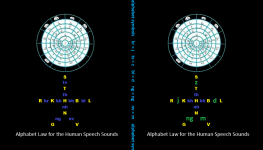
That "map" is awful. It doesn't look like a person at all.
It's derived from the position of the sound in the mouth. Think of it like a perpendicular cross-section of a person's mouth, who is looking towards your left. The front of the mouth (ee) and the back of the mouth (oo) are clearly marked on the X axix. The Y axis is based on how open the oral cavity is.

So in a way, if you look at it abstractly enough, it does look like a person.
 
My father in law runs a choir of mainly very elderly people high in the French Alps and his thing is to find pleasant seasonal songs from across the globe that he can arrange for forty-odd voices. I help with the coaching for the languages I speak… English and German come out fairly recognisably but the one song we tried in Irish was a real struggle. Rewarding, though, hearing a song in Donegal Irish ringing out in a seventeenth century church deep in rural France.

That must have been wonderful!

We're doing a multicultural Christmas concert, singing in French, German and Latin as well as Gaelic. Somewhat shamefully it's the Gaelic that needs the most work. Some of the choir are English, but in any case Gaelic hasn't been spoken communally in this part of Scotland for a long time. It's all over the landscape in the place names though. (Paradoxically, many/most of the place names in the islands where Gaelic is spoken now are Norse.) We are doing a Basque carol but we took one look at the Basque text and decided to sing it in translation!

Gaelic is taking a small foothold again; there are various meetings and a group of parents is trying to get a Gaelic-medium school set up (we're the only region in Scotland without one), but it will be a long time if ever before the language is really spoken again round here.
 
One of my favourite albums in my car is the Glasgow Islay Gaelic Choir Tribute to Runrig. Oddly on my headphones it all sounds fine but in my car the song "A Ros" has a deep cough in it but only in the car. A friend recommended Audacity and I sort of removed the cough.
 
I mustard mitt that the OP was incomprehensible to me, but I am what the geat philosopher Weller would call 'a dull and simple lad'. Nonetheless, I believe that title of the thread is true, and I can prove it and I now shall do that thing. Lend me your eyes, my joyful dumplings, and witness a proof:

The claim - "there is a law inside the alphabet".

Here is the alphabet (the Roman one, which is the one the OP specifies):

A B C D E F G H I J K L M N O P Q R S T U V W X Y Z

The astute amongst you may have noticed that some of these letters have been highlighted, namely A, L, and W. What word can we make with these letters (apart from awl, which is irrelevant here, as this is not a leatherworking thread)? LAW!

But that is not all, no there is more. How many laws have we found in the alphabet? ONE! We have found A LAW in the alphabet! Can we find another? No, because we have used the letters L, A and W, which are the only letters that spell LAW.


The OP claimed, and I quote: "there is a law inside the alphabet". They are right. There is no denying it, there is a law inside the alphabet. There is also a crime inside the alphabet. There is also a ◊◊◊◊ inside the alphabet, and a ◊◊◊◊, and a bum, and a devil, but pay no attention to these coincidental occurrences, the important thing is that there is a law inside the alphabet, and it looks like a big-headed stick man.
 
Symbols of the human speech sounds are alphabet letters.
Human speech sounds are vowels and consonants.
Alphabet symbols can be scrambled in different nations, regions, .... or dialects.
By seeing through the veil of symbols and all the scrambles.
If the clouds goes away, then the Moon will shine again.
1765248104355.png
 
Actually (pushes glasses up nose) Old English was displaced by Norman French in the upper classes after the Norman invasion of 1066. What emerged in the 1500s is now known as Middle English. Because the lower English-speaking classes didn't write stuff down, we don't actually know a lot about exactly how Old English transformed into Middle English.

As it happens that video came up in my YouTube recommendations just a few days ago.
I'll have to watch it now. lol
 
Also, big. The Gaelic for big is mòr (as mentioned in the video). Mòr, more, not much scope for getting that wrong, surely? Except, the Gaelic for small is - beag. Pronounced pretty close to big. And in the genitive it actually becomes big.
I knew them from the names for the 'modern' kilt and the original blanket like 'great kilt'

the original being the fèileadh-mòr and the modern small kilt being the fèileadh beag.

That's the limit of my Gaelic.
 

Back
Top Bottom