Dave Rogers
Bandaged ice that stampedes inexpensively through

I suspect it all makes more sense in the original Turkish.
Dave
Dave


This is interesting as I grew up with Irish and I was today years old when I noticed similarities in sound between "big" and "beag". Completely different registers in my brain.

When my Irish wife differentiates her nephew from her brother as Shaun beag it sounds more like “bake” to me, used to the sound of Scottish Gaelic from Harris. She’s from Galway but lived for years in an tSudaire if that matters. Maybe my ears.This is interesting as I grew up with Irish and I was today years old when I noticed similarities in sound between "big" and "beag". Completely different registers in my brain.

On a vaguely similar note, there has occasionally been amusement in Irish pubs in which the toilets are labelled as Gaeilge. "Fir" for the Gents and "Mná" for the Ladies. Natives don’t give it a second glance but English speakers can easily get misled.
When my Irish wife differentiates her nephew from her brother as Shaun beag it sounds more like “bake” to me, used to the sound of Scottish Gaelic from Harris. She’s from Galway but lived for years in an tSudaire if that matters. Maybe my ears.


I _think_ I tend to pronounce it something like "beck", but I’m feeling odd sitting in my office talking to myself and trying to listen to what I’m saying. Nobody else ever does.It sounds more like "bake" to me too, but we're talking beginners. Also seeing the word written.
"Bad at spelling". From a user of a language full of random gees and accents pointing in the wrong directionIt's a slightly weird experience being in Ireland, mainly characterised by "these people are really bad at spelling." I'd get the"fir" and "mnà" part all right, but I remember being slightly thrown by a car park labelled "saor". In Gaelic, saor means free in the sense of not captive (also a carpenter, for no readily apparent reason), but also "cheap". The term for free as in no charge is "an-asgaidh". So I'm sitting there in my car thinking, if the parking is cheap, won't you tell me how much it actually is?

Oh, there is a clear difference. What I meant and probably failed to express was that I’d never consciously noted the similarity in sound between two utterly distinct words because they sit in different places in my brain.Maybe to you there is a difference, however slight? Someone, especially an adult, who is trying to learn a new language, will most likely not be able to "hear" sounds they are not used to, and/or differentiate between them and any similar sounds in your native language.
Swedish is not tonal, but it is a pitch-accent language, and to anyone who is not used to that, it's very difficult to actually hear the, to us, very obvious difference, never mind try to reproduce it.
I may be ot now, but I have no idea what the t is.

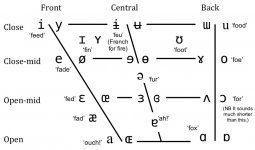
That "map" is awful. It doesn't look like a person at all.Here's a much better map of phonemes:
View attachment 66865
This is one that only covers the English vowels, but there are similar that include all the phonemes. If there's a law to be found in the kinds of noises people make with their mouths, it will probably be found by taking into account the geography of the noisemaker.
Bah, amateurish.Cool. Now do Japanese.
This reminds that it is generally believed that black, blank, and blanco are all cognates. That is, all derived from the same root. Prot indo european that probably meant something like empty.That was really interesting.
Probably coincidentally, it highlights a couple of places where Gaelic learners consistently slip up. The Gaelic for dog is cù, right there in the group of c-words mentioned (canis, chien etc.) Unfortunately the Scots word for cow is coo, pronounced exactly like cù. Cue predictable mistakes. (The Gaelic for cow is bò, nicely in line with beef and bovine and so on.)
Also, big. The Gaelic for big is mòr (as mentioned in the video). Mòr, more, not much scope for getting that wrong, surely? Except, the Gaelic for small is - beag. Pronounced pretty close to big. And in the genitive it actually becomes big.
Yes, I have made this mistake. More than once. Despite my actual name being a feminisation of mòr.
I _think_ I tend to pronounce it something like "beck", but I’m feeling odd sitting in my office talking to myself and trying to listen to what I’m saying. Nobody else ever does.
There’s also the issue of massive linguistic variation. Cousins of mine from barely 150km from my roots are incomprehensible when they start telling wild stories and forget that there are foreigners present. So my accent is only a single datapoint.
"Bad at spelling". From a user of a language full of random gees and accents pointing in the wrong direction

Not to mention Terry Pratchett's quote:I thought this summed up English rather well.
In Windows Power Toys there is a tool to cycle through accented characters. As I recall one of my Windows PCs has a version I hacked to add something that escapes me. Try it (some other good things in there) Feel free to DM for helpand now since Windows 11 my keyboard has lost the "acute" accent (which was useful) and so the world goes to hell in a handbasket.
I don't believe that's how they spell Sean.When my Irish wife differentiates her nephew from her brother as Shaun beag it sounds more like “bake” to me, used to the sound of Scottish Gaelic from Harris. She’s from Galway but lived for years in an tSudaire if that matters. Maybe my ears.
I'll tell them some guy on the internet said they spell their name wrong.I don't believe that's how they spell Sean.
