• Quick note - the problem with Youtube videos not embedding on the forum appears to have been fixed, thanks to ZiprHead. If you do still see problems let me know.

What book is everyone reading at the moment? Part 2.

I don't think that's it, but thanks anyway.

The author was someone famous to me, and I never heard of Stross. The cover is wrong too.
Oh, well. All my SF* friends are gearing up for Dragoncon, but I got in touch with one and posed the question. His suggestion:
Brian Aldiss, "But Who Can Replace a Man?" I don't think this is likely, because it's a short story and because while it has sentient inanimate objects in it, I don't recall a toaster.

*Science-fiction. I don't have any friends in San Francisco. :(
 
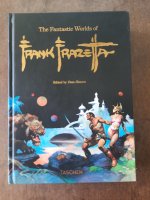
This. A very nice coffee table book, only 6x9, but thick at 1.5 inches. It contains a lot of Frazetta's work in full color and fantastic quality. I've always been a big fan of fantasy and sci-fi art and Frazetta is of course, the King. However, while I love his iconic works that practically everyone is familiar with, I have found I generally like other artists' work more. (Sacrilege!) Most of their work came afterwards, of course, and were naturally influenced by Frazetta. I do have an incentive to rewatch Fire and Ice now.
20250825_135414.jpg
 
I don't know the answer to this one, but I remember reading a short story about a science-fiction author who was writing a story about the fact that wire coat hangers seemed to multiply spontaneously.

Spoiler:
He was found dead in his apartment, strangled by a coat hanger wrapped around his neck.
That one's "Or All the Seas with Oysters," Avram Davidson.
 
A Wodehouse Bestiary, P.G. Wodehouse, edited and with a preface by G.K. Bensen, Foreword by Howard Phipps, Jr.

As well as being a talented novelist and lyricist, P.G. Wodehouse created memorable characters—Jeeves and Wooster, Psmith, Mr. Mulliner, and the zany inhabitants of Blandings—and humor that still provokes laughter. And in addition to all that, he was an animal lover, especially fond of dogs.

This collection selects fourteen short stories, each of which features some species and tons of graceful prose and hilarious situations, people, and critters. Jeeves and Wooster appear in “Sir Roderick Comes to Lunch” (a salmon from Harrods and a small herd or flock of cats), “Comrade Bingo” (Ocean Breeze, a racehorse so slow that he might come in first in the race after the one he’s in), “Jeeves and the Impending Doom” (a fiendish swan whose eyebrows meet in the center), and “Jeeves and the Old School Chum” (More race horses, thought this one presses the outer limit of “bestiary” rather far). All are wonderful, and “Jeeves and the Impending Doom” is splendid.

Blandings Castle is represented by “Pig Hoo-o-o-o-ey!” (the splendidly obese Empress of Blandings, Lord Emsworth’s prize-winning and much-beloved sow), the quintessential tale of man and pig. Freddy Threepwood of Blandings gets involved with a woman who keeps fourteen dogs in “The Go-Getter.’ The loquacious raconteur Mr. Mulliner narrates ‘The Unpleasantness at Bludleigh Court’ (the Peke Reginald, plus -rabbits and ex-rabbits), ‘Something Squishy’ (a snake), “Monkey Business” (a fearsome but talented and quite personable gorilla, once you get to know him), “Open House” (cats, canaries, and other dumb chums), and ‘The Story of Webster” (the cat Webster). Ukridge the entrepreneur starts a college for dogs in, rather naturally, “Ukridge’s Dog College.”

I won’t go through every story, but all are amusing and some are treasures. I must mention “Uncle Fred Flits By,” a glorious tale of confusion in which a gray parrot plays a significant role, and “The Mixer,” narrated by a charming young but inexperienced watchdog.

Dogs, and Pekes in particular, often appear. The foreword, by the President of the New York Zoological Society, recalls Plum’s warmth toward animals and provokes a smile when he mentions that the author is memorialized in the name of the P.G. Wodehouse Shelter in Westhampton, Long Island. Wodehouse and his wife were seldom without a dog—one comfortable dachshund, and many Pekes—and if a man who likes dogs can’t be all bad, a man whom dogs like must be quite good indeed. Recommended.

I clicked on this thread and yours was the first new post I guess since I last clicked. As it happens I am just about finished with Joy in the Morning, one of the Bertie and Jeeves novels. Sadly very little in this book on our dumb chums. At this point I just about know the plot of every story, but Wodehouse always has those clever bits of wordplay that you never remember, so you can read them five year later and still find enjoyment.
 
Tai-Pan, by James Clavell.

I usually don't report on a book until I've finished it, but I'm about to quit this one. It gets weirdly preachy with certain author opinion inserts. But even more obnoxious, it seems to be an endless series of manufactured conflicts and emergencies.

I know it might seem disingenuous to complain about manufactured conflict in a work of fiction. My complaint here is about the endless parade of them, and how the story rushes headlong from one to the next, without really giving any of them a chance to ripen. It's like Clavell keeps thinking, "good thing I got the Tai-Pan out of that mess, now I better get him into another mess as soon as possible!"

It doesn't help that the narrator for this e-book is really into delivering the various dialects and accents used in the book. At first I thought this was a feature. But it turns out that an hour of May-May speaking in pidgin Chinese, followed by an hour of Brock speaking in broad Scottish dialect, is very draining. Try less hard, dude.
 
Going to read Accelerando by Charles Stross again soon ( might be my 5th time).
It's the story about space exploration, AI, mind uploads, aliens and the future I wish the Tech Bros had read instead of just versions of Matrix-infused Atlas Shrugged.
 
Going to read Accelerando by Charles Stross again soon ( might be my 5th time).
It's the story about space exploration, AI, mind uploads, aliens and the future I wish the Tech Bros had read instead of just versions of Matrix-infused Atlas Shrugged.
As Stross and others have said, the problem is the tech bros continually proudly proclaiming "We have now recreated the Torment Nexus from legendary SciFi book 'Do Not Invent The Torment Nexus".
 
I'm currently reading "A Kist O Skinklan Things" a collection of poems in Lowland Scots from the twentieth-century Scottish Renaissance. The title means "a chest of sparkling things". It's actual Scots and not an English dialect. I was born in Ayrshire and grew up in Argyllshire and heard dialects of both as I grew. Sample:
Nae man wha loves the lawland tongue
But warsles wi’ the thocht—
There are mair sangs that bide unsung
Nor a’ that hae been wrocht.
 
Little Women, Louisa May Alcott

An American classic, traditionally thought of as a children’s book, Alcott’s bildungsroman tells the story of the four March sisters (and assorted parents, relatives, and admirers) from childhood to adulthood. It’s well-written, with good characterization and a clear style, though it seems loosely plotted.

That may be because the original publication was in two volumes, the first being almost a month-to-month account of the year 1862, while the second volume carries the story forward to the 1870s. The March family is clearly based on the Alcotts: the father, a kindly, well-meaning, but unfocused minister, is absent for much of the book, at first an invalid (he was a Union chaplain in the Civil War and fell ill with pneumonia). Interestingly, in real life Bronson stayed home while Louisa volunteered as a nurse in the war, fell ill, and Bronson traveled to Washington to bring her back. Jo, the wannabe author of the March family, is Louisa herself. She finds her first success writing shockers, maybe a step up from penny dreadfuls, just as Louisa did.

All the sisters, Meg, Jo, Beth, and Amy, are very human and very endearing. They sometimes play mean tricks on each other (Amy, the youngest, gets frustrated because she’s not allowed to go with Jo on an outing and burns Jo’s unpublished manuscripts, provoking a severe break with her older sister). However, they are also very loving. When Amy falls through the ice while skating, Jo forgives her at last; when Beth is seriously ill, they rally around. Early on, when the family is too poor for Christmas gifts, they all cooperate to take baskets to folk even poorer.

Eventually they grow up, meet beaus, and in three cases marry—even tomboy Jo. The novel has realistic sentimental, and romantic sections, sharply-observed actions, and nifty dialogue. It definitely is not just for kids and deserves a re-reading.
 
Reading Deadhouse Gates, book 2 of the Malazan series by Steven Erikson. It took a bit for me to get into book 1, but enjoying this so far. I hope the series continues to be good.
 
The Hound of the Baskervilles, Sir Arthur Conan Doyle
A re-read, of course: For me, this is the best Sherlock Holmes novel. It begins with Watson doing some not-bad deductions from a walking-stick forgotten the previous evening by a visitor whom Watson and Holmes had missed. As Holmes corrects a few of them, the man himself shows up and becomes Holmes's newest client.

The problem is that old Sir Charles Baskerville recently died - apparently of fright - and the client, Dr. Mortimer, greatly fears that a legendary spectral hound reputed to haunt the Baskerville family has returned to kill the newest heir. Odd events occur, Holmes takes on the case, but as he says he's busy wrapping up a major case in London, he sends Watson to Baskerville Hall in misty, foreboding Dartmoor to investigate on his behalf.

More mystifications follow, involving a deadly bog, an escaped convict, romantic complications, and the solution of Who Stole the Boots? Two boots, to be precise, and they were not mates. It's an atmospheric and fun adventure, and I'd highly recommend it to all fans of mystery and of Victoriana.
 
Killing Time is IMO the best Time Police novel so far; I am looking forward to the next one!

I have now finished all the ER Punshon Bobby Owen books except the 11th one Comes A Stranger, as that one isn't currently available on kindle. However, I've ordered it through the library so I'm hoping they can get it soon.

Recent books:
  • The Word is Murder, The Sentence is Death, A Line to Kill and The Twist of A Knife - Anthony Horowitz. Modern whodunnits mixing fact with fiction from the author of the Alex Rider/new authorised Sherlock Holmes books
  • Shadow of the Past and The Keeper of Secrets - Judith Cutler. Regency murder stories about a vicar turned amateur sleuth
  • The Family Upstairs - Lisa Jewell. Psychological thriller that kept me turning the pages
  • The Woman Who Lied - Claire Douglas. Another psychological thriller but with an easily guessable solution - this was supposed to be the September book club pick but apparently it had already been a book club choice before I joined. So I read it and then it was changed to
  • The Wrong Sister - Claire Douglas. Lots of twists and a surprising ending
  • We Solve Murders - Richard Osman. Well, I guess he's improving with more books, but I didn't really enjoy this
  • Jane Austen At Home - Lucy Worsley. Excellent well researched biography
  • Grey Mask, The Case is Closed and Lonesome Road - Patricia Wentworth. First three of a series of 32 Golden age detective fiction books starring Miss Maud Silver, retired governess. Wonderful, well-plotted books
  • and currently reading: The Hallmarked Man - Robert Galbraith. Review to follow.
 
Killing Time is IMO the best Time Police novel so far; I am looking forward to the next one!
I found it good, but it dropped off near the end. Also several of the characters appear to be incompetent idiots.
I have now finished all the ER Punshon Bobby Owen books except the 11th one Comes A Stranger, as that one isn't currently available on kindle. However, I've ordered it through the library so I'm hoping they can get it soon.
I read it, it's not bad but a trifle predictable.
Recent books:
  • The Word is Murder, The Sentence is Death, A Line to Kill and The Twist of A Knife - Anthony Horowitz. Modern whodunnits mixing fact with fiction from the author of the Alex Rider/new authorised Sherlock Holmes books
Also the man behind Midsomer Murders, after all Caroline Graham's novels ran out.
  • Shadow of the Past and The Keeper of Secrets - Judith Cutler. Regency murder stories about a vicar turned amateur sleuth
  • The Family Upstairs - Lisa Jewell. Psychological thriller that kept me turning the pages
  • The Woman Who Lied - Claire Douglas. Another psychological thriller but with an easily guessable solution - this was supposed to be the September book club pick but apparently it had already been a book club choice before I joined. So I read it and then it was changed to
  • The Wrong Sister - Claire Douglas. Lots of twists and a surprising ending
  • We Solve Murders - Richard Osman. Well, I guess he's improving with more books, but I didn't really enjoy this
  • Jane Austen At Home - Lucy Worsley. Excellent well researched biography
  • Grey Mask, The Case is Closed and Lonesome Road - Patricia Wentworth. First three of a series of 32 Golden age detective fiction books starring Miss Maud Silver, retired governess. Wonderful, well-plotted books
  • and currently reading: The Hallmarked Man - Robert Galbraith. Review to follow.
I must look at some of these. The Miss Silver books were good.
 
I still need to make more time for actual reading, but I recently made a start on Unruly, a history of the British monarchy by David Mitchell.

In tone it reads somewhat like Stephen Fry's accounting of Greek mythology. While reading it, I can imagine it in Mitchell's own voice.
I read that a while back. It's good fun, and thoughtful.
 
I read that a while back. It's good fun, and thoughtful.
I'm not overly interested in the British monarchy, but since I love David Mitchell, and like his writing, I read the book, and I really enjoyed it. And not only because I could hear the voice of the author throughout; it was actually quite interesting!
 
I'm reading:

The French Revolution: From Enlightenment to Tyranny by Ian Davidson, 2016.

Half-way through and I'm learning lots, having only a brief high school knowledge of the French Revolution.

I wasn't aware of (or didn't remember) the different political factions and clubs, the September massacres, the war with Prussia and Austria, the contrasts between the bourgeois revolutionaries and the Paris sans-culottes and the provinces, the intermediate period when the King still ruled, and much more.

Davidson presents the facts in a seemingly unbiased manner. Looking forward to continuing, and my thoughts on its relevance to current US politics congealing.
 

Back
Top Bottom