d4m10n
Penultimate Amazing

Whereas Trump secretly plans for the largest forcible population transfer since 1948.Biden was more Pro Israeli leadership than Trump currently is: he just let them do whatever.
Last edited:

Whereas Trump secretly plans for the largest forcible population transfer since 1948.Biden was more Pro Israeli leadership than Trump currently is: he just let them do whatever.

not much of a Plan.Whereas Trump secretly plans for the largest forcible population exchange transfer since 1948.


This is correct. I have an old copy of the classic political science book, The Making of the President: 1960. You would think you were reading about another country. The idea of the primaries was not to win a bunch of them, it was to win enough to prove to the party bosses that you could get people to pull the lever next to your name. Then you went to the convention and the deal-making began, because nobody went to the convention with enough delegates. So-called "favorite son" candidates (a state's governor or senator) would control all his state's delegates, and thus any hopeful nominee would need to appeal to multiple parts of the country, ensuring moderate candidates.So, every other western democracy is an oligarchy? Because, that is what pretty much every other democratic system does. The parties chose candidates, and the voters choose from among the parties. That is a better system. I just think the dems should have done that a bit sooner.
Even in the US, while the primaries were originally a progressive and democratic reform over caucuses and conventions, they were mostly used by the parties to figure out which of the potential candidates could actually appeal to the people. They weren't really how the parties chose candidates until the IDK, 70s or 80s.
E on X, June 8, 2025
Read Pitfalls of Liberalism by Kwame Ture
“The liberal is so preoccupied with stopping confrontation that he usually finds himself defending and calling for law and order, the law and order of the oppressor. Confrontation would disrupt the smooth functioning of the society and so the politics of the liberal leads him into a position where he finds himself politically aligned with the oppressor rather than with the oppressed.”

Depends. Are we talking about both parties, or neither?when we talk about the party of law and order, are we talking about branding or conduct?

Depends. Are we talking about both parties, or neither?




In the 2024 election, Donald Trump gained a surprising edge from an unlikely group: Americans who typically don’t vote. According to a New York Times analysis, these low-turnout voters backed Trump by a double-digit margin, flipping the script from prior years when non-voters leaned Democratic. This wasn’t just a quirk of the horse-race polls; Campaign operatives, analysts, and post-election surveys all pointed to the same conclusion: The less you followed politics, the more likely you were to vote for Trump.
But now that he's president again, something’s shifted.
New polling shows that the very voters who powered Trump’s return to office are now abandoning him. And if that trend holds, it could upend assumptions about how much campaign messaging and elite discourse really matter. Because it turns out the people who don’t read the Times, don’t watch the Sunday shows, and don’t care about the policy details... still care when the economy sours and their lives get harder.
This is the story of the disengaged voter: why they showed up for Trump, why they’re turning on him now, and what that tells us about political accountability in the era of the “engagement gap.”
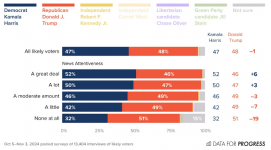
What Trump's election showed us was the consequences of an increasing engagement gap in U.S. politics. And by engagement, I do not just mean engagement in the voting process, but engagement in politics or with political information whatsoever. For example, a post-election survey from Data for Progress found that the voters who paid the most attention to the news in 2024 voted for Kamala Harris by 6 percentage points, while those who paid no attention at all voted for Trump by 19. Democrats are also posting huge numbers in special elections, largely because low-engagement voters just aren't showing up.
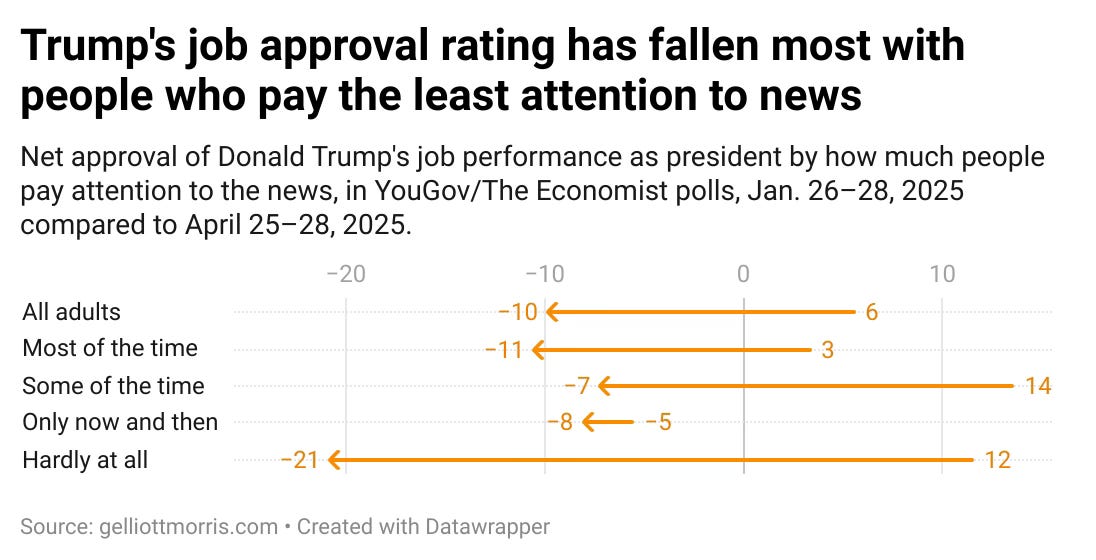
Comparing these crosstabs for YouGov's first poll of Trump's presidency, conducted Jan. 26–28, 2025, to their most recent survey, fielded April 25–28, 2025, we see a massive 33 percentage point decline in Trump's net approval rating over the last 3 months with people who consume the least news. When Trump was inaugurated, net approval among people who say they read or watch news “hardly at all” was +12, and it's now -21. That compares to just a 14-point drop in Trump approval, from +3 to -11, among people who say they pay attention to the news "most of the time."
 www.gelliottmorris.com

Data like this are why people hate liberals so much. [/some poster]I am concerned that this data will hurt the feelings of posters who insist that Trump voters aren’t stupid and how dare anyone ever suggest that.