MRC_Hans
Penultimate Amazing

- Joined
- Aug 28, 2002
- Messages
- 24,961
During december 2023, several storms hit the Danish West Coast. This always digs up stuff from the bottom and sends it onto the beaches of Jutland and the Islands along the coast. For instance, between Xmas and New Year, those people that braved the cold, wind, and rain on the beach of the island where I live, found a good deal of amber. Among them were many of the German tourists that literally flock to the island most of the year.
One such German tourist also spotted something else: A large piece of what seemed to be an aircraft. By help of the internet, he tentatively identified it as part of an FW190 fighter from WW2.
He contacted the local WW2 history association, of which I am currently chairman. Our normal work area is the 400+ bunkers left strewn over most of the 50 odd Km2 island, but of course this was also interesting.
Unfortunately, before I could locate it, our local beach-cleaning team had picked it up and dumped it in the scrap metal container at the recycling station.
However, I found it there and recovered it, so it is currently in my backyard.
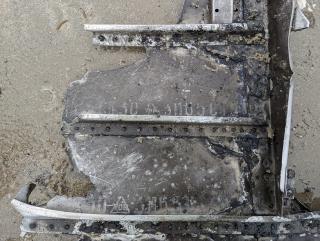
So, after studying photos and drawings, I can in fact confirm the identification: Focke Wulff 190. It is on surprisingly good condition after 80+ years in the sea. Presumably it have been buried in the sand bottom for most of the time, this also explains why it is largely free of anything growing on it.
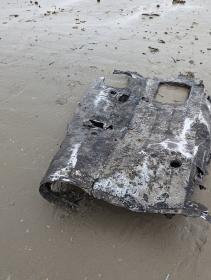
It is the bottom and port side of the rear fuselage, between the cockpit area and the tail assembly, all flattened out. I enclose a picture of it as it was found on the beach (the finder's photo). It is about 2 meters long, and in the foreground in the picture you see the bottom with the ventral hatch (for some equipment access), and above the square side hatch, also for various service access. The oval shape of the ventral hatch hints at it being an FW190A-6, as that hatch was round on most other models.
The goal now is to stabilize and conserve it. We will then endeavour to prop it in some scaffolding so we can bend it back in roughly original shape. It will then be put on display in our museum bunker. As the association has it's 25 year anniversary this year, it is a nice present from the sea.
Hans

One such German tourist also spotted something else: A large piece of what seemed to be an aircraft. By help of the internet, he tentatively identified it as part of an FW190 fighter from WW2.
He contacted the local WW2 history association, of which I am currently chairman. Our normal work area is the 400+ bunkers left strewn over most of the 50 odd Km2 island, but of course this was also interesting.
Unfortunately, before I could locate it, our local beach-cleaning team had picked it up and dumped it in the scrap metal container at the recycling station.
However, I found it there and recovered it, so it is currently in my backyard.
So, after studying photos and drawings, I can in fact confirm the identification: Focke Wulff 190. It is on surprisingly good condition after 80+ years in the sea. Presumably it have been buried in the sand bottom for most of the time, this also explains why it is largely free of anything growing on it.
It is the bottom and port side of the rear fuselage, between the cockpit area and the tail assembly, all flattened out. I enclose a picture of it as it was found on the beach (the finder's photo). It is about 2 meters long, and in the foreground in the picture you see the bottom with the ventral hatch (for some equipment access), and above the square side hatch, also for various service access. The oval shape of the ventral hatch hints at it being an FW190A-6, as that hatch was round on most other models.
The goal now is to stabilize and conserve it. We will then endeavour to prop it in some scaffolding so we can bend it back in roughly original shape. It will then be put on display in our museum bunker. As the association has it's 25 year anniversary this year, it is a nice present from the sea.
Hans
Last edited: