On the NIST website "Questions and Answers about the NIST WTC 7 Investigation (Updated 09/17/2010)" you find the following:
That short free fall was/is discussed a lot.
I tried to "replicated" the NIST measurement.
HOW DID NIST MEASURE THE FREE FALL?
According to NIST_NCSTAR_1-9_vol2 12.5.3. NIST used the "camera 3".
That's the view NIST used for the measurement:

In the Draft Report NIST states: "The elevation of the top of the parapet wall was +925 ft. 4 in. The lowest point on the north face of WTC7 visible on the camera 3 video (section 5.7.1) prior to any downward movement was the top of windows on floor 29, which had an approximate elevation of +683 ft 6 in."

That information got lost in the final NCSTAR 1A Report.

However, just a small part of the "top of windows on floor 29" is visible.
To measure the fall of the building NIST had to measure a vertical path above the visible top of the windows.
Therefore we have to know how NIST defined the "parapet wall".

NIST defined "parapet wall" for the same elevation they defined as "roofline" in the final report.
Hence, we have to measure that path:

The following image shows that NIST was aware of a difficult problem to measure the fall down the described path:

The "screenwall" is visible above the roofline and had an elevation of about two additional floors and the lack of contrast allows no direct tracking of the roofline.

So how was NIST able to measure the fall of the perimeter wall?
They answer the question in the FAQ:
In other words, NIST did not measure the parapet wall! They measured the fall of the screenwall about 2 floor heights above the parapet wall. They took the time and subsequently calculated a fall speed for the smaller fall distance.
And there is a second problem with the NIST method.
The perimeter wall didn't bow downwards as visible from a different vantage.

Instead the perimeter wall stayed vertically straight even during the fall for several floors.
The motion of the perimeter wall as visible from "camera 3" is nothing but the bowing of the perimeter towards the core.

In other words, NIST measured the drop of the "screenwall" + the transition of the falling screenwall into the horizontal bowing of the perimeter wall + the transition into the vertical motion of the perimeter wall.
The red curve shows the motion NIST measured:

The fat bright blue curve is a calculated free fall.
The lower curves are the trackings of several floors in the NIST measure path. The slow onset of motion of these lower curves is the result of bowing away from the camera.
Since NIST gave the real elevations along the path it is possible to calculate the velocity for the entire motion.

That's a pretty different result.
In the Final Report as well as in the FAQ NIST described their result this way:
The NIST "stage 1" includes about the frames 150 ... 202 of my motion tracking measurement.
That NIST "slower than free fall" stage 1 includes the following real events:
- the screenwall on top of the core started to move (frame 150...155)
- the screenwall reached about free fall (frame 156...170)
- the screenwall disappeared behind the parapet wall (frame 170)
- the perimeter wall bows towards the core (frame 170...180)
- the perimeter wall dropped above gravity (frame 180...200)
That's where stage 2 at "gravitational acceleration (free fall)" begins.
That means there is almost no vertical motion slower than freefall but for the very first 0.17 seconds AND that short amount of "slower than free fall" is probably stretched by the symmetrical averaging of the velocity over 9 frames.
So how is it possible that the perimeter dropped faster than free fall?
Simply imagine some dumbbell like object that rotates vertically and fall at the same time.

Core and perimeter were still connected by the floor system. Once the core dropped at gravitytational acceleration the core-floor-perimeter acted like a spring system. Firstly, the core pulled the perimeter inwards. Secondly, the perimeter failed at a very low elevation and was shot downwards by the "floor-springs". The falling core was slowed down at the same time until the entire system fell as one unit.
Of course the center of mass of the entire system cannot exceed gravitational acceleration but the perimeter can and it tells a lot about the intact inner structure of the upper and visible building part.
I leave it up to you to decide if either NIST did several "beginners mistakes" in a row while being very aware of the higher screenwall or if NIST just tries to hide the facts. The measurement itself is unambiguous.
http://www.nist.gov/public_affairs/factsheet/wtc_qa_082108.cfmIn a video, it appears that WTC 7 is descending in free fall, something that would not occur in the structural collapse that you describe. How can you ignore basic laws of physics?
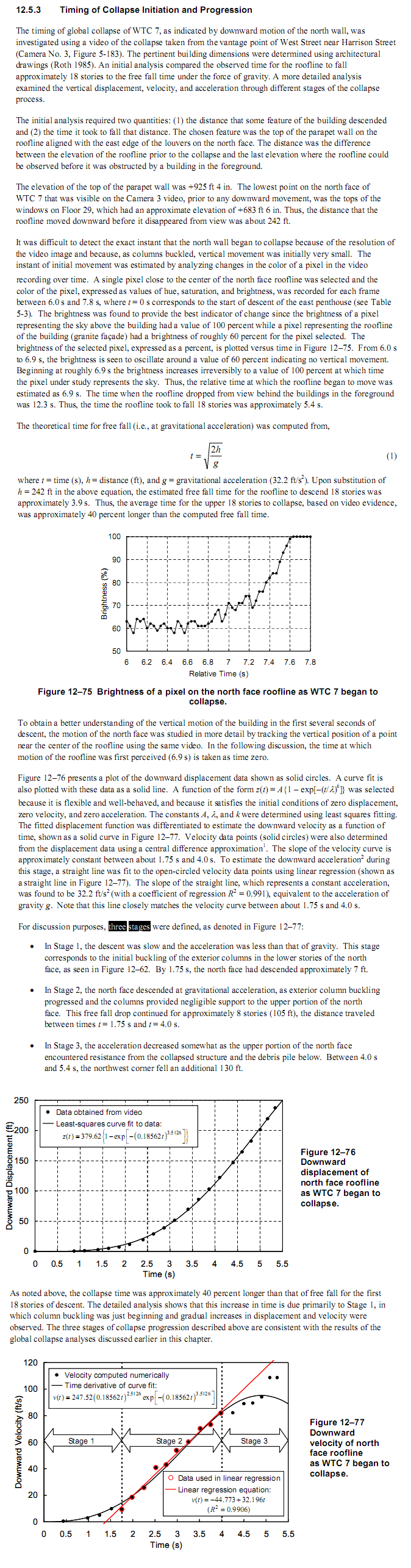
In the draft WTC 7 report (released Aug. 21, 2008; available at http://wtc.nist.gov/media/NIST_NCSTAR_1A_for_public_comment.pdf), NIST stated that the north face of the building descended 18 stories (the portion of the collapse visible in the video) in 5.4 seconds, based on video analysis of the building collapse. This time period is 40 percent longer than the 3.9 seconds this process would have taken if the north face of the building had descended solely under free fall conditions. During the public comment period on the draft report, NIST was asked to confirm this time difference and define the reasons for it in greater detail.
To further clarify the descent of the north face, NIST recorded the downward displacement of a point near the center of the roofline from first movement until the north face was no longer visible in the video. Numerical analyses were conducted to calculate the velocity and acceleration of the roofline point from the time-dependent displacement data. The instant at which vertical motion of the roofline first occurred was determined by tracking the numerical value of the brightness of a pixel (a single element in the video image) at the roofline. This pixel became brighter as the roofline began to descend because the color of the pixel started to change from that of the building façade to the lighter color of the sky.
The approach taken by NIST is summarized in Section 3.6 of the final summary report, NCSTAR 1A (released Nov. 20, 2008; available at http://wtc.nist.gov/NCSTAR1/PDF/NCSTAR 1A.pdf) and detailed in Section 12.5.3 of NIST NCSTAR 1-9 (available at http://wtc.nist.gov/NCSTAR1/PDF/NCSTAR 1-9 Vol 2.pdf).
The analyses of the video (both the estimation of the instant the roofline began to descend and the calculated velocity and acceleration of a point on the roofline) revealed three distinct stages characterizing the 5.4 seconds of collapse:
* Stage 1 (0 to 1.75 seconds): acceleration less than that of gravity (i.e., slower than free fall).
* Stage 2 (1.75 to 4.0 seconds): gravitational acceleration (free fall)
* Stage 3 (4.0 to 5.4 seconds): decreased acceleration, again less than that of gravity
This analysis showed that the 40 percent longer descent time—compared to the 3.9 second free fall time—was due primarily to Stage 1, which corresponded to the buckling of the exterior columns in the lower stories of the north face. During Stage 2, the north face descended essentially in free fall, indicating negligible support from the structure below. This is consistent with the structural analysis model which showed the exterior columns buckling and losing their capacity to support the loads from the structure above. In Stage 3, the acceleration decreased as the upper portion of the north face encountered increased resistance from the collapsed structure and the debris pile below.
That short free fall was/is discussed a lot.
I tried to "replicated" the NIST measurement.
HOW DID NIST MEASURE THE FREE FALL?
According to NIST_NCSTAR_1-9_vol2 12.5.3. NIST used the "camera 3".
That's the view NIST used for the measurement:
In the Draft Report NIST states: "The elevation of the top of the parapet wall was +925 ft. 4 in. The lowest point on the north face of WTC7 visible on the camera 3 video (section 5.7.1) prior to any downward movement was the top of windows on floor 29, which had an approximate elevation of +683 ft 6 in."
That information got lost in the final NCSTAR 1A Report.
However, just a small part of the "top of windows on floor 29" is visible.
To measure the fall of the building NIST had to measure a vertical path above the visible top of the windows.
Therefore we have to know how NIST defined the "parapet wall".
NIST defined "parapet wall" for the same elevation they defined as "roofline" in the final report.
Hence, we have to measure that path:
The following image shows that NIST was aware of a difficult problem to measure the fall down the described path:
The "screenwall" is visible above the roofline and had an elevation of about two additional floors and the lack of contrast allows no direct tracking of the roofline.
So how was NIST able to measure the fall of the perimeter wall?
They answer the question in the FAQ:
The instant at which vertical motion of the roofline first occurred was determined by tracking the numerical value of the brightness of a pixel (a single element in the video image) at the roofline. This pixel became brighter as the roofline began to descend because the color of the pixel started to change from that of the building façade to the lighter color of the sky.
In other words, NIST did not measure the parapet wall! They measured the fall of the screenwall about 2 floor heights above the parapet wall. They took the time and subsequently calculated a fall speed for the smaller fall distance.
And there is a second problem with the NIST method.
The perimeter wall didn't bow downwards as visible from a different vantage.
Instead the perimeter wall stayed vertically straight even during the fall for several floors.
The motion of the perimeter wall as visible from "camera 3" is nothing but the bowing of the perimeter towards the core.
In other words, NIST measured the drop of the "screenwall" + the transition of the falling screenwall into the horizontal bowing of the perimeter wall + the transition into the vertical motion of the perimeter wall.
The red curve shows the motion NIST measured:
The fat bright blue curve is a calculated free fall.
The lower curves are the trackings of several floors in the NIST measure path. The slow onset of motion of these lower curves is the result of bowing away from the camera.
Since NIST gave the real elevations along the path it is possible to calculate the velocity for the entire motion.
That's a pretty different result.
In the Final Report as well as in the FAQ NIST described their result this way:
* Stage 1 (0 to 1.75 seconds): acceleration less than that of gravity (i.e., slower than free fall).
* Stage 2 (1.75 to 4.0 seconds): gravitational acceleration (free fall)
* Stage 3 (4.0 to 5.4 seconds): decreased acceleration, again less than that of gravity
The NIST "stage 1" includes about the frames 150 ... 202 of my motion tracking measurement.
That NIST "slower than free fall" stage 1 includes the following real events:
- the screenwall on top of the core started to move (frame 150...155)
- the screenwall reached about free fall (frame 156...170)
- the screenwall disappeared behind the parapet wall (frame 170)
- the perimeter wall bows towards the core (frame 170...180)
- the perimeter wall dropped above gravity (frame 180...200)
That's where stage 2 at "gravitational acceleration (free fall)" begins.
That means there is almost no vertical motion slower than freefall but for the very first 0.17 seconds AND that short amount of "slower than free fall" is probably stretched by the symmetrical averaging of the velocity over 9 frames.
So how is it possible that the perimeter dropped faster than free fall?
Simply imagine some dumbbell like object that rotates vertically and fall at the same time.
Core and perimeter were still connected by the floor system. Once the core dropped at gravitytational acceleration the core-floor-perimeter acted like a spring system. Firstly, the core pulled the perimeter inwards. Secondly, the perimeter failed at a very low elevation and was shot downwards by the "floor-springs". The falling core was slowed down at the same time until the entire system fell as one unit.
Of course the center of mass of the entire system cannot exceed gravitational acceleration but the perimeter can and it tells a lot about the intact inner structure of the upper and visible building part.
I leave it up to you to decide if either NIST did several "beginners mistakes" in a row while being very aware of the higher screenwall or if NIST just tries to hide the facts. The measurement itself is unambiguous.