Panoply_Prefect
Graduate Poster

Hi.
A few CT sites claim that the pictures of engine parts found at the Pentagon shows a small engine- reasoning that since the disc is so small, the engine had to be small. I've spent some time trying to pin down why its nonsense. I'd like your input.
This is the picture for reference:

First, my knowledge of jet-engines comes from my time in the Swedish navy. I did one year as a mechanic working with RR Marine Proteus gas-turbines. This was back in 1991 so its been awhile. However I did get hands on experience in handling them.
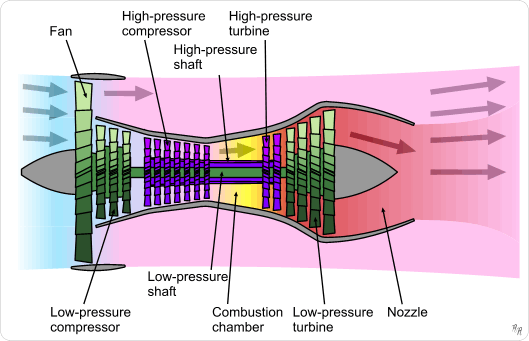
A jet-engine, or gas-turbine (A jet-engine is a gas-turbine that uses the high speed exhaust gases for propulsion. Other uses of gas-turbines are for propeller propulsion, as on ships, or for electrical power production) is made up of several compression/turbine discs. They are placed so that air gets sucked in at the compression side, compressed, ignited and pushed out the turbine side. You can get a good idea of how it works from this image:
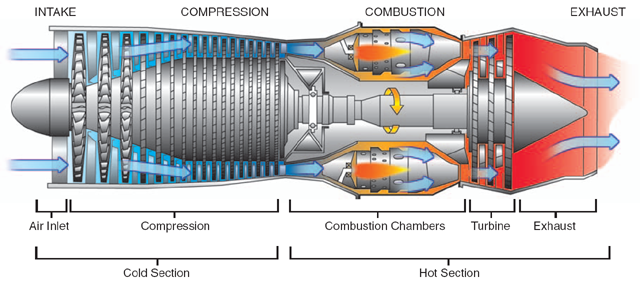
The compressor/turbine disc that is seen on the image taken at the Pentagon has lost its blades, something that is common when a jet-engine is destroyed. The reason is that strong g-forces are involved -the average Airliner jet-engine rotates with 10,000 rpm - and when the balance is lost those g-forces are released, wrecking havoc. You can see the blades here:

If you remove the blades the discs themselves are distinctivly smaller. Also note that the discs are of different sizes, with smaller discs to the left, and larger ones to the right.
Now, since the discs aren't of the same size, we need to know if the disc in the picture taken at the Pentagon is one of the larger ones or one of the smaller:

Without that knowledge there is no way to judge its size -this could be one of the largest discs, making the engine a smaller one, or it could be the smallest, making the engine a larger one. You have to know how the engine it came from was constructed.
That is why saying this photo shows a small engine, without knowledge of the engine it came from, is nonsens.
This site, apparently had that knowledge.
Cheers,
S
A few CT sites claim that the pictures of engine parts found at the Pentagon shows a small engine- reasoning that since the disc is so small, the engine had to be small. I've spent some time trying to pin down why its nonsense. I'd like your input.
This is the picture for reference:
First, my knowledge of jet-engines comes from my time in the Swedish navy. I did one year as a mechanic working with RR Marine Proteus gas-turbines. This was back in 1991 so its been awhile. However I did get hands on experience in handling them.
A jet-engine, or gas-turbine (A jet-engine is a gas-turbine that uses the high speed exhaust gases for propulsion. Other uses of gas-turbines are for propeller propulsion, as on ships, or for electrical power production) is made up of several compression/turbine discs. They are placed so that air gets sucked in at the compression side, compressed, ignited and pushed out the turbine side. You can get a good idea of how it works from this image:
The compressor/turbine disc that is seen on the image taken at the Pentagon has lost its blades, something that is common when a jet-engine is destroyed. The reason is that strong g-forces are involved -the average Airliner jet-engine rotates with 10,000 rpm - and when the balance is lost those g-forces are released, wrecking havoc. You can see the blades here:
If you remove the blades the discs themselves are distinctivly smaller. Also note that the discs are of different sizes, with smaller discs to the left, and larger ones to the right.
Now, since the discs aren't of the same size, we need to know if the disc in the picture taken at the Pentagon is one of the larger ones or one of the smaller:
Without that knowledge there is no way to judge its size -this could be one of the largest discs, making the engine a smaller one, or it could be the smallest, making the engine a larger one. You have to know how the engine it came from was constructed.
That is why saying this photo shows a small engine, without knowledge of the engine it came from, is nonsens.
This site, apparently had that knowledge.
Cheers,
S
Last edited: