• Quick note - the problem with Youtube videos not embedding on the forum appears to have been fixed, thanks to ZiprHead. If you do still see problems let me know.

Why ‘Obamanomics’ is working

Tony

Penultimate Amazing
Joined
Mar 5, 2003
Messages
15,410
http://www.msnbc.msn.com/id/36322393/ns/business-businessweekcom/page/2/

The rallying markets haven't been bothered by these differences, largely because of their context. Martin Baily, who was a chairman of the Council of Economic Advisers during the Clinton Administration, says he suspects Rubin and the rest of the Clinton economic team would have made similar decisions — on bailouts, fiscal stimulus, and deficit spending — had they faced a crisis of similar magnitude. "I think we would have gone the same way," he says. The Obama team, he continues, navigated the financial crisis while never losing sight of the importance of private enterprise and private markets (a point Obama stressed in his Feb. 9 interview with Bloomberg BusinessWeek). "A lot of people on the left were urging them to nationalize banks. Instead they injected capital, and now they're pulling capital out. That looks more like Rubinomics than a set of socialist or left-wing economic policies." The Obama economic team looks a lot like Rubin's, too; three of its most prominent members — Treasury Secretary Tim Geithner, National Economic Council Chairman Larry Summers, and White House budget director Peter Orszag — are Rubin protégés.


A decent read, but I don't think the recovery will start to seem real to Joe-Six-Pack until unemployment starts to drop and wages start to rise. Hopefully, that will happen soon, god help us if conservative regain the House or Senate.
 
I actually still am registered republican. I still get mail and surveys from them which I occasionally fill out. However, I consider myself a liberal leaning independent. The Bush Admin caused me to rethink a lot of things about the claims made by conservatives vis-a-vis their values and ideas.
 
Last edited:
Well, re-thinking things is what being a skeptic is all about.
 
But people still claim he has nationalized banks and car companies :confused: .

Good read.
 
I consider myself a liberal leaning independent. The Bush Admin caused me to rethink a lot of things about the claims made by conservatives vis-a-vis their values and ideas.

Is thinking like that legal in Texas? ;)

Bush 43 was the best think that happened to the GOP since Nixon, but people have short memories in this country and our denial of reality is still a national epidemic, alas.
 
But people still claim he has nationalized banks and car companies :confused: .

Good read.

Well, the United States Department of the Treasury owns about 61% of General Motors. I'm not sure if that qualifies as "nationalized" or not in your book, but the government definitely does have a controlling stake in what GM does.
 
OMG! We ownz one or two ub da 6100 companies in America! Dat's da Soshilizm!
:rolleyes:
 
http://www.msnbc.msn.com/id/36322393/ns/business-businessweekcom/page/2/


A decent read, but I don't think the recovery will start to seem real to Joe-Six-Pack until unemployment starts to drop and wages start to rise. Hopefully, that will happen soon, god help us if conservative regain the House or Senate.

Apparently this lags by quite a bit, like a year or more. From what I see on Sunday talk shows, even the left is skeptical it will happen before the election.


It's important because people vote with their wallet.
 
The problem with such analysis is the same as with any similar analysis: when the economy is bad, it's one's predecessor's fault (or, as a last resort, things would have been even worse if the other guy were in charge). When the economy is good, it's one's own achievement.

The economy was bad and now it is better. For some, this proves, first, that "capitalism has collapsed" and now "Obamanomics is working". For others, this proves, first, how "government intervention caused irresponsible spending" and now, how the recovery is a "false dawn".

The truth is probably that the economy is in one of its usual cycles, and it's being spinned for obvious reasons.
 
The problem with such analysis is the same as with any similar analysis: when the economy is bad, it's one's predecessor's fault (or, as a last resort, things would have been even worse if the other guy were in charge). When the economy is good, it's one's own achievement.

The economy was bad and now it is better. For some, this proves, first, that "capitalism has collapsed" and now "Obamanomics is working". For others, this proves, first, how "government intervention caused irresponsible spending" and now, how the recovery is a "false dawn".

The truth is probably that the economy is in one of its usual cycles, and it's being spinned for obvious reasons.
This is the gist of it, though it is true that the actions of powerful people can affect the duration and intensity of the cycles. Nevertheless, it reminds me of an old joke.

***
A new president is in his office on his first day and he finds three numbered envelopes on his desk with a note from his predecessor to open them, one at a time, when a crisis hits.

The first crisis comes and the worried president opens the first envelope. All it says is "Blame your predecessor". The president does, and things eventually blow over.

The second crisis comes and he opens the second envelope. "Blame the economy", it says. The president rails about the bad economy and this is grudgingly accepted by the public.

Finally a third crisis hits and the frantic president opens the third envelope. In it are the words, "Make three envelopes..."
***
 
The truth is probably that the economy is in one of its usual cycles, and it's being spinned for obvious reasons.

I disagree.

We've seen what "usual cycles" are -- in 1981, 1991, 2001, and so forth. This particular dip wasn't by any stretch of the imagination "usual."

While selling it as "the collapse of capitalism" is obviously over-the-top, it's quite reasonable to point to the differences between 1991 and 2007 and to look for causes for the extreme differences in severity.
 
drkitten --

I'm not saying all analysis of economic cycles is worthless, of course. Surely it's worth while to investigate economic crises and see how various crises change in various times.

I'm just pointing out that I'd look for it in peer-reviewed economic journals publishing work by established economists (although, economics being what it is, that too is hardly infallible), not in articles by pundits in obviously left- or right-wing popular media.
 
Its like Bush's "stimulus" bills.

When there is a recession, politicians have a crisis through which they can pass their pets projects in the name of the crisis. For Bush, it was tax cuts. For Obama, it was the megalith of projects known as the stimulus bill. As with every recession before, we came out of it, before the microeconomic impacts of the various responses were even felt fully.

So the President will go through the bizarro kubuki where they take credit but can't tell you how. It will be a gnomish proposition, "we dumped a bunch of money into projects, ????????, recovery". Or the Bush version, "we cut taxes, ????????????, recovery".

In truth, Obama has slowed recovery. Some businesses are still in holding patterns on hiring because of health care. Energy companies are in holding patterns waiting to see what happens to them. The amount of uncertainty due to Obama's domestic agenda and ominous downsides hasn't been a great confidence builder.

The stock market is back up. So the investor class has made money. Of course, it had recovered most of that back in the summer. That first 6500-9500 was really a correction.
 
Its like Bush's "stimulus" bills.

When there is a recession, politicians have a crisis through which they can pass their pets projects in the name of the crisis. For Bush, it was tax cuts. For Obama, it was the megalith of projects known as the stimulus bill. As with every recession before, we came out of it, before the microeconomic impacts of the various responses were even felt fully.
So the President will go through the bizarro kubuki where they take credit but can't tell you how. It will be a gnomish proposition, "we dumped a bunch of money into projects, ????????, recovery". Or the Bush version, "we cut taxes, ????????????, recovery".

In truth, Obama has slowed recovery. Some businesses are still in holding patterns on hiring because of health care. Energy companies are in holding patterns waiting to see what happens to them. The amount of uncertainty due to Obama's domestic agenda and ominous downsides hasn't been a great confidence builder.

The stock market is back up. So the investor class has made money. Of course, it had recovered most of that back in the summer. That first 6500-9500 was really a correction.

What about the agricultural depressions of the 19th Century, or the 1930's?
 
I have a theory in the back of my head that, since these things are cyclic, Bush felt the need to jam out a huge stimulus to blunt what may be the de facto assumption that the upcoming administration (which he knew would be Democrats) gets credit for the recovery. Now they can claim a thumb, and an early thumb at that, in it.


It may be ironic that massive spending by both sides may have delayed it due to uncertainties (interest rates, possible tax increases) associated with massive increases in borrowing.

I also suppose it's cynical to think, "Hey, well then, we'll borrow so damned much it will overcome their uncertainties, as they greedily go after the money we spend!"

Fortunately, I'm not a cynic.
 
I read an article a few weeks back that AIG was paying back most of its loan/gift/guarantee. But the expectation is that all of it won't come back.

If GM recovers, and stock value goes up, how does any realized gain on that capital holding by the US Gov't get credited to the Treasury?

Example: US Gov't sells a bit of GM stock as the price raises, in small amounts, to get back some of the money it spent on GM. If it does so in large blocks, price goes down, defeating purpose of the sale, of course.

How soon can US Gov't liquidate its holdings in GM? Five years? Ten? If you own 61% of a company, you don't usually liquidate your holdings all at once unless you get a tender offer for the whole pile ... at a premium price.

ETA: Tony, nice to "see" you again.

DR
 
I'm not saying all analysis of economic cycles is worthless, of course. Surely it's worth while to investigate economic crises and see how various crises change in various times.

I'm just pointing out that I'd look for it in peer-reviewed economic journals publishing work by established economists (although, economics being what it is, that too is hardly infallible), not in articles by pundits in obviously left- or right-wing popular media.

Well, you're obviously unfamiliar with the time scale of "peer-reviewed economic journals"; lead times of up to three years are not uncommon, so if you're looking for an analysis of current events, you won't find it.

But beyond that,.... no, that's not what you are pointing out, or at least not what you wrote.

I quote:
The economy was bad and now it is better. For some, this proves, first, that "capitalism has collapsed" and now "Obamanomics is working". For others, this proves, first, how "government intervention caused irresponsible spending" and now, how the recovery is a "false dawn".

The truth is probably that the economy is in one of its usual cycles,....

Left-wing pundits say "poTAYto," right-wing pundits say "poTAHto," so the truth is probably in the middle.

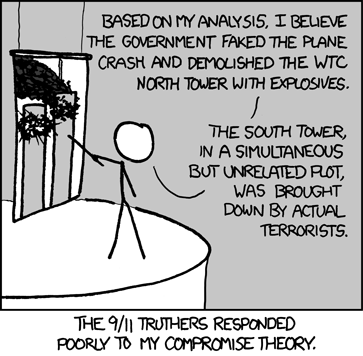
Wrong. That's a well-understood fallacy, the so-called "fallacy of the golden mean," or "the fallacy of the middle ground." Just because to every extremist, there is an equal and opposite extremists does not mean that both extremists are wrong. If I say that the world is 5 billion years old, and a creationist says that the world is 6000 years old, that doesn't mean that the truth is world is "really" two-and-a-half billion years old.

Whatever else we know, we know that this is not a "usual" cycle for the economy; it's much worse. And if right-wing pundits are claiming that this is a "false dawn,".... well, that statement is either true or false on its own merits (and we will know which in six months). If the Dow stays above 10,000 and unemployment drops to 9% -- that's not a strong recovery, but it's still a recovery, enough to disprove that particular pundit.

It's not enough to simply read both sides and divide by two. You have to take into account the possibility that Glenn and Rush are both actively wrong -- or conversely, that Arianna is.
 
Wrong. That's a well-understood fallacy, the so-called "fallacy of the golden mean," or "the fallacy of the middle ground." Just because to every extremist, there is an equal and opposite extremists does not mean that both extremists are wrong. If I say that the world is 5 billion years old, and a creationist says that the world is 6000 years old, that doesn't mean that the truth is world is "really" two-and-a-half billion years old.


http://xkcd.com/690/
semicontrolled_demolition.png


And the hover text:

I believe the truth always lies halfway between the most extreme claims.
 

Back
Top Bottom