• Quick note - the problem with Youtube videos not embedding on the forum appears to have been fixed, thanks to ZiprHead. If you do still see problems let me know.

The best science and medicine books

macdoc

Philosopher
Joined
Dec 30, 2008
Messages
8,139
Location
Planet earth on slow boil
I'm going to request this be a sticky for this forum.
Please add your top books AND some commentary and review, what you found AWESOME! ;)
....not just a laundry list please.

••••

This guy is flat out fun...not just for science readers....
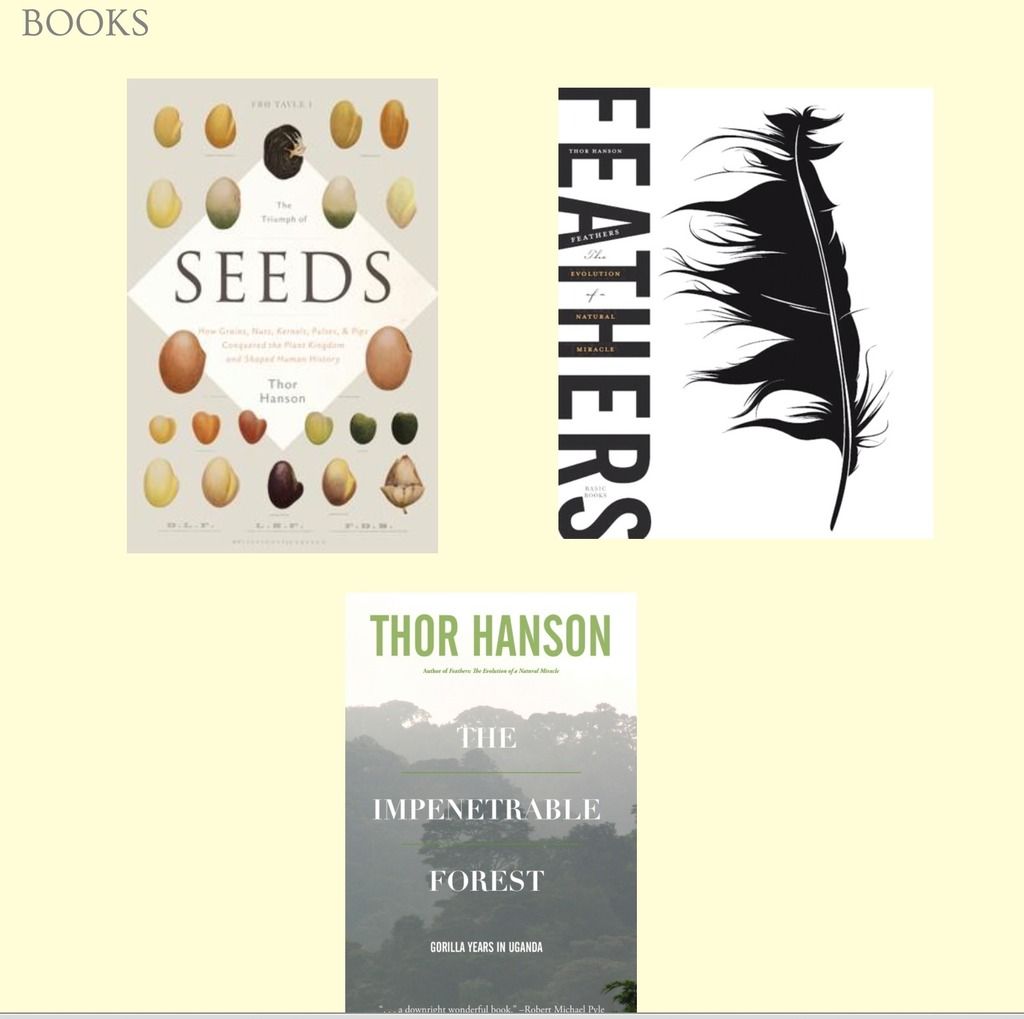


a total delightful triology - you'll find yourself every few pages exclaiming loudly .....I never knew that !!!...it's both accessible and intensely developed and erudite.

The three books start with him as a fresh faced Peace Corp volunteer establishing a gorilla reserve in Uganda ( that was an eye opener about the country and gorillas)

and progressed through Feathers and Seeds both of which are world view benders.

Thor Hanson was born and raised in the Pacific Northwest, where he now lives on an island with his wife and son. He caught his first salmon at age four, and often collected a wide array of temporary summertime pets, from caterpillars and tadpoles to garter snakes, hermit crabs, and tree frogs. His early interest in the natural world steered him towards a career in conservation biology. Hanson received his bachelor’s degree from the University of Redlands, his master’s from the University of Vermont’s Field Naturalist Program, and his doctorate in a joint program through the University of Idaho and the Centro Agronómico Tropical de Investigación y Enseñanza, Costa Rica.

Hanson’s research and conservation activities have taken him around the globe. He has studied Central American trees and songbirds, nest predation in Tanzania, and the grisly feeding habits of African vultures. He served as a U.S. Peace Corps volunteer in Uganda, where he helped establish the mountain gorilla tourism program in Bwindi Impenetrable National Park, and he has also helped manage a brown bear tourism project for the U.S. Forest Service in Alaska. He often works at the interface between natural and human systems, and is currently involved in a project assessing the ecological impacts of warfare.

Hanson is a Guggenheim Fellow, a Switzer Environmental Fellow, and an independent conservation biologist based in the San Juan Islands. He has received research grants from the Organization for Tropical Studies, the DeVlieg Foundation, and the National Science Foundation’s IGERT Program, among others. He teaches field courses, reviews for academic journals, consults for conservation groups and government agencies, and is a sought-after public speaker. Hanson's many media appearances have included NPR's Fresh Air, PRI's The World, and The Current on CBC.

​His recent book, FEATHERS, won the John Burroughs Medal and was nominated for The Samuel Johnson Prize. It also received the A.A.A./Subaru SB&F Prize for science writing and a Pacific Northwest Booksellers Association Award, and was a finalist for The Washington State Book Award. His first book, THE IMPENETRABLE FOREST, won the 2008 USA Book News Award for nature writing

Seeds is just out and I'm sure will win its share of awards as well.
Funny, informative...brilliant combination. He tells a good story and you come away better informed....in some cases MUCH better informed. :D He weaves science into everyday life and the books ( especially when his young kid gets engaged ) in a marvelous manner.
 
Excellent we have a sticky. :D Prefer not to discuss the books in this thread but do provide a description and what impressed you - perhaps a "did you know" teaser...

••

If you read ONE science book in your life it should be this one.

If you want a totally joyous read- grab Song of the Dodo - you will be thoroughly entertained and very well informed on evolution and island bio-geography which sounds dry but is fascinating and he just a terrific writer.
You will not regret getting it. Poignant, funny, informative.


Page after fascinating page he takes you on a romp through the history of evolution ( he retraces Wallace ) - and the fascinating creatures we share the planet with.
Just get it.
 
Last edited:
For me, one of the most illuminating books on the scientific principle was "T. rex and the crater of doom", by Walter Alvarez, 1997. Title sounds a little dramatic, but the book was aimed at a non-specialist audience. Brilliantly takes the reader through the process of how an idea, or hypothesis, becomes scientific fact. From the iridium anomaly to the final discovery and dating of the crater. Well written, and you can sense the excitement and frustrations of the team as they worked toward the final outcome.
How science actually works, and something some posters here would be well advised to read to figure out the difference between an unsubstantiated idea, and proven scientific fact, and how you go about getting there.

 
Last edited:


Anyone alive in the eighteenth century would have known that "the longitude problem" was the thorniest scientific dilemma of the day-and had been for centuries. Lacking the ability to measure their longitude, sailors throughout the great ages of exploration had been literally lost at sea as soon as they lost sight of land. Thousands of lives, and the increasing fortunes of nations, hung on a resolution. The scientific establishment of Europe-from Galileo to Sir Isaac Newton-had mapped the heavens in both hemispheres in its certain pursuit of a celestial answer. In stark contrast, one man, John Harrison, dared to imagine a mechanical solution-a clock that would keep precise time at sea, something no clock had ever been able to do on land. Longitude is the dramatic human story of an epic scientific quest, and of Harrison's forty-year obsession with building his perfect timekeeper, known today as the chronometer. Full of heroism and chicanery, it is also a fascinating brief history of astronomy, navigation, and clockmaking, and opens a new window on our world.

http://books.google.com.au/books/about/Longitude.html?id=lW8DYSPa6fEC&redir_esc=y

It's an amazing story of a man far far ahead of his peers.....so far ahead ....that a clock he designed but was never funded to build was recently built and tested.

He claimed his clock would be off less than a second in 100 days ...now this is clock that has to wound !!!:boggled:
He was laughed at at the time and the clock never built - if you read the book you'll see how astounding his clocks are.

What made me recall this fascinating book

Last year, the first trial of the clock –overseen by the Worshipful Company of Clockmakers and the National Physical Laboratory – was carried out at the Observatory. This showed it was capable of performing to the standard that Harrison claimed. “This year’s final test began on 6 January, when the clock was sealed in a clear plastic container that had been made tamper-proof by the application of wax seals across wires that lock the case’s fixing bolts shut and is the official trial of its accuracy,” added McEvoy.

At the start of the trial, it was noted by witnesses that the clock was running quarter of a second behind Greenwich Mean Time. At the end of the trial yesterday morning, the clock read 7/8ths of a second behind GMT. It had lost 5/8ths of a second in the 100-day trial.

This entire article covers off a bit more. You'll learn a lot and ....marvel.

http://www.theguardian.com/science/...n-harrison-vindicated-250-years-absurd-claims

The entire search for a way to measure longitude at sea is a fascinating read and John Harrison an unikely hero
 
Expected: "Principles of Planetary Climate" and "The Global Carbon Cycle"

Coming from me, these two should probably have amounted to expected and typical.

:)


http://www.amazon.com/Principles-Pl...=sr_1_1?ie=UTF8&s=books&qid=1291418043&sr=8-1

picture.php

Probably too heavy for a casual read, but most of it can be followed without an in-depth mathematical degree. Too bad its often a textbook, meaning that it isn't as often read for personal interest and knowledge enhancement. His lecture series used to appear online, I haven't seen them lately, but it is worth reading for those with a desire for a more detailed understanding. Though much of this is also true of the next offering, it is a bit more casual reading "friendly."

If you want to understand the basic building blocks of planetary climate (ours and others throughout the solar system and universe) this is the primer. "The Principles of Planetary Climate" is Climate Science 101

http://www.amazon.com/Global-Carbon-Princeton-Primers-Climate/dp/0691144141/ref=pd_cp_b_2

picture.php

As alluded to above, While this book is every bit the text, it is much more readable, IMO. the focus of this work is much more on our planet's carbon cycle with respect to its short-term, intermediate term and long-term impacts upon our planet's climate, in the past, present and future.
 
Trex and Valley of Doom is just superb....learning so much with the cross discipline discovery

Good story telling....
And damn I think that's the same RIchard Muller at Berkeley who took the wind out of the AGW deniers.
Highly recommended
 
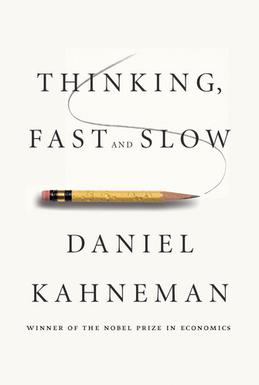
For the intersection of psychology and economics, Thinking, Fast and Slow by Daniel Kahneman. It puts together a comprehensive research based analysis of human thinking patterns in a way both personal and comprehensive. A great read and well deserving of it's many accolades. It has a special insight for those of us facing the challenge of woo, both in others and ourselves.

Thinking%2C_Fast_and_Slow.jpg


http://www.amazon.com/Thinking-Fast...586053&sr=8-1&keywords=thinking+fast+and+slow
 
Last edited:
For the intersection of psychology and economics, Thinking, Fast and Slow by Daniel Kahneman. It puts together a comprehensive research based analysis of human thinking patterns in a way both personal and comprehensive. A great read and well deserving of it's many accolades. It has a special insight for those of us facing the challenge of woo, both in others and ourselves.

[qimg]https://upload.wikimedia.org/wikipedia/en/c/c1/Thinking%2C_Fast_and_Slow.jpg[/qimg]


http://www.amazon.com/Thinking-Fast...586053&sr=8-1&keywords=thinking+fast+and+slow

Interesting, thanks for sharing. It sounds a lot like one of the Scientific American online classes I recently signed up for,..."Behavioral Finance: Using Psychology in the Market" - (May 1- 15) http://www.scientificamerican.com/p...ioral-finance-using-psychology-in-the-market/
Its not a book, but interesting none-the-less.
 
Last edited:
The Organized Mind: Thinking Straight in the Age of Information Overload

In The Organized Mind, Levitin demonstrates how the Information Age is drowning us with an unprecedented deluge of data, and uses the latest brain science to explain how the brain can organize this flood of information. Levitin then demonstrates methods that readers can use to regain a sense of mastery over the way they organize their homes, workplaces, and time. It answers three fundamental questions: Why does the brain pay attention to some things and not others? Why do we remember some things and not others? And how can we use that knowledge to better organize our home and workplaces, our time, social world, and decision making?

https://en.wikipedia.org/wiki/The_Organized_Mind

http://www.amazon.com/Organized-Min...qid=1429591842&sr=8-1&keywords=organized+mind

Brilliant science that might actually be useful
 
In a parallel theme...this one blew my mind...


The Brain That Changes Itself: Stories of Personal Triumph from the Frontiers of Brain Science Paperback –

An astonishing new science called "neuroplasticity" is overthrowing the centuries-old notion that the human brain is immutable. In this revolutionary look at the brain, psychiatrist and psychoanalyst Norman Doidge, M.D., provides an introduction to both the brilliant scientists championing neuroplasticity and the people whose lives they've transformed. From stroke patients learning to speak again to the remarkable case of a woman born with half a brain that rewired itself to work as a whole, The Brain That Changes Itself will permanently alter the way we look at our brains, human nature, and human potential.

you betcha....worldview altering for me...
Charts the change in perception of our brains and some of the stories are jaw dropping and the uphill battle against embedding views in the main stream.

http://www.amazon.com/The-Brain-That-Changes-Itself/dp/0143113100

••

another one that covers off the change in forest management over time is this...

The Big Burn: Teddy Roosevelt and the Fire that Saved America

National Book Award–winner Timothy Egan turns his historian's eye to the largest-ever forest fire in America and offers an epic, cautionary tale for our time.

On the afternoon of August 20, 1910, a battering ram of wind moved through the drought-stricken national forests of Washington, Idaho, and Montana, whipping the hundreds of small blazes burning across the forest floor into a roaring inferno that jumped from treetop to ridge as it raged, destroying towns and timber in the blink of an eye. Forest rangers had assembled nearly ten thousand men to fight the fires, but no living person had seen anything like those flames, and neither the rangers nor anyone else knew how to subdue them. Egan recreates the struggles of the overmatched rangers against the implacable fire with unstoppable dramatic force, and the larger story of outsized president Teddy Roosevelt and his chief forester, Gifford Pinchot, that follows is equally resonant. Pioneering the notion of conservation, Roosevelt and Pinchot did nothing less than create the idea of public land as our national treasure, owned by every citizen. Even as TR's national forests were smoldering they were saved: The heroism shown by his rangers turned public opinion permanently in favor of the forests, though it changed the mission of the forest service in ways we can still witness today.

Aside from an amazing story - the challenge of managing forests in a manner that was based in science and sense is an ongoing struggle.
It's a really good read.
 
Last edited:
Hands down Nick Lane's "The Vital Question: Why Is Life the Way It Is?", which was released in the UK region on April 23rd, but won't be released in North America until July 20 with a less provocative subtitle.

http://www.amazon.co.uk/The-Vital-Question-Why-life/dp/1781250367

though it seems you can get the UK version here earlier

http://www.amazon.com/The-Vital-Question-Why-Life/dp/1781250367

He won the the 2010 Royal Society Prize for "Life Ascending: The Ten Great Inventions of Evolution", which discussed the origin of life, the creation of DNA, photosynthesis, the evolution of complex cells, sex, movement, sight, warm bloodedness, consciousness and death.

The Vital Question focuses on three of those:

1) the origin of life - provides even more support for a place of constant disequilibrium like alkaline hydrothermal vents being the most plausible birthplace for life not just here but anyplace with rocks (like olivine), liquid water, and carbon dioxide.

2) the evolution of complex cells - given the abundance of those three in the universe why the Fermi Paradox? Given the way bacteria and archaea operate, they'll stay small as single entities less they be out competed. Only endosymbiosis could produce the complex cell and for the reasons he goes into, it wasn't as inevitable as people assume it was. Even if something like Parakaryon myojinensis pops up once in a while, nothing has stuck around but the original.

3) Sex - This gets discussed in relation to it being a means to maintaining genetic health in the complex cell, particularly in keeping the genes in the nuclear genome devoted to the mitochondria in sync with the ones in the mitochondria.

I am probably doing the book a disservice with this post. Read it anyway.:)
 
Last edited:
Just starting a new one

The Disappearing Spoon: And Other True Tales of Madness, Love, and the History of the World from the Periodic Table of the Elements

http://www.amazon.com/dp/B003JTHXZY/ref=pe_385040_118058080_TE_M1T1DP


An even better book by the same author is The Tale of the Dueling Neurosurgeons.


Also check out The Poisoner's Handbook, about the birth of forensic medicine.


And, of course, the best book ever written by anybody about anything: Bill Bryson's A Short History of Nearly Everything.
 
I've just finished re-reading Chris Stringer's The Origin of our Species, 2011.
This is a quite up to date synopsis of the current state of knowledge of our ancestry, from one of the world's leading palaeoanthropologists. Stringer was one of the earliest proponents of the 'Out of Africa' hypothesis for human origins, which remains essentially intact, but this work covers more recent findings, such as the discovery of Neanderthal and Denisovan DNA in modern humans.
I've read a few of Stringer's books, and always find them enjoyable and informative. Well worth a look if this is your type of thing.

330dx5g.jpg
 
Last edited:
Following on from the above, I decided I'd had Svante Pääbo's book lying around for a while, and ought to read it.
Well, it was a real eye-opener. The story of his whole career is fascinating enough, but his revelations of his sexuality and dalliances, the intergroup co-operation and rivalries, and a certain amount of ego, all make for a fascinating read. Then there are the discoveries he and his group have made.
There are some parts which are technical, but it is easy to get through those without it detracting from a story that was far more readable than I'd expected it to be.

3096bo9.jpg
 
Hands down Nick Lane's "The Vital Question: Why Is Life the Way It Is?"
......
I am probably doing the book a disservice with this post. Read it anyway.:)

I am happy to hear that you enjoyed this book. I don't have it yet, but it has been next on my list of books to buy since I first heard of it.

Lane is an amazing author - "Oxygen" and "Power, Sex, Suicide" were outstanding books. "Life Ascending" might be my favorite popular science book of all time. It is good to see that his newest book is getting similar reviews.
 
I am happy to hear that you enjoyed this book. I don't have it yet, but it has been next on my list of books to buy since I first heard of it.

I hope you are enjoying it or soon will be. "The Vital Question: Energy, Evolution, and the Origins of Complex Life" is shipping and on some store shelves right now. It appears at the moment to be different from the U.K. version only in the subtitle.

To add to my first post, "Vital Question" also deals with Death, particularly in sections like the one titled "Immortal germline, mortal body".

Lane is an amazing author - "Oxygen" and "Power, Sex, Suicide" were outstanding books. "Life Ascending" might be my favorite popular science book of all time. It is good to see that his newest book is getting similar reviews.

All worthy books to bring up in this thread. They each cover some of the same ground with older information, but they also cover areas the "Vital Question" does not.
 

Back
Top Bottom