• Quick note - the problem with Youtube videos not embedding on the forum appears to have been fixed, thanks to ZiprHead. If you do still see problems let me know.

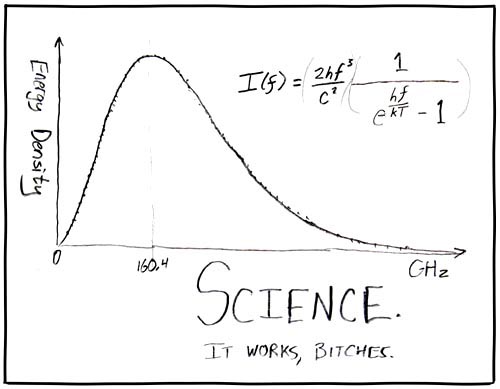
Stephen Hawking illustrates an important difference between science and religion.

Towlie

ancillary character
Joined
May 22, 2009
Messages
1,474
http://www.straitstimes.com/Breaking+News/Tech+and+Science/Story/STIStory_444348.html

Hawking bets collider won't work
...

"I think it will be much more exciting if we don't find the Higgs. That will show something is wrong, and we need to think again. I have a bet of 100 dollars that we won't find the Higgs," said Prof Hawking...
Reading between the lines, my impression is that Stephen Hawking doesn't really expect the experiment to fail, rather, he wants to illustrate that he won't be disappointed if it does. I have a feeling that this "bet" is intended to highlight an important aspect of science, and it's my observation that it's an aspect religion lacks.

Imagine a comparable situation relating to Christianity or any other religion. Suppose, for example, that something was discovered or an experiment was devised that might prove or disprove Christian beliefs to some extent, and tests were planned to establish whether the find was real. Then imagine the Pope or some other Christian authority saying something like "I think it will be much more exciting if we don't establish that the find is real. That will show something is wrong, and we need to think again."

Obviously, that would never happen. No religious authority would ever say anything like that. Religion is forever stagnant and that's exactly the way they want it.

P.S. - Rumors of Hawking's death are greatly exaggerated.
 
Much of science disproves religion to some extent. Evolution disproves creationism and the religious have been up in arms over it for decades and in the modern age are trying to supplant it with Intelligent Design.
 
Reading between the lines, my impression is that Stephen Hawking doesn't really expect the experiment to fail, rather, he wants to illustrate that he won't be disappointed if it does. I have a feeling that this "bet" is intended to highlight an important aspect of science, and it's my observation that it's an aspect religion lacks.

Imagine a comparable situation relating to Christianity or any other religion. Suppose, for example, that something was discovered or an experiment was devised that might prove or disprove Christian beliefs to some extent, and tests were planned to establish whether the find was real. Then imagine the Pope or some other Christian authority saying something like "I think it will be much more exciting if we don't establish that the find is real. That will show something is wrong, and we need to think again."

Obviously, that would never happen. No religious authority would ever say anything like that. Religion is forever stagnant and that's exactly the way they want it.

P.S. - Rumors of Hawking's death are greatly exaggerated.

Oh, I don't know. I think there is an important difference between talking about science and religion, versus talking about scientists and religious people. Specifically, that while science and religion are fairly well defined concepts, people are much less so, and can call themselves anything (scientists, christians, conservatives, evolutionists, etc), and still not be what someone else would call a 'pure' one.

Resulting, imho, that you could find someone who identifies as a Christian who would be comfortable in saying "I think it will be much more exciting if we don't establish that the find is real. That will show something is wrong, and we need to think again.", and you could find someone who identifies themselves as a scientist who would fight tooth and nail to continue to support a discredited theory.

To me, it's a lot less about the labels and categories that indicate how specific people will react, than it is about the specific people.
 
Even if the experiment does not yield the expected results, it will be a giant leap in knowledge. It may mean a change of direction and that is all for the good. Observed nature wont change that much, we will just need differing explanations. And that's a result.

Could you imagine any religion, major or minor, even suggesting such a thing? They will leap around in their familiar mania screaming that science got it wrong. When in actual fact, even if the experiment yields unexpected results - that's what science is. We will have answered one particular question one way or another.
 
Then imagine the Pope or some other Christian authority saying something like "I think it will be much more exciting if we don't establish that the find is real. That will show something is wrong, and we need to think again."

Obviously, that would never happen. No religious authority would ever say anything like that.
Does this count?

"If there were a real proof that the Sun is in the center of the universe, that the Earth is in the third sphere, and that the Sun does not go round the Earth but the Earth round the Sun, then we should have to proceed with great circumspection in explaining passages of Scripture which appear to teach the contrary, and we should rather have to say that we did not understand them than declare an opinion false which has been proved to be true."
Cardinal Bellarmine
 
Does this count?
I guess a claim that the Bible was misunderstood is the most we can hope for from a religious leader. We'll certainly never see it granted that the Bible might simply be wrong.
 
I guess a claim that the Bible was misunderstood is the most we can hope for from a religious leader. We'll certainly never see it granted that the Bible might simply be wrong.

Exactly! Did a single doctrine of the church change because of the new understanding of the sun being the centre of the solar system?
 
science.jpg


... just because someone has to.
 

Back
Top Bottom