If I read this correctly, the FCC's beef is not with delaying the transmission of large files, but with blocking them entirely. I haven't read much on this, but am interested in knowing more. It seems to me the FCC is telling ISPs that they must, if necessary, degrade the performance for all of their customers to accommodate those relatively few customers who take up major bandwidth by swapping huge files.Comcast is testing new technologies that would slow the transmission of Internet files for its biggest users by as much as 20 minutes during times of heavy network congestion. But the nation's largest cable provider has promised not to target specific content, such as video files that compete with its cable television business.
The tests come as the Federal Communications Commission yesterday released an order that forces Comcast to stop its earlier efforts to block transmission of certain Internet files, a ruling that public interest groups hailed, saying it would prevent network operators from acting as gatekeepers of the Web.
Comcast didn't respond to details of the FCC's order, but spokeswoman Sena Fitzmaurice said, "We are examining the order and will evaluate our next step."
Comcast began testing its system of slowing certain traffic in March and has expanded the tests to Warrenton; Chambersburg, Pa.; Colorado Springs; Lakeview, Fla.; and East Orange, Fla. It will adopt the new network management technology by the end of the year, the company said.
"We are in a trial, and final results of that are yet unknown, which is why we do trials," said Mitch Bowling, Comcast's general manager of online services. "The important point is that the intent of network management has and continues to be to provide a great experience for our customers."
In yesterday's order, the FCC concluded that Comcast's earlier management of Internet traffic was discriminatory and "inconsistent with the concept of an open and accessible Internet."
After public hearings in Cambridge, Mass., and Silicon Valley and several months of investigations, the agency said Comcast had looked into the packets of Internet files being transferred between users and deliberately blocked certain files.
The commission said Comcast had an "anticompetitive motive" because it delayed and blocked peer-to-peer files through applications such as BitTorrent. Such files often are high-quality video that might otherwise be watched and paid for on cable television.

You are using an out of date browser. It may not display this or other websites correctly.
You should upgrade or use an alternative browser.
You should upgrade or use an alternative browser.
Should Your ISP Be Allowed To Delay Your File Transfers?

Aren't they private companies? If so and if it's in the contract you have with them the answer is "yes".
idoubtit
Critical Thinker

- Joined
- May 3, 2007
- Messages
- 365
Yet Comcast promotes the speed of its high-speed. They slay me! I'm all for paying by use. I download mighty little compared to someone down the street using up the bandwidth for TV shows or movies. I think it should be charged sort of like your wireless or water bills - you get a certain allotment for a set fee then pay extra for whatever you go over. That also means that I shouldn't suffer a decrease in service for someone hogging it. Right now, I'm trying to download a file and from two servers, it's only giving me some 60 kb/s. Lame. My Speedtest gives me well over 10,000. Don't know what the deal is.

I don't have any significant complaints about Comcast. But even if I did, changing my ISP would not be an option, since they are the only cable provider in the area - they have a government-sanctioned monopoly. And Verizon doesn't have high-speed service in my neighborhood.For me QOS is good. If you don't like it (perhaps you don't use many interactive services) change to a provider who doesn't use it. That's what the free market is all about.
So my question isn't so much about what can I do about the service, but a question of principle. Should ISPs be allowed to discriminate against bandwidth hogs? Or, turning the question around, should ISPs be required to give bandwidth hogs the same service as your mom, who only sends out one email a week (usually with the subject line, "FWD: Warning!!!! Killer Death Virus!!!")?
Gord_in_Toronto
Penultimate Amazing

- Joined
- Jul 22, 2006
- Messages
- 26,456
This is a BIG ISSUE here in Canada at the present time as the claim is made that the two major network providers (and ISPs) have been or are in the process of doing similar "traffic shaping".
If you take a look at the Usenet group can.internet.highspeed you can read the discussion at inordinate length with arguers on both sides. The issue has reached the CRTC (Canadian equivalent of the FTC) and a "decsion will be made shortly". Based on prior experience I guess it will satisfy no one.
If you take a look at the Usenet group can.internet.highspeed you can read the discussion at inordinate length with arguers on both sides. The issue has reached the CRTC (Canadian equivalent of the FTC) and a "decsion will be made shortly". Based on prior experience I guess it will satisfy no one.
WildCat
NWO Master Conspirator

- Joined
- Mar 23, 2003
- Messages
- 59,856
I don't think it is in the contract, but I can't say for sure since I don't have Comcast. I do know they advertise about their high speed and limitless downloads.Aren't they private companies? If so and if it's in the contract you have with them the answer is "yes".
For example, here's what it says on their web site:
They don't ever mention that one of those "many factors" is them deliberately slowing down traffic, do they?High-Speed Service: Speeds stated for downloads only and compare Comcast 6.0 Mbps to 1.5 Mbps DSL and 56Kbps dial-up. Many factors affect speed. Actual speeds will vary and are not guaranteed. McAfee is not compatible with Macintosh systems.
Last edited:
I think BPSCG is more interested in the "bigger picture" rather than a single company - that's why I tried t answer in a generic manner. Of course if the specific company contracts with you to provide service X and they don't then that is wrong.
geni
Anti-homeopathy illuminati member

- Joined
- Oct 14, 2003
- Messages
- 28,209
Depends on exactly what they are doing. I tend to feel the problem could be delt with by selling a better range of products. Stop messing around with hidden caps and the like and dirrectly and openly sell differnt products to normal and high capacity users.
billydkid
Illuminator

- Joined
- Aug 27, 2002
- Messages
- 4,917
If you are paying a premium price for fast internet - which many of us are - that is what we should get. It's that simple. I have noticed that my Time/Warner Road Runner has gotten progressively slower over the past year or so. We pay a premium price for this service as well as for the TV programming. If we are paying for high speed internet and getting instead the equivalent of phone line internet we are getting nothing except ripped off.
KoihimeNakamura
Creativity Murderer

It's more likely the internet's getting clogged and it'd cost too much money (Seriously) to put in more links and highbandwidth connections.
I'll find the link later.
I'll find the link later.
I don't have any significant complaints about Comcast. But even if I did, changing my ISP would not be an option, since they are the only cable provider in the area - they have a government-sanctioned monopoly. And Verizon doesn't have high-speed service in my neighborhood.
Now that's worth complaining about. We don't like monopolies
Is your cable provider the only option for high speed internet service?
There may be a culture gap here. I live across the pond in the UK. Here there's a basic choice between getting your internet from the folks who provide your Cable TV via Cable Modem or getting it via ADSL over your phone line - where you have a choice of providers.
That's not to mention the possibilities of having a dedicated fibre connection like we have at work but it's unreasonable to expect a home user to fork out that much.
Less common options are wireless, satalite or mobile (UTMS is nearly as good as ADSL broadband in my area)
Still if the USA is are going to allow their churches to dictate their school science curricula then being a little technologically backward is the price theu must pay

geni
Anti-homeopathy illuminati member
- Joined
- Oct 14, 2003
- Messages
- 28,209
If you are paying a premium price for fast internet - which many of us are - that is what we should get. It's that simple. I have noticed that my Time/Warner Road Runner has gotten progressively slower over the past year or so. We pay a premium price for this service as well as for the TV programming. If we are paying for high speed internet and getting instead the equivalent of phone line internet we are getting nothing except ripped off.
The problem is that fo the most part you are not actualy paying for for fast internet. Most companies work on the basis that most people who buy their product will not actuly use very much of it. As long as most don't those who do are subsidised by the rest. As more people use more bandwidth the system breaks down which means either various forms of complex rationing or the company has to set up a geniune premium service which will tend to be rather more expenisive than the current one.
Denver
Penultimate Amazing

- Joined
- Sep 8, 2007
- Messages
- 10,015
In the beginning, ISPs charged dial users by the hour for connection time. But over time, some ISPs were able to arrange their costs and their support and their tech in such a way as to support a flat fee model. Everyone liked this, and it became an important sales issue: those who did not offer a reasonable flat-fee service, lost a lot of customers.
I think this is where we may be going with charge by use. I think it is perfectly reasonable for ISPs to try different models here. Some will fall flat. Some will be grundgingly allowed. And some won't matter to most people.
But if this method of charging does begin to be adopted, then over time, as costs again come down, competitors will start offering flat-fee again. They will win the customers. And the likes of Comcast will have to undo all their work and go back to flat-fee again.
So, to me, it's just a marketplace issue. Have at it.
I think this is where we may be going with charge by use. I think it is perfectly reasonable for ISPs to try different models here. Some will fall flat. Some will be grundgingly allowed. And some won't matter to most people.
But if this method of charging does begin to be adopted, then over time, as costs again come down, competitors will start offering flat-fee again. They will win the customers. And the likes of Comcast will have to undo all their work and go back to flat-fee again.
So, to me, it's just a marketplace issue. Have at it.
Now that's worth complaining about. We don't like monopolies
Is your cable provider the only option for high speed internet service?
There may be a culture gap here. I live across the pond in the UK. Here there's a basic choice between getting your internet from the folks who provide your Cable TV via Cable Modem or getting it via ADSL over your phone line - where you have a choice of providers.
That's not to mention the possibilities of having a dedicated fibre connection like we have at work but it's unreasonable to expect a home user to fork out that much.
Less common options are wireless, satalite or mobile (UTMS is nearly as good as ADSL broadband in my area)
Still if the USA is are going to allow their churches to dictate their school science curricula then being a little technologically backward is the price theu must pay
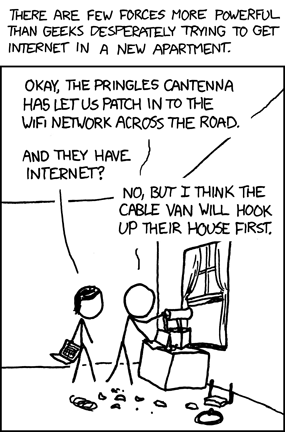
And there's always this...
http://xkcd.com/466/
Rob Lister
Unregistered
- Joined
- Apr 1, 2004
- Messages
- 8,504
In the beginning, ISPs charged dial users by the hour for connection time. But over time, some ISPs were able to arrange their costs and their support and their tech in such a way as to support a flat fee model. Everyone liked this, and it became an important sales issue: those who did not offer a reasonable flat-fee service, lost a lot of customers.
I think this is where we may be going with charge by use. I think it is perfectly reasonable for ISPs to try different models here. Some will fall flat. Some will be grundgingly allowed. And some won't matter to most people.
But if this method of charging does begin to be adopted, then over time, as costs again come down, competitors will start offering flat-fee again. They will win the customers. And the likes of Comcast will have to undo all their work and go back to flat-fee again.
So, to me, it's just a marketplace issue. Have at it.
Used to be that water was too cheap to meter. Same with electricity.
Rest assured, like both of the above, your bandwidth will eventually get metered in some form.
WildCat
NWO Master Conspirator
- Joined
- Mar 23, 2003
- Messages
- 59,856
I don't have a water meter! Flat rate, no matter how much I use. My garden is doing well.Used to be that water was too cheap to meter.
Rob Lister
Unregistered
- Joined
- Apr 1, 2004
- Messages
- 8,504
I don't have a water meter! Flat rate, no matter how much I use. My garden is doing well.
Consider yourself one of the lucky few. I not only pay for the water I use, I have to pay for the rain that falls on my roof. I kid you not.
Denver
Penultimate Amazing
- Joined
- Sep 8, 2007
- Messages
- 10,015
Used to be that water was too cheap to meter. Same with electricity.
Rest assured, like both of the above, your bandwidth will eventually get metered in some form.
This may have a lot to do with the monopoly and regulation situation with water and electricity. As more options come online, and with it more competition, we may very well see options other than straight metering.
Consider yourself one of the lucky few. I not only pay for the water I use, I have to pay for the rain that falls on my roof. I kid you not.
Well if you did anything like stormwater detention tanks or green roofing, you wouldn't have to pay sewer charges, now would you?
You have options to avoid those charges. In the case of detention, it would also lower your overall water bill. If you choose not to exercise those options, it seems slightly insane to complain about getting charged.