
Sea salt vs. table salt

Lisa Simpson

Unregistered
Joined
Mar 2, 2004
Messages
21,960
A couple days ago, I got my tragus pierced.
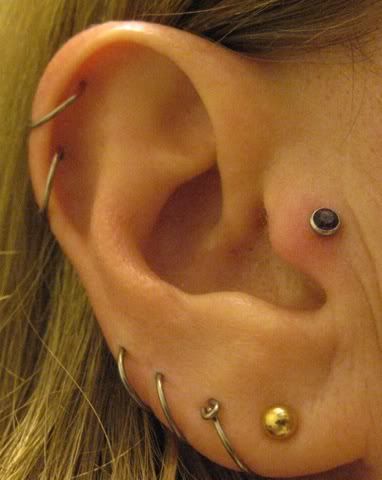
43286463.jpg


The piercing place gave me after care instructions which include rinsing it off several times a day with a salt water solution. But the piercers and the internets in general insist it has to be sea salt to make the solution. That if I use plain old non-iodized table salt I risk infection. The stuff I found on the 'net about sea salt vs. table salt were all about nutrition, not about piercing. So I'm asking the brain trust here. What's the difference between the two (if any) and why wouldn't I be able to use table salt?
 
What's the difference between the two (if any) and why wouldn't I be able to use table salt?

I suspect the "difference" is an urban myth and that the anti-bacterial properties are dependent on the HCL density and not at all on the source.
 
Tragus pierced? Kinky!

My reading several years ago was that even plain salt IS sea salt, from millions of years ago. But that the mined stuff had less magnesium in it.

If it's magnesium you want, use Epsom salt. But did they say use warm water? Then it may be the heat. I'd probably use antibiotic ointment, but all my piercings have been accidental. Wood or metal slivers, NOT in my private parts. But I did get my Tragus (new name for it?) stuck in my zipper once, in new jeans. Left a blue tatoo where nobody ever sees.
 
I suspect the "difference" is an urban myth and that the anti-bacterial properties are dependent on the HCL density and not at all on the source.

What RR said. Salt is salt (Well, NaCl is NaCl is more precise here) If there is any difference, it is in regular salt's favor as it means the sea salt had other things in it (other minerals, the odd bit of organic matter, etc.

To sell sea salt for food purposes it has to come from seawater pretty devoid of organic stuff (whatever the current FDA rules allow) and any organic stuff is more likely to allow bacteria to grow than the opposite.

Same thing for taste (except if you are using iodized salt): no difference except one of perception due to A) crystal form (flat and thin, tiny-large "rocks"), B) cost (must taste better 'cause it costs more) or C) flavor additives (smoke, citrus,legitimate plant oils/crushed parts...).

In reality, pretty much any salt you get for eating/food purposes is sea salt - as it was once part of an ocean. Only question is how long ago.
 
The concentration I've been told to use is 1/8th teaspoon in four ounces of warm water. It tastes about as salty as a potato chip.

So far, so good. It hurts considerably less than the two helix piercings at the top of my ear.
 
Iodine seems to me to be the difference not the source of the salt. Do they even make plain old non-iodized salt?

Iodine is a known disinfectant. Of course I doubt the concentration is enough in iodized slat to reach disinfectant levels but it would require work for me to look it up.

BTW, it looks a tad inflamed in the image.
 
you should be using a pre packaged sterile saline solution with no additives, (every time you prepare a salt solution yourself you risk adding bacteria to it)
or you could try getting a dog to lick it j/k
:p
 
Iodine seems to me to be the difference not the source of the salt. Do they even make plain old non-iodized salt?

Iodine is a known disinfectant. Of course I doubt the concentration is enough in iodized slat to reach disinfectant levels but it would require work for me to look it up.

BTW, it looks a tad inflamed in the image.

That was taken right after it was done, so not inflammation, just the normal swelling from having a needle shoved through it.
 
<snip>

But the piercers and the internets in general insist it has to be sea salt to make the solution. That if I use plain old non-iodized table salt I risk infection.

<snip>


I thought they routinely added iodine to salt as an extra micro-nutrient in regular table salt, and the the stuff over-priced as "sea salt" was what didn't always have it.


Yeah, I know that.

The point I was trying to make is that starting around the early twentieth century, iodine was being added to "table salt" in the U.S. as part of a health initiative to combat iodine deficiencies, and by the Fifties and Sixies "regular" table salt that wasn't iodized was the exception rather than the rule. The reverse was true for the products marketed as "sea salt".
 
I thought they routinely added iodine to salt as an extra micro-nutrient in regular table salt, and the the stuff over-priced as "sea salt" was what didn't always have it.

Kosher salt is not iodized IIRC. And, yes, iodine is for medical purpose: protection of the thyroid gland (which needs iodine from some source - seafood is a primary, but if you don't get seafood......
 
That's not been my experience, but I have always lived in hippy dippy California. Maybe iodized salt messes with your karma, because non-iodized has always been ubiquitous here.
 
Sea salt also has substantial magnesium and calcium salts in it. Not sure why that would matter to what appears to be an osmotic bacteriacide. But I'm not a doctor.
 
Kosher salt is not iodized IIRC. And, yes, iodine is for medical purpose: protection of the thyroid gland (which needs iodine from some source - seafood is a primary, but if you don't get seafood......


Not usually, nor does it usually have any anti-caking agents. The "additive free" hype isn't due to any religious strictures as far as I know, though. The main distinction in kosher salt is the texture of the grains. The salt, in and of itself, isn't what is kosher. Its use in preparing meat is, and the larger, flaky grains work best for that.

"Pickling salt" doesn't have iodine added, either, because it can darken the veggies being pickled. Anti-caking agents can make the pickle juice cloudy. As additives to salt these are not harmful to the pickling process, just potentially unsightly by comparison. Pickling salt grains are usually finer than regular table salt to help it dissolve more readily when making a brine.

Neither is commonly used as a condiment at the table.
 
That's not been my experience, but I have always lived in hippy dippy California. Maybe iodized salt messes with your karma, because non-iodized has always been ubiquitous here.
I believe that historically, people who lived in coastal regions had more iodine in their diets and the iodine deficiencies were concentrated in non-coastal regions. I'm fairly certain of that memory but allow that it could be a false memory and I don't want to bother Googling the matter. :)
 
I believe that historically, people who lived in coastal regions had more iodine in their diets and the iodine deficiencies were concentrated in non-coastal regions. I'm fairly certain of that memory but allow that it could be a false memory and I don't want to bother Googling the matter. :)
Your memory is fine on that.
 

Back
Top Bottom