• Quick note - the problem with Youtube videos not embedding on the forum appears to have been fixed, thanks to ZiprHead. If you do still see problems let me know.

Robots taking people’s jobs—examples

-all middle management is unnecessary if you organize properly and don't let organizations become too big - when you do, all benefits of economies of scale are being eaten up by increased need for supervision, documentation, internal strife. In addition, big organizations distort markets.
-pretty much all financial services are unnecessary and dangerous, creating artificial fluctuations in markets and creating markets where no markets are needed, and distort markets
-all programs based on means-testing are unnecessary, creating waste and preventing those who really are in need it from getting help
-most law-related jobs are complete busywork, artificially created, and the result of an arms race between powerful private interests.
-most products are completely redundant and/or built intentionally to be ineffective or quickly obsolete to create more demand.
- most people don't need to owe most things themselves, they could share them, instead of buying inferior products they use only a fraction of the time
-all adverting is unnecessary and distorts the market

I could go on for much longer - obviously, since we have gained so much productivity, and yet at the same time people work more than ever before, proof that what we are doing is superfluous.


quality of life depends on not having to worry about basic needs and having the time to enjoy each other's company.
OK, but what to do? I'm skeptical of most of these assertions. I think that dividing the economy and jobs market along the lines of someone's subjective idea of what is "necessary" or "unnecessary" is not, ultimately, a useful way to think about it.

Is a Taylor Swift concert tour "necessary" or all of the jobs and economic activity created by it? No. I think you would have a hard time arguing that any sort of leisure activity, art, music or the like is "necessary". Nobody will die if they don't get to see Taylor Swift in concert.

If you think that "most law-related jobs are complete busywork" try living in a society without laws or people to enforce them. Haiti comes to mind.
Massacre Upon Massacre: Haiti’s Bleak Spiral Into a Failed State (New York Times)
A news conference to announce the reopening of a public hospital that had been closed for nine months because of gang violence came under another gang attack, killing two reporters and a police officer.
The hospital shooting followed two massacres in separate parts of the country that killed more than 350 people and have shined a harsh spotlight on the failures and shortcomings of local authorities and an international security force deployed to protect innocent civilians.

One of the massacres unfolded last month in an impoverished, sprawling, gang-controlled Port-au-Prince neighborhood where a lack of any police presence meant that for three days older people were dismembered and thrown to the sea without the authorities finding out. At least 207 people were killed between Dec. 6 and Dec. 11, according to the United Nations.

At about the same time, another three-day killing spree took place 70 miles north in Petite Rivière. Community leaders say 150 people were killed as gang members and vigilante groups attacked one another.

Guatemalan and Salvadoran forces arrive in Haiti to join fight against violent gangs (CNN)

If "all programs based on means-testing are unnecessary" what would you replace them with, and who would pay for it? Universal income? I'm attracted to the idea in theory but I'm an empiricist. I want to see an actual working example of such a society before I buy into it. When all these jobs that you claim are "unnecessary" go away, what actually happens? Do young men with no other employment prospects join street gangs, like in Haiti?

 
baseline communism, organized on the local level. Just as happens organically in any small, close-knit community or family.
This has been the State of Human Existence throughout most of history. It's the basis of most World Religions; it's the actual Family Values.

as even Smith new, people's natural instinct is to take care of each other - it takes a lot of brainwashing to make people accept that in a contest between common decency and profit maximization, the latter is the moral choice.

RE: Bad Men: only only need them in a crisis, so avoiding crises is the best way to avoid needing Bad Men. The moral problem on the Titanic was not who would or would not get into a lifeboat, but who built the ship with too few lifeboats in the first place.
 
Last edited:
In the above video an example is given of a project management application that breaks up a project into subtasks, allocates those tasks to freelancers on the internet, and watches those freelancers so that it can do that task next time.
Indeed, I'm working on a project atm where this is being used. The freelancers are happier with the AI management.
 
The OP is addressing the wrong problem.
Rising productivity over the last century means that about 3/4th of all jobs are already completely unnecessary busywork, or work that is necessary to patch over the problems caused by other jobs that should not exist.
AI taking jobs just gives us another opportunity to look at the concept of Work again, and realize that it is not what we have been told it is.
Absolutely, but few people are willing to even contemplate the necessary social reorganisation that will be needed.

We are living in the period of human history where the rate of change is greatest. Humans don't like change.
 
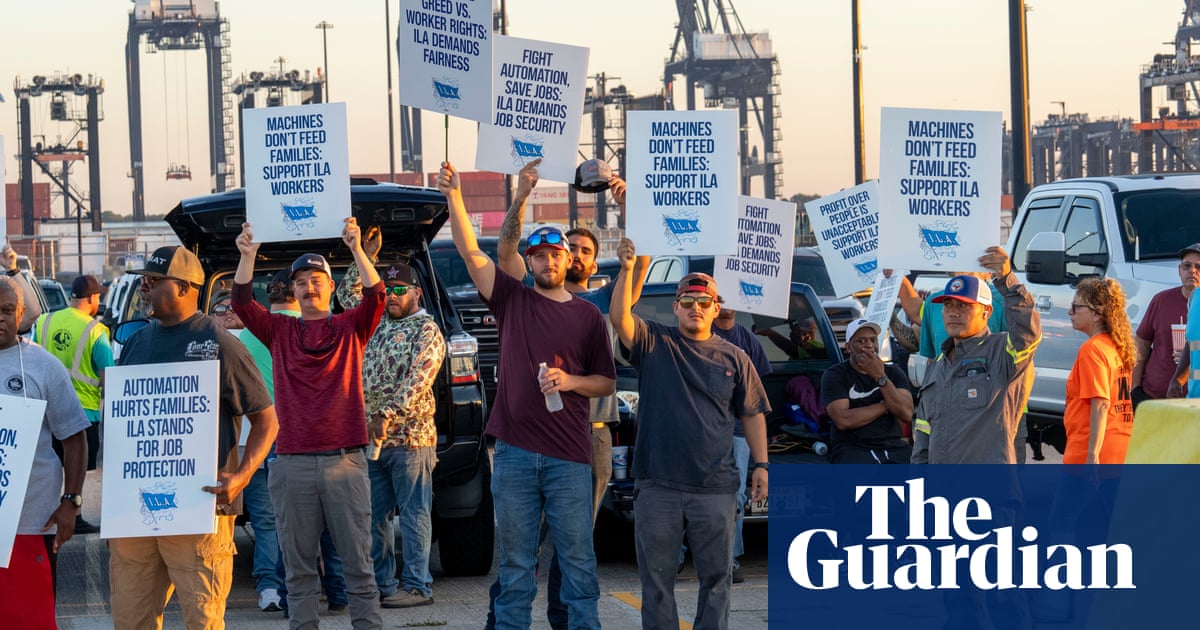
Trying to get back onto the original topic of the thread. There was a recent labor dispute involving longshoremen in US where opposition to automation was a key demand of longshoremen.


The picket signs for example express opposition to "automation" and "machines".

So at least one union is very much opposed to "robots taking people's jobs."
 
A friend of mine does a lot of technical writing. Her employer's adoption of AI has made her job a lot easier. It greatly speeds up her first draft process, reducing cognitive load and letting her expertise get to a final document much faster.
 
A friend of mine does a lot of technical writing. Her employer's adoption of AI has made her job a lot easier. It greatly speeds up her first draft process, reducing cognitive load and letting her expertise get to a final document much faster.

I'd assumed that a lot of 'technical' writing has been produced by robots for a long time.

The result in 'documentation' like this:

The flurbleblooble screen contains seven buttons.
The buttons may be pressed.
The button labels are: trheach, treaglor, tratch, fringlefrap, csartts, iletrope and scradle.

Trheach may contain a value from -1,000 to +65.
Treaglor may be deprecated in a future release.
Tratch must have a value that is consistent with the iletrope value.
Fringlefrap may or may not contain text.
...

None of the terms appear in any industry publication, none of the terms return anything on any search, except for thousands of people asking what the ◊◊◊◊ the terms mean, using every forum they can find around the world.

I'm being kind. Most applications have a secondary edit that removes any hint of what fields do, or valid values from any documentation.
Even though the documentation says that Fringlefrap may contain text, the application will not run unless it contains a specific series of numbers and those numbers have to be entered via an arcane process that stops them from being stored as a string, and that process is achieved through a direct update to the database, the correct value cannot be entered via the administration functions, and every user is able to type crap into that field. When this happens the application will not run, shutting down your entire organisation, but the error message is something about public holidays, and the application has no HR or scheduling functions.

The documentation is thousands of pages of text, that only reveal what the administrator can see on the screen for themselves, without the slightest hint about what any function does, or why values need to be set.

This, my friends, is why the new age of you can sack all the programmers because of magic AI, is going to suck really, really, badly.

By the way, salespeople have been saying "You can sack all the programmers if you buy this product" since the 1950's.

Brain-dead managers have believed it, every ◊◊◊◊◊◊◊ time someone buys them a lunch.
 

Back
Top Bottom