• Quick note - the problem with Youtube videos not embedding on the forum appears to have been fixed, thanks to ZiprHead. If you do still see problems let me know.

Merged Relativity+ / Farsight

Farsight

Banned
Joined
Mar 26, 2008
Messages
2,640
I'm John Duffield, and a few weeks back I was talking to a guy who's a member of the ISST. I was looking something up and bumped into a discussion here about causality, FTL, and time travel, so I explained why time travel is science fiction. I then got sucked into backup details that rather hijacked the thread and took us into particle physics and the standard model. apologies. Now I've been challenged to present the geometry of the electromagnetic field. I expect this to lead on to the photon and the quantum of quantum mechanics, an explanation of how pair production works, and maybe the standard model with gravity.

standard-model.png


I don't know if you all know, but Einstein won his Nobel prize primarily for his 1905 photoelectric paper "On a Heuristic Viewpoint Concerning the Production and Transformation of Light". This established the quantum nature of light. Another paper in this his "mirabalis" year was "On the Electrodynamics of Moving Bodies". This is electrodynamics and refers to Maxwell, but is considered to be Einstein's special relativity paper. Another important paper was "Does the Inertia of a Body Depend Upon Its Energy Content?" concerning mass and energy. This is where E=mc2 comes from. See http://en.wikipedia.org/wiki/Annus_Mirabilis_papers for more, but note it's all rather a mixed bag, and Einstein covered rather more than some appreciate. He’s mainly remember for gravity and The Foundation of the General Theory of Relativity (3.6Mbytes). IMHO people tend to forget that he was in on the ground floor of quantum mechanics in 1905, and still centre stage at the 1927 Solvay Conference:

550px-Solvay_conference_1927.jpg


This meeting discussed the Copenhagen Interpretation of quantum mechanics, and Einstein essentially lost the argument. After this he was still lauded by the media and public, but became somewhat detached from the scientific mainstream. Quantum mechanics morphed into quantum field theory, quantum electrodynamics, and so on, but Einstein didn’t play much of a part. Instead he became something of a trophy for Princeton, working largely alone trying to unify electromagnetism and gravity to come up with a unified field theory. He died trying.

The point of all this is that electromagnetism was very important to Einstein. He had pictures of Maxwell and Faraday on the wall of his study, along with Newton. When you read the original material you get a better idea of where Einstein was coming from. For example in Relativity: the Special and General Theory he said:

Einstein said:
..according to the general theory of relativity, the law of the constancy of the velocity of light in vacuo, which constitutes one of the two fundamental assumptions in the special theory of relativity and to which we have already frequently referred, cannot claim any unlimited validity. A curvature of rays of light can only take place when the velocity of propagation of light varies with position."

Most people don't appreciate the significance of this, and don’t go back to the original German which reads die Ausbreitungsgeschwindigkeit des Lichtes mit dem Orte variiert. Put it through google translate to find out what he really said. It isn't what the textbooks say he said, and if you understand impedance you know how important this is. It's the same for Maxwell. Read his original work and it's very different to the textbook version. "Maxwell's Equations" aren't Maxwell's equations, because Heaviside rewrote them in vector form. When you read Newton’s Opticks there’s more. That's when you start feeling skeptical about what you've been taught, and start doing your own research. You find out about Einstein and Cartan and torsion, about Einstein and Gödel and time, about Maxwell and Kelvin and vortices, and about physicists and papers you’ve never heard of before.

It takes you places, and along the way, it tells you about the electromagnetic field. See what you make of this:
 
Most people have heard of Minkowski’s Space and Time paper from 1908. They’re aware that it constituted an important development for special relativity. However very few people notice a little paragraph two pages from the back:

Minkowski said:
"Then in the description of the field produced by the electron we see that the separation of the field into electric and magnetic force is a relative one with regard to the underlying time axis; the most perspicuous way of describing the two forces together is on a certain analogy with the wrench in mechanics, though the analogy is not complete".

You scratch your chin and wonder about this, then you read some more Maxwell. In particular you read On Physical Lines of Force. It’s on wikipedia, see page 53:

Maxwell said:
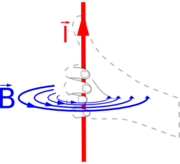
A motion of translation along an axis cannot produce a rotation about that axis unless it meets with some special mechanism, like that of a screw

Now look at the right-hand rule on English wikipedia. For a current in a wire, your thumb points in the direction of the current flow, and your fingers “are curled to match the curvature and direction of the motion or the magnetic field”.

180px-Right_hand_rule.png


But note it’s one field, it’s the electromagnetic field, not separate electric fields and magnetic fields. Jefimenko's equations are a useful reminder in this respect. The electromagnetic field is a dual entity, there’s only one field there. Moving through an electric field doesn’t cause a magnetic field to be generated, because as Minkowski said, it’s the electromagnetic field, and it exerts force in two ways. What does it look like? It doesn’t actually look like anything, but iron filings on a piece of paper tells you that you can visualize a field. Note though that iron filings only show you a slice through a “magnetic” field, and you need to see the real-deal electromagnetic field in three dimensions. Ever done any metalwork? I have. I’ve got a variety of reamers in my toolbox, bought as a job lot from a stall in Saffron Walden years back. This kind of thing:

reamer-001.jpg


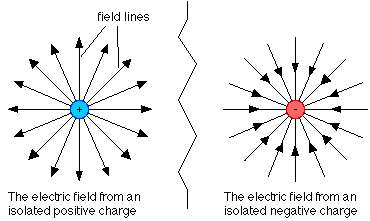
I pick one up and look at it from the top and it reminds me of an electric vector field, like this one from Andrew Duffy’s PY106 physics course material at http://physics.bu.edu/~duffy/ :

2e.GIF


If you’ve got a reamer, grab it in your right fist, put your left thumb on the bottom of it, and push upwards. It turns. You’re emulating the right-hand rule for the current in the wire. The reamer is giving you a picture of the electromagnetic field around a vertical column of electrons. Pushing upwards is emulating the current flow, and the rotation you can feel is the magnetic curl or rot, which is short for rotor.

Minkowski referred to a wrench and Maxwell referred to a screw because the electromagnetic field really is like this. It’s essentially a “twist” field. Motion through it results in “turn”. Or vice-versa. Turn a screw with a screwdriver and you get forward motion, so you can induce a current up the wire. Start with the forward motion like with a pump-action screwdriver and you get rotation. This is why we have dynamos and generators, because this is how the electromagnetic field is.

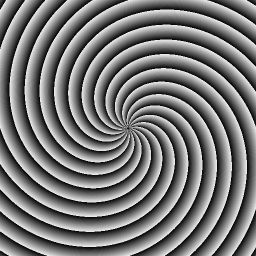
What does it look like for a single electron? That reamer depicts the electromagnetic field for a column of electrons at an imaginary cylindrical surface some distance round the wire. You have to use a fatter reamer to visualize the electromagnetic field for a larger cylindrical surface. Then to match the way the field diminishes with distance, the degree of twist has to reduce. So imagine a continuous series of fatter and fatter reamers, all occupying the same space, and take a horizontal slice through it. You’re also taking a horizontal slice through an electron’s electromagnetic field, and it looks like this:

pinwheel.jpg


That’s what the electron’s electromagnetic field would look like if you sliced through it from any direction. It’s isotropic. Let your eyes linger on it. Does it remind you of a whirlpool? A vortex? Ever heard of a vorton? Now maybe you understand what Maxwell was groping for with his vortexes. He thought an electromagnetic field was a sea of vortices, and particles moved through it. But he got it back to front.

Let's see how we get on with this before I start talking about photons.
 
That’s what the electron’s electromagnetic field would look like if you sliced through it from any direction. I

No it's not. The electromagnetic field of an electron looks like a diverging electric field and a dipole magnetic field.
 
The problem with this thread, as one who has seen this general theory before could predict, is that it is almost entirely divorced from science. How does this "present the geometry of the electromagnetic field"? How does this relate to a single experiment that one could actually do with electromagnetism?
Most people have heard of Minkowski’s Space and Time paper from 1908. They’re aware that it constituted an important development for special relativity. However very few people notice a little paragraph two pages from the back:
The reason that people are unfamiliar with the passage is that few people outside of those who actually study the history of the science actually read the paper. There are far better means of studying relativity theory, means that actually teach how to relate the theory to experiments, than to read the original papers.

And why would we think that Minkowski is referring to some theory of twisting, when he is probably referring to considering a wrench to be a resultant wrench, the sum of a number of wrenches. Two systems of forces are equipollent if they have the same resultant wrench and thus they produce the same effect on rigid body motion.

Note that the above explanation actually invokes the use of wrench in classical mechanics whereas the Farsight explanation does not.
Moving through an electric field doesn’t cause a magnetic field to be generated, because as Minkowski said, it’s the electromagnetic field, and it exerts force in two ways.
What Minkowski says, if one bothers to follow the mathematics he uses, is that the electric and magnetic components of the field are determined by the system of coordinates that one uses.

In addition, if one bothers to read further into Minkowski's text rather than pick out one passage out of context that looks like it might possibly support a particular point, then one sees that Minkowski makes this point in the written word later when he points out that in 4-D spacetime, the laws of electromagnetism show their "full simplicity" and that they only become complicated when "a three dimensional space is forced upon us."

Now before Farsight begins his usual spiel about how physics isn't mathematics, I think it is instructive to turn to the end of the Minkowski paper he has cited:
Hermann Minkoswki said:
In the development of its mathematical consequences there will be ample suggestions for experimental verifications of the postulate [underlying Special Relativity], which will suffice to conciliate even those to whom the abandonment of old-established views is unsympathetic or painful, but the idea of a pre-established harmony between pure mathematics and physics.
If Farsight could demonstrate how his theory could produce predictions that would match experiments, then his theory would be believable. So far he has been unwilling or unable to present such predictions.
 
Last edited:
I don't think you're right, Farsight, pretty much as ben m says. It's hard to tell though as I don't really know what you think that last spiral is supposed to be. If I dropped another electron next to the first, how would the two move? How does that fit with the spiral pattern you've put up there? And how does it fit with the non-spiral electric field directly above it? What would I have to do to measure that spiral?
 
For the posters here with access to Misner, Thorne and Wheeler: in Figure 4.5 (page 109) there is a rather beautiful illustration of the dual of the e/m field tensor due to a point charge at rest (well, a constant-time slice through it). I tried looking for a similar diagram for the electron's field - i.e. point charge plus magnetic dipole - but have not had much luck. Has anyone here come across such a thing? Since we're being asked to visualise the electron's field I thought something like this might be helpful, but if not then on worries.
 
I'm John Duffield, and a few weeks back I was talking to a guy who's a member of the ISST. The point of all this is that electromagnetism was very important to Einstein. He had pictures of Maxwell and Faraday on the wall of his study, along with Newton. When you read the original material you get a better idea of where Einstein was coming from. For example in Relativity: the Special and General Theory he said:
Originally Posted by Einstein
..according to the general theory of relativity, the law of the constancy of the velocity of light in vacuo, which constitutes one of the two fundamental assumptions in the special theory of relativity and to which we have already frequently referred, cannot claim any unlimited validity. A curvature of rays of light can only take place when the velocity of propagation of light varies with position
Most people don't appreciate the significance of this, and don’t go back to the original German which reads die Ausbreitungsgeschwindigkeit des Lichtes mit dem Orte variiert. Put it through google translate to find out what he really said.
A couple of general points, Farsight.
Citing a quote from Einstein (or any other authority) as the basis for a scientific theory is the logical fallacy of argument from authority.

Secondly the full paragraph from the book (intended for a general audience) is:
Originally Posted by Einstein
In the second place our result shows that, according to the general theory of relativity, the law of the constancy of the velocity of light in vacuo, which constitutes one of the two fundamental assumptions in the special theory of relativity and to which we have already frequently referred, cannot claim any unlimited validity. A curvature of rays of light can only take place when the velocity of propagation of light varies with position. Now we might think that as a consequence of this, the special theory of relativity and with it the whole theory of relativity would be laid in the dust. But in reality this is not the case. We can only conclude that the special theory of relativity cannot claim an unlinlited domain of validity ; its results hold only so long as we are able to disregard the
influences of gravitational fields on the phenomena (e.g. of light).
There is nothing in this paragraph that needs a replacement for SR and GR.

I notice that Einstein is comparing SR and GR. I suspect that he is talking about the velocity of propagation of light varying with position in SR when compared to GR. This is confirmed by the start of the section where he states "Let us suppose, for instance, that we know the space-time " course " for any natural process whatsoever, as regards the manner in which it takes place in the Galileian domain relative to a Galileian body of reference K.".
 
If you had the effects of gravity factored in with quantum mechanics and the standard model you'd have a theory of everything
 
What does it look like for a single electron? That reamer depicts the electromagnetic field for a column of electrons at an imaginary cylindrical surface some distance round the wire. You have to use a fatter reamer to visualize the electromagnetic field for a larger cylindrical surface. Then to match the way the field diminishes with distance, the degree of twist has to reduce. So imagine a continuous series of fatter and fatter reamers, all occupying the same space, and take a horizontal slice through it. You’re also taking a horizontal slice through an electron’s electromagnetic field, and it looks like this:

[qimg]http://www.jbum.com/pixmagic/pinwheel.jpg[/qimg]

That’s what the electron’s electromagnetic field would look like if you sliced through it from any direction. It’s isotropic.


That doesn't seem geometrically possible. What if I looked at the electron from exactly the opposite side, but made the same slice (that is, the slice is in the same plane)? Wouldn't the spirals then be going the other way?

Then, suppose I move continuously around from one side to the other, examining perpendicular slices as I go. Wouldn't the image have to transform continuously from the clockwise pattern on one side to the counterclockwise pattern on the other?

Respectfully,
Myriad
 
There is nothing in this paragraph that needs a replacement for SR and GR.
See, you've just fallen into his trap. He will now claim that he doesn't actually have a theory and that he's simply explaining SR & GR how Einstein understood them.
 
Last edited:
The hypnotic spiral pattern hurts my eyes. Seriously.
What does it represent? The electric field of an electron doesn't look anything like that - the lines of E should be straight and radial. Nor does the diagram look like the lines of B in a magnetic dipole field. I'm more than a little puzzled.
 
See, you've just fallen into his trap. He's will now claim that he doesn't actually have a theory and that he's simply explaining SR & GR how Einstein understood them.
So Farsight is a medium channeling the ghost of Einstein :rolleyes:!

Seriously I hope (probably in vain) that he realizes that science is not the opinions or beliefs of a few authorities. How Einstein understood SR and GR does not matter. What interpretations Farsight makes of the opinions of Einstein do not matter.

The match of SR and GR to the real universe is what makes them science. Mathematics is the language that allows these matches to be made. So far all we have seen from Farsight is pretty pictures and vague descriptions.
 
I don't think you're right, Farsight, pretty much as ben m says. It's hard to tell though as I don't really know what you think that last spiral is supposed to be. If I dropped another electron next to the first, how would the two move?
The two electrons would move apart. Remember they're dynamical entities, like two vortexes. In fact you can emulate this with Falaco solitons in a pond.

FalacoSystem.gif


Dip a plate halfway into the water and stroke gently forward while lifting it clear, and you make a “U-tube” double whirlpool. Create another one angled towards the first, and repeat with various aims. When the left-hand-side of one double whirlpool is near the left-hand-side of the other, the two similar whirlpools keep clear of one another. When the left-hand-side of one double whirlpool is near the right-hand-side of the other, the two opposite whirlpools move together. That's essentially attraction and repulsion. If you aim two double whirlpools straight at one another, face on, they meet and merge and disappear. (This is best in a shallow pond with muddy bottom, when you see a surprisingly energetic kick-up). That's essentially annihilation. It's just a fluid analogy and it's by no means perfect, but it gets across the dynamical entity concept - there's this round thing there in the water that's made out of movement.

How does that fit with the spiral pattern you've put up there? And how does it fit with the non-spiral electric field directly above it? What would I have to do to measure that spiral?
The spiral pattern is what you'd get if you tried to use a floor-polisher on a rubber sheet. The non-spiral electric field depiction shows vectors, and they tell you how your dropped-in electron moves. I'm not sure about measuring the spiral. What you measure is motion, and that depends on the initial relative motion of your electrons. If you start with a vertical stack of electrons moving upwards, your test electron doesn't move away, and instead spirals around the "magnetic field lines".

elgyro.jpg
 
A couple of general points, Farsight.
Citing a quote from Einstein (or any other authority) as the basis for a scientific theory is the logical fallacy of argument from authority.
The points I'm making are based on observable scientific evidence, which some dismiss on the authority of their textbook. The references to Einstein etc are to show that I'm not making this up. No, there's nothing in that paragraph that demands a replacement for GR. Note though that GR "subsumed" SR.

Seriously I hope (probably in vain) that he realizes that science is not the opinions or beliefs of a few authorities. How Einstein understood SR and GR does not matter. What interpretations Farsight makes of the opinions of Einstein do not matter. The match of SR and GR to the real universe is what makes them science. Mathematics is the language that allows these matches to be made. So far all we have seen from Farsight is pretty pictures and vague descriptions.
Opinions and beliefs don't matter. Scientific evidence matters, and mathematics.
 
Opinions and beliefs don't matter. Scientific evidence matters, and mathematics.
So show a little evidence! People in this thread do not believe anything about your spiral pictures because when people measure electromagnetic fields, they get something far, far different from your spiral pictures. Show us how we can measure these fields in a way that produces something like what you have shown.

So far, all you have offered is arguments from authority and claims that you have evidence without ever demonstrating these claims.
 
The two electrons would move apart. Remember they're dynamical entities, like two vortexes. In fact you can emulate this with Falaco solitons in a pond.

Sorry, Farsight, but after 100 years of relativistic, quantum, and high-energy experiments there is no evidence whatsoever that electrons are "dynamical entities" of this sort, and plenty of evidence that they're not. To start with, dynamical waves like these do not obey Lorentz invariance, while all observed particles do.

The spiral pattern is what you'd get if you tried to use a floor-polisher on a rubber sheet.

But you said it represented the field of an electron. Why did you say that?

If you start with a vertical stack of electrons moving upwards, your test electron doesn't move away, and instead spirals around the "magnetic field lines".

Don't get confused by this---remember that that "magnetic field line" is a shorthand for the presence of large numbers of moving charges somewhere nearby. The spiral is the normal, expected behavior of a normal electron (or any particle which generates those outward-pointing electric fields) feeling the force due to those nearby moving charges.
 
INRM said:
If you had the effects of gravity factored in with quantum mechanics and the standard model you'd have a theory of everything
That's what they call it. I don't like the phrase myself, I prefer unified model, but even so all I've really got is a few pointers that I've picked up from various sources to sketch a possible route forward.

Myriad said:
That doesn't seem geometrically possible. What if I looked at the electron from exactly the opposite side, but made the same slice (that is, the slice is in the same plane)? Wouldn't the spirals then be going the other way?
Yes, but it isn't an ideal depiction. It's "flat", and the electromagnetic field isn't.

Myriad said:
Then, suppose I move continuously around from one side to the other, examining perpendicular slices as I go. Wouldn't the image have to transform continuously from the clockwise pattern on one side to the counterclockwise pattern on the other?
This gets tricky, because there's two rotations here. If you look at a clock you'd normally say the hands are moving clockwise. However if it was transparent and you looked at it from the back you'd say the hands were moving anticlockwise. But if I spin the clock like a coin, you can't say the hands are going clockwise or anticlockwise. Re the spiral picture, for a better concept, assume you've got a ball of wax along with many pieces of wire. Bend each piece of wire into a Fibonacci spiral, then lie it flat on your desk and bend it up into a Fibonnaci spiral in an orthogonal direction. So it's chiral and "curly". Now stick the wires into the ball working your way around each meridian.

ctamblyn said:
The hypnotic spiral pattern hurts my eyes. Seriously.
What does it represent? The electric field of an electron doesn't look anything like that - the lines of E should be straight and radial. Nor does the diagram look like the lines of B in a magnetic dipole field. I'm more than a little puzzled.
The electromagnetic field of an electron. I showed the radial electric vectors in my second post. Can we come back to the electron magnetic dipole moment later? For now consider that it's of no concern, and consider this gedankenexperiment: you are very small, with a vertical stack of electrons motionless in front of you. You have an electron-tipped wand with which you can feel the electromagnetic field. Take it slowly and you can feel out a cylinder of repulsion. Now swipe the wand down past the stack of electrons, and the end of your wand moves in circles. You're still feeling the electromagnetic field. There aren't two fields there, only one, and it exerts force in two different ways.
 
Now swipe the wand down past the stack of electrons, and the end of your wand moves in circles.

No it doesn't. The magnetic *field* is pointing in circles, but that makes you feel a repulsive force---the force due to a magnetic field does not point along the magnetic field, but orthogonal to it. (In vector terms F = qv x B; that's a cross product.)
 
If you start with a vertical stack of electrons moving upwards, your test electron doesn't move away, and instead spirals around the "magnetic field lines".

[qimg]http://www.mdahlem.net/img/astro/elgyro.jpg[/qimg]
Further to ben m's post, the vertical B-field you show in this picture does indeed lead to the depicted electron moving in a spiral, but this B-field is not what you get from a vertical stack of electrons moving upwards, which would instead give B-field lines going in circles around the current, and the force on the electron would point away from the line. It's fairly simple to understand if you transform to the rest frame of the line charge, in which the e/m field is purely electric and points away from the line.
 

Back
Top Bottom