The_Animus
Illuminator

- Joined
- Nov 24, 2006
- Messages
- 3,583
Please note from the start of this that my knowledge on this subject is limited, hence the asking for clarification.
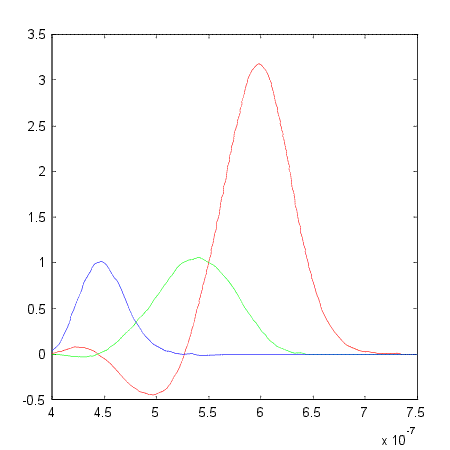
To my understanding this is how light works. Light is emitted from a source, (sun, lightbulb, etc.), and either travels to your eye, or reflects off an object and into your eye. From there it reacts with the rods and cones in your eyes which take the wavelength and the number of photons hitting your eye in a unit time and turns it into what you see as color and brightness.
Also the wavelength is a result of the energy of the light in electron volts eV.
So essencially the color and brightness we precieve from a lightsource or reflected from an object is determined by the amount of energy the light has and the photon density?
White light is a combination of all wavelengths of visible light. So when it is reflected off an object we percieve as blue it means that the object absorbed all of the wavelengths except the blue one, or possibly changed the eV of the light so it's now a blue wavelength?.
So does this mean that all objects are actually colorless? I know there is light and pigment, but even pigments need light to be seen. What causes objects to absorb only certain wavelengths/energy levels or to affect intensity?
And I know that light exists both as a wave and a particle, just not at the same time. I would assume with a wavelength the light would be in wave form, but for brightness it's the number of photons in a given time, which I would assume means particle state. So I know I'm not understanding something correctly here.
It's just interesting that a large amount of light can come from a source, such as the sun, and that all this light starts off basically the same, but ultimately changes as it interacts with any object which results in us seeing green plants, and brown dirt, and blue sky and so forth. It's almost like as light interacts with an object that object imprints information on it and then that information is there to be found, whether by our eyes or some device like a camera.
Any clarification or corrections on what I've said would be most excellent. I've been thinking about this after observations of the moon during a walk at night but haven't taken the time to learn more about it until now.
To my understanding this is how light works. Light is emitted from a source, (sun, lightbulb, etc.), and either travels to your eye, or reflects off an object and into your eye. From there it reacts with the rods and cones in your eyes which take the wavelength and the number of photons hitting your eye in a unit time and turns it into what you see as color and brightness.
Also the wavelength is a result of the energy of the light in electron volts eV.
So essencially the color and brightness we precieve from a lightsource or reflected from an object is determined by the amount of energy the light has and the photon density?
White light is a combination of all wavelengths of visible light. So when it is reflected off an object we percieve as blue it means that the object absorbed all of the wavelengths except the blue one, or possibly changed the eV of the light so it's now a blue wavelength?.
So does this mean that all objects are actually colorless? I know there is light and pigment, but even pigments need light to be seen. What causes objects to absorb only certain wavelengths/energy levels or to affect intensity?
And I know that light exists both as a wave and a particle, just not at the same time. I would assume with a wavelength the light would be in wave form, but for brightness it's the number of photons in a given time, which I would assume means particle state. So I know I'm not understanding something correctly here.
It's just interesting that a large amount of light can come from a source, such as the sun, and that all this light starts off basically the same, but ultimately changes as it interacts with any object which results in us seeing green plants, and brown dirt, and blue sky and so forth. It's almost like as light interacts with an object that object imprints information on it and then that information is there to be found, whether by our eyes or some device like a camera.
Any clarification or corrections on what I've said would be most excellent. I've been thinking about this after observations of the moon during a walk at night but haven't taken the time to learn more about it until now.
Last edited:


 ? Like colour, that's to do with our perceptions, it's not intrinsic to the physical phaenomenon.