
• Quick note - the problem with Youtube videos not embedding on the forum appears to have been fixed, thanks to ZiprHead. If you do still see problems let me know.

POM -- Transhumanism?

Joined
Apr 8, 2004
Messages
869
Any takers on a "philosophy" of the month? I stumbled across this website during an exchange with Tricky last week. Here's a summary of the "philosophy," if it is fair to use the word:

http://www.transhumanism.org/index.php/WTA/more/transhumanist-values/

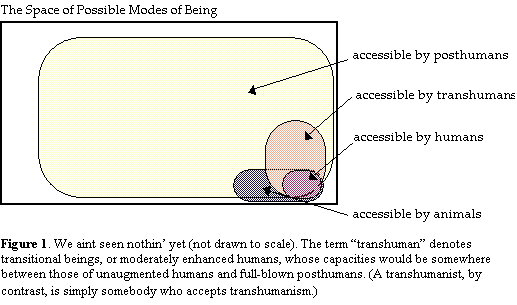
It seems worthy of debate whether or not their view of the "Space of Possible Modes of Being" is philosophically sound. (See Figure 1 in the link). Philosophically, this speaks to the concept of "limits," touched on by Wittgenstein and others. But does it stand logically?

Second, it seems to be an interesting place where science, postmodernism, and theology could work together should they choose:

(from the site)

Transhumanism does not entail technological optimism. While future technological capabilities carry immense potential for beneficial deployments, they also could be misused to cause enormous harm, ranging all the way to the extreme possibility of intelligent life becoming extinct. Other potential negative outcomes include widening social inequalities or a gradual erosion of the hard-to-quantify assets that we care deeply about but tend to neglect in our daily struggle for material gain, such as meaningful human relationships and ecological diversity. Such risks must be taken very seriously, as thoughtful transhumanists fully acknowledge.

Also, in the world of ethics, to what extent should the "future" play into our current value structure? I mean this to say more than just environmentalism or world hunger. I mean specifically the values with which we apply knowledge, or specifically scientific understanding. Here's a clip:

According to Lewis’s theory, something is a value for you if and only if you would want to want it if you were perfectly acquainted with it and you were thinking and deliberating as clearly as possible about it. On this view, there may be values that we do not currently want, and that we do not even currently want to want, because we may not be perfectly acquainted with them or because we are not ideal deliberators.

The idea that we currently do not "want to want" particular values is of interest to me, considering how such unwanted values may impact the future of technological discovery. Asking questions about what we do not "want to want" also seems valuable in determining whether or not what we don't "want to want" is of any value down the road. I have thoughts, but I'm more curious about yours.

Flick
 
Any takers on a "philosophy" of the month? I stumbled across this website during an exchange with Tricky last week. Here's a summary of the "philosophy," if it is fair to use the word:
http://www.transhumanism.org/index.php/WTA/more/the-ubermensch-the-superman-and-the-posthuman/

I don't know post-human and Ubermensch do seem to be roughly equivilent to me.

The only difference I can see is that they choose to express Nietzche's will to power exclusively through technological methods.

Is there more to this than medicore philosophers daydreaming about the scientific future?
 
http://www.transhumanism.org/index.php/WTA/more/the-ubermensch-the-superman-and-the-posthuman/

I don't know post-human and Ubermensch do seem to be roughly equivilent to me.

The only difference I can see is that they choose to express Nietzche's will to power exclusively through technological methods.

Is there more to this than medicore philosophers daydreaming about the scientific future?

Nietzsche (using the words of the link you provided) described the over-man as "manifested destructively in the rejection of, and rebellion against, old ideals and moral codes;"

Transhumanism seems to think there is something to be gained from these old ideals and codes.

As far as daydreaming about the future, one could reduce it to such, but the transhumanist is likely to see it as "planning for the future." To believe that today's ideologies will not have direct impact on future discoveries, or tomorrow's ideologies is not sound thinking. To what extent are these things being considered outside of transhumanism?

Flick
 
image001.gif

The transhuman stage, out-growing from human ideals is only the first stage in "Transhumanism" which actually aims for posthumans.

In the same way Nietzsche was not interested in destroying everything now and immediately becoming the over-man, but in self overcoming and the act of transending limits as they arose.

By his[her] nature the over-man[woman/whatever] is destructive to all human thought, as he encompasses so much more and only sees current conventional thought as a restriction of his thoughts.

N. even talks of the intermediate "transhuman" stage in Thus Spake Zarthustra when he urges people to improve themselves now, for the sake of the over-man who will arises from them.

The man criticising the comparision hasn't read N. and had to look him up on Wikipedea.

Regarding your second point, it is comon for people working in potentally influental fields to speculate about the implications of their work. It's also commonly covered by a lot of science fiction authors.

I don't see any good high quality speculation with the transhuman label attached to it, or any indication that their speculation is coming from an in depth knowledge of future technologies, but then this is the first I've heard of them.
 
image001.gif

The transhuman stage, out-growing from human ideals is only the first stage in "Transhumanism" which actually aims for posthumans.

In the same way Nietzsche was not interested in destroying everything now and immediately becoming the over-man, but in self overcoming and the act of transending limits as they arose.

By his[her] nature the over-man[woman/whatever] is destructive to all human thought, as he encompasses so much more and only sees current conventional thought as a restriction of his thoughts.

N. even talks of the intermediate "transhuman" stage in Thus Spake Zarthustra when he urges people to improve themselves now, for the sake of the over-man who will arises from them.

The man criticising the comparision hasn't read N. and had to look him up on Wikipedea.

Regarding your second point, it is comon for people working in potentally influental fields to speculate about the implications of their work. It's also commonly covered by a lot of science fiction authors.

I don't see any good high quality speculation with the transhuman label attached to it, or any indication that their speculation is coming from an in depth knowledge of future technologies, but then this is the first I've heard of them.

Well I do know Nietzsche and know very well what he wanted to overcome-- anything that made men weaker. He made that pretty clear. Religion being one of these things, and truth be told, democracy itself. We could discuss N. in another thread if you like, but I'll be heading out for the weekend in a moment, so it will be a stretch before I get back to you.

As to the diagram thanks for posting it, I'm curious as to the philosophical ramifications of the possibility.

Finally, while I agree with you that much of the people working in their subsequent fields do consider the implications of their work. However, that's somewhat of an oxymoron. It's their work. They devoted themselves to it for whatever reason and any real thoughts they have about it are going to be influenced accordingly. This is what I think the authors mean by values we do not "want to want."

I suppose since WWII, it looks on the surface that the best minds of three generations of Americans have been pimped by the military (in the worst case scenario), and by government itself (in the best case). In the case where neither has happened, it tends to be captialism that drives progress. There is a limited amount of wiggle room for the future under a handful of ideologies, and since technology (and often science) pretty much grows on top of what has been established, the day dreaming today really is more important than we might think.

So when it come to transhumanism, I'd not heard of it either until a week ago. My questions would be...

"What is valuable to their approach?"
"What is a waste of time, and why?"
"Are there core philosophical problems?"
"If we nix transhumanism, or let them "float on," what do we turn to for ideological balance in the dawn of new discoveries?"
"If not the name "transhumanism," what groups are doing this and what are they called?"
"Is there any decent reason that science, technology, or religion should reject their core values?"

That sort of thing...

Flick


Peace out... cyas Sunday night.
 

Back
Top Bottom