• Quick note - the problem with Youtube videos not embedding on the forum appears to have been fixed, thanks to ZiprHead. If you do still see problems let me know.

Moral Imperatives and Time Travel

Loss Leader

I would save the receptionist., Moderator
Joined
Jul 10, 2006
Messages
28,550
Location
Florida
Here's the hypothetical: You are a healthy American male in your twenties. You have traveled back in time to 1943 in an undetectable way - you fit right in, all your papers are in order, etc. You cannot return to the present or do any further time jumping in any direction. Whatever effect you're going to have on the timeline, you're already having it. The US has just entered World War II.

The question is: Do you fight?

On the one hand, it is a just war and you'd be fighting against some of the worst tyranny our planet has ever seen. On the other hand, you know that the allies win in a reasonable amount of time and your presence on any battlefield isn't going to change the outcome of the war.

Are you a citizen of 1943, morally bound to defend your country? Or does your knowledge of the future exempt you from making that moral choice?


ETA: Forget using your future knowledge to give the allies key information or invention. Nobody is going to believe you and you'll be hanged as a spy. You can be a regular soldier or a regular civilian and that's it.
 
Can I be a regular civilian in an essential job like Fireman or something so people don't think I'm shirking?
 
Can I be a regular civilian in an essential job like Fireman or something so people don't think I'm shirking?


Can you just walk with a limp?

More seriously: Would the perceptions of those around you color your choice?
 
Sure. In fact, I'd volunteer for the toughest assignment with the most danger they had to offer. I already know I didn't die in WWII.
 
Sure. In fact, I'd volunteer for the toughest assignment with the most danger they had to offer. I already know I didn't die in WWII.

Hmmm...do you know you didn't get captured and tortured and suffer horribly in WWII?

(I think a certain amount of suspension of disbelief is required to even dip your toes in this whole hypothetical scenario?)
 
kill_hitler.png


Revised directive: It is forbidden for you to interfere with human history until you have at least taken a class in it
 
Sure. In fact, I'd volunteer for the toughest assignment with the most danger they had to offer. I already know I didn't die in WWII.

How? All you know is that yourself before you used time travel didn't die, unless you had outside confirmation that you didn't die, which could potentially be enough to change the outcome during the next iteration.

I probably wouldn't, myself, but then, chances are very good that all I'd do is get myself killed without accomplishing anything.
 
I'd fight. I'd actually be really excited to be part of something that I know for a fact is the right thing to do.
 
How? All you know is that yourself before you used time travel didn't die, unless you had outside confirmation that you didn't die, which could potentially be enough to change the outcome during the next iteration.

But if I can't rely on the past being the same this time around, how can I rely on WWII coming out the same? It's all or none, isn't it?

Come to think of it, if I do fight and I didn't the first time, all bets about the future are off. So I shouldn't fight. But then... anything I do might be enough to alter history, even dying in place - my dead body might set off a chain of events that culminate in Hitler winning.

Probably best if I just wake up and see if I can have a different dream later.
 
Forget using your future knowledge to give the allies key information or invention. Nobody is going to believe you and you'll be hanged as a spy.

But no one will bat an eye when I show up at the Recruitment Center with no identification, no documented history, no one to vouch for me, and only the sketchiest knowledge of recent events?

If I found myself in the situation you describe, I would consider it my moral obligation to further science by learning as much about the consequences of time travel as possible. I would deliberately try to cause some kind of demonstrable paradox, just to see what happened.

I would then buy comic books. So many comic books...
 
Even setting aside the issue of my mere presence potentially changing the course of history, we don't actually know that history would play out the same every time if I wasn't there. I mean, it's not like we can rewind the clock on a historical event to test and see if it comes out the same way every time.

Adding time travel to the mix makes things even worse. For starters, I have no idea what kind of affect my mere presence in the past has. I could be causing some kind of butterfly-effect shenanigans that result in things taking a completely different turn than they did historically. But I've actually got a bigger concern than that: what if I'm not the only time-traveler? If I did it then other people could do it too, and they'd all have an affect on the timeline, same as me. And what if some of them are able to use their knowledge to change the tide of history? What if Hitler has a time-traveling adviser telling him that Normandy is going to be invaded on June 6, 1944? There's no reasonable way for me to conclude that history is going to play out just the same as it did before I decide to go chrono-hopping.

So my only real option is to treat the future as something that isn't set in stone. Which means answering it roughly the same way I would answer it if I wasn't a time-traveler, and was instead just a guy living in 1943. And the answer (if we're going by what I'd like to think I'd choose, and not what I would likely actually choose as someone with a deep and abiding fear of being shot to death) is "fight".
 
Last edited:
Here's the hypothetical: You are a healthy American male in your twenties. You have traveled back in time to 1943 in an undetectable way - you fit right in, all your papers are in order, etc. You cannot return to the present or do any further time jumping in any direction. Whatever effect you're going to have on the timeline, you're already having it. The US has just entered World War II.

The question is: Do you fight?

On the one hand, it is a just war and you'd be fighting against some of the worst tyranny our planet has ever seen. On the other hand, you know that the allies win in a reasonable amount of time and your presence on any battlefield isn't going to change the outcome of the war.

Are you a citizen of 1943, morally bound to defend your country? Or does your knowledge of the future exempt you from making that moral choice?


Ohhh.... It sounds like someone just read Heinlein's "Time Enough For Love".

Only it was World War I, not Word War II.

It also brings up other moral questions. Is it morally acceptable for a time traveler to have sex with their own mother?

(She was already slightly pregnant with one of his younger siblings, so there's zero chance of him becoming his own father. She and her husband have a sort of open relationship, so it wouldn't mess up their marriage either.)

Sure. In fact, I'd volunteer for the toughest assignment with the most danger they had to offer. I already know I didn't die in WWII.

How would you know? You didn't have a chance to search the records to find out whether or not you died.
 
Last edited:
But if I can't rely on the past being the same this time around, how can I rely on WWII coming out the same? It's all or none, isn't it?

It's really not. Most of the time, one grunt, so to speak, doesn't really affect the course of a war by much. That said, your proposition is much, much more untenable than the possibility that you illustrated after, in general. Even if the timeline didn't really change, you very easily could die long before you were born or even after you were born, without significantly affecting your life up until the time that you time travelled. In short, all you really know is that you were born and lived in the future, but don't know your personal future and when you will actually die or what will happen next, except in a very broad sense, unless you're adding a number of assumptions that were not included in the scenario.
 
This was brought about by an article I read regarding Terminator. Since they know the future (at least that a war is coming), they're morally free to do anything the want. They can kill anybody, crash any car, set anything on fire - if it helps Sarah Connor live long enough to have a baby, it's fair game.


ETA: I cannot see how adding one soldier to all of World War II is going to have any noticeable effect on the war. You'll change destinies of all sorts of people with your butterfly effect, but you'd be doing that anyway even if you stayed home.
 
Last edited:
This was brought about by an article I read regarding Terminator. Since they know the future (at least that a war is coming), they're morally free to do anything the want. They can kill anybody, crash any car, set anything on fire - if it helps Sarah Connor live long enough to have a baby, it's fair game.
I don't see how knowing the future equates with moral freedom to do anything. Murder isn't wrong because it disrupts the timeline or something like that; it's wrong because you're taking the life of an innocent person. That's still the case if you're killing a person in the past.

ETA: I cannot see how adding one soldier to all of World War II is going to have any noticeable effect on the war.
That argument works whether you know what's going to happen or not. If your question is "would you sign up to fight in a war, even though your presence there probably won't matter in the scheme of things?" then there's no need to bring time travel into it at all.

You'll change destinies of all sorts of people with your butterfly effect, but you'd be doing that anyway even if you stayed home.
You sure about that? I've never traveled through time before--have you? Maybe merely existing in the past will have a ripple affect, but maybe it won't. Maybe it depends on what I do.
 
Interesting topic.

This was brought about by an article I read regarding Terminator. Since they know the future (at least that a war is coming), they're morally free to do anything the want. They can kill anybody, crash any car, set anything on fire - if it helps Sarah Connor live long enough to have a baby, it's fair game.
A lot of that was covered in the movie "Loopers."

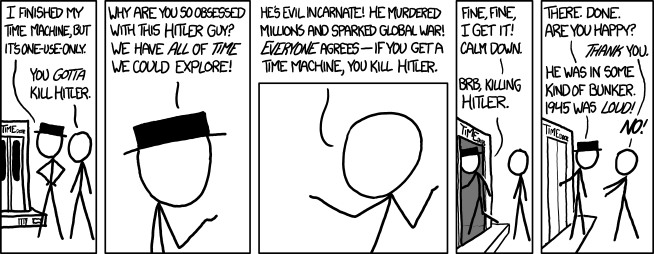
A relevant comic:

 
Last edited:

Back
Top Bottom