
• Quick note - the problem with Youtube videos not embedding on the forum appears to have been fixed, thanks to ZiprHead. If you do still see problems let me know.

Monty Hall Problem... For Newbies

Don't answer this poll until AFTER your read the OP!


  • Total voters
    141

Brian-M

Daydreamer
Joined
Jul 22, 2008
Messages
8,044
I'm curious about how many people pick the correct answer to the Monty Hall problem when they first hear about it, so only answer the poll if you hadn't heard about the Monty Hall problem until now (and no looking up the answer before you respond).

There are a couple of threads about this problem already (here, and here), but none of them have polls attached.

The Situation:

You're on a game-show trying to win a new car. The car is behind one of three doors. Behind the other two doors are goats.

You pick one of the three doors at random and the presenter (who knows which door the car is behind) opens a door that you didn't pick, revealing a goat. (This is standard procedure for the show.)

The presenter then offers you a chance to change your mind and pick the remaining door instead.

The Problem:

Are you more likely to win the car if you stick with your original choice?
Are you more likely to win the car if you change your mind?
Does it even make a difference?

Now you know the problem, let us know what you think the right answer is in the poll above.

Obligatory XKCD reference
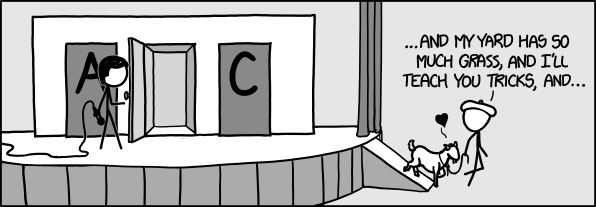
monty_hall.png

"A few minutes later, the goat from behind door C drives away in the car."
 
I voted how I would've when I first heard the problem, which I now know was incorrect. :o
 
Interestingly I just asked one of my daughters, who hates mathematics, what she would do. She thought about it a bit and said "of course you will change". Yet previous threads about this have gone on and on....
 
You explained the situation well. Sometimes people forget to point out that Monty knows where the car is and is bound to show you a goat.

I encountered the same idea many years ago in the game of bridge, where the 'principal of restricted choice' sometimes kicks in.
 
You explained the situation well. Sometimes people forget to point out that Monty knows where the car is and is bound to show you a goat.

Absolutely. It's when the problem isn't explained correctly that threads go forever.
 
You explained the situation well. Sometimes people forget to point out that Monty knows where the car is and is bound to show you a goat.
Yes. And the fact that this is standard operating procedure in the show is also relevant.

(I didn't vote because I'm not a newbie to the problem).

I encountered the same idea many years ago in the game of bridge, where the 'principal of restricted choice' sometimes kicks in.
[ grammar nazi ] Your bridge partner was a school headmaster?
 
[ grammar nazi ] Your bridge partner was a school headmaster?

:D Good one.

But I swear the bridge equivalent is more complicated and causes even more arguments (among those with an interest, anyway).
 
Familiar with the problem and yes, I got it wrong the first time. Now I know which answer to say but...

Sometimes people forget to point out that Monty knows where the car is and is bound to show you a goat.

Yes. And the fact that this is standard operating procedure in the show is also relevant.

How can it matter whether it's SOP? In this instance, it happens, regardless of how Monty may have played it in the past. It surely can't affect the odds whether he does it on a whim or to a script?

Equally, what does it matter that Monty knows? He has to know, of course, or he might open the car by accident if you hadn't already chosen it, but it doesn't tell you whether have or haven't. Either way, he knows where one goat is and shows you one goat. It's a math's question, not a body language question - he might be avoiding the car, he might merely be picking one of the two available goats, there's no way of telling.

Or is this all just an elaborate joke at the expense of the mathematically-challenged?

Absolutely. It's when the problem isn't explained correctly that threads go forever.

Go ahead... As I said, sources I trust assure me of the correct answer, but I still see three doors between me and two goats. Whichever door I pick first there will always be a goat left. How does showing me there's a goat left change anything?
 
.... he might be avoiding the car, he might merely be picking one of the two available goats ...

The clue is in that phrase. Sometimes he's obliged to avoid showing the car, sometimes he might as well flip a coin.
 
How can it matter whether it's SOP? In this instance, it happens, regardless of how Monty may have played it in the past. It surely can't affect the odds whether he does it on a whim or to a script?

Because if he's deviating from SOP then this brings up his motivation for opening a door and offering the contestant a chance to switch. It might be suspected that he's attempting to give the contestant a very strong hint.
 
I already have a car.
If I had a goat, I wouldn't need to cut the grass.

The interesting thing about the MHP is how certain we generally are about it being a 50:50 call, until it's demonstrated why it is not.
Default beliefs- especially ones that look sensible- can be very hard to shake.
 
The clue is in that phrase. Sometimes he's obliged to avoid showing the car, sometimes he might as well flip a coin.

But we can't know which it is. With no doors open, the odds of any given door hiding a car are X (I do hope it's 1 in 3, right? But that's beside the point) and the odds of at least one door hiding a goat are 100%. With one door open, showing a goat, surely no odds have changed? There's a goat we knew had to be behind a door, now proven to be behind a door. 100% goat. We cannot know, nor hope to guess, whether we've been shown the only safe goat. Whichever door you pick first, there's a safe goat...though there might be two. But how do the odds of you having picked the other goat change? The die is cast (in this case a d3).

Because if he's deviating from SOP then this brings up his motivation for opening a door and offering the contestant a chance to switch. It might be suspected that he's attempting to give the contestant a very strong hint.

Is it a strong hint? There has to be a safe goat. He shows it to us. We have no more information than we started with. The probabilities certainly don't care whether this is the first time he's done this. I'd assume (though probabilities often surprise me...) that there's an equal chance that it's a big bluff. Is he showing me a goat because I picked a goat? Or because I picked the car? Is it a hint, is it a bluff? There may well be a method of establishing the probablity of either option (by which I mean 'no there isn't', it's only ever going to be a wild-assed guess), but it has no bearing on the probability of which door you ultimately select.
 
As I understand it (explained by Derren Brown) You start with a car and two goats (1:3 car - 2:3 goat) you pick one, let's say door 1 and are left holding your choice (1:3) while MH opens door 3 and shows a goat. If you maintain your original choice, door 1 (1:3) your odds are still as they were from the outset. However, if you swap, you are now picking from a 1:2 or fifty - fifty option, thereby improving your chances of winning the car.

I think!
 
How can it matter whether it's SOP? In this instance, it happens, regardless of how Monty may have played it in the past. It surely can't affect the odds whether he does it on a whim or to a script?
What Brian already said.

Equally, what does it matter that Monty knows? He has to know, of course, or he might open the car by accident if you hadn't already chosen it, but it doesn't tell you whether have or haven't. Either way, he knows where one goat is and shows you one goat. It's a math's question, not a body language question - he might be avoiding the car, he might merely be picking one of the two available goats, there's no way of telling.
Monty opening a random door, without knowing anything, can lead to him opening the door with the car. It doesn't change the probabilities, but it makes for bad TV.

Monty knowing only one goat leads to the same: if you first pick the door he knows has a goat behind it, he then has to randomly pick one of the other doors, with the chance of him opening the door with the car.
 
I already have a car.
If I had a goat, I wouldn't need to cut the grass.

The interesting thing about the MHP is how certain we generally are about it being a 50:50 call, until it's demonstrated why it is not.
Default beliefs- especially ones that look sensible- can be very hard to shake.

And as Lionking said, until it's properly explained...

Indeed, as I said, I know I've had it explained in the past, got it (or took it on faith...), but still, I see the problem afresh every time. How does the act of confirming something we already knew alter the likelihood that you just picked the car?

Let me further embarrass myself by showing my workings...it starts at 1 in 3, of that I'm quite sure. Three doors; X, Y & Z. A 33.33r% chance of picking the car-door, and a 100% certainty that one of the unchosen doors hides a goat. You pick door X. To nobody's surprise, there is a safe goat (behind Y, let us say, as if it mattered). Now the question becomes 'which of two doors hides the car? Is it X or Z?'. You certainly have a better chance of finding the car from a 50/50 choice than a one in 3, I see that. But why isn't just as likely to be behind the door you originally picked? 50% one door, 50% the other. An equal chance at the start that the car is behind X, and an equal chance after seeing a goat that the car is behind X.

Monty always opens a door. That happens whether you picked the car or a goat. There is always a door available to Monty that hides the goat, the safe goat. The safe goat is a red herring.
 
What Brian already said.

Monty opening a random door, without knowing anything, can lead to him opening the door with the car. It doesn't change the probabilities, but it makes for bad TV.

Monty knowing only one goat leads to the same: if you first pick the door he knows has a goat behind it, he then has to randomly pick one of the other doors, with the chance of him opening the door with the car.

What I already said. He has to know, that's a given, or as you say it would make for dreadful television. I'm not a complete idiot. But his knowing surely has no bearing on the mathematics. Whatever you pick, he knows where to find a safe goat. You know there will always be a safe goat. You are shown a goat, which we all know to be safe. No surprises there. There was a 100% certainty that he could, and would, show you a goat. (I wouldn't, by the way, claim any of this was great television, but we're in the wrong sub-forum for that discussion).
 
Let me further embarrass myself by showing my workings...it starts at 1 in 3, of that I'm quite sure. Three doors; X, Y & Z. A 33.33r% chance of picking the car-door, and a 100% certainty that one of the unchosen doors hides a goat. You pick door X. To nobody's surprise, there is a safe goat (behind Y, let us say, as if it mattered). Now the question becomes 'which of two doors hides the car? Is it X or Z?'. You certainly have a better chance of finding the car from a 50/50 choice than a one in 3, I see that. But why isn't just as likely to be behind the door you originally picked? 50% one door, 50% the other. An equal chance at the start that the car is behind X, and an equal chance after seeing a goat that the car is behind X.

Because 50/50 was never the odds.

You started with a 1/3 chance of being right, and a 2/3 chance of being wrong, and you end with exactly the same chances. They don't change.

It's how the gameshow stays profitable. Most players think their odds changed and stay with their door, meaning they lose and the show gives away fewer prizes.
 

Back
Top Bottom