• Quick note - the problem with Youtube videos not embedding on the forum appears to have been fixed, thanks to ZiprHead. If you do still see problems let me know.

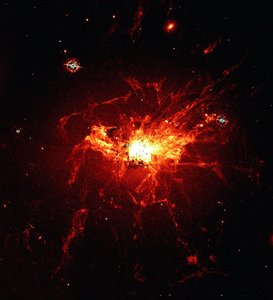
Magnetic PerseusA galaxy

Dancing David

Penultimate Amazing
Joined
Mar 26, 2003
Messages
39,700
Location
central Illinois
http://www.sciencedaily.com/releases/2008/08/080820162958.htm
It is an active galaxy, hosting a supermassive black hole at its core, which blows bubbles of radio-wave emitting material into the surrounding cluster gas. Its most spectacular feature is the lacy filigree of gaseous filaments reaching out beyond the galaxy into the multi-million degree X-ray emitting gas that fills the cluster.

These filaments are the only visible-light manifestation of the intricate relationship between the central black hole and the surrounding cluster gas. They provide important clues about how giant black holes affect their surrounding environment.

http://hubblesite.org/newscenter/archive/releases/2008/28/
 
Last edited:
Since the word 'magnetic' is in the title, I'm guessing that this somehow shows that Big Bang theory is a bunch of crap.
 
A good 'old news, new news' story.

'AGN blows bubbles in a cluster' could be the heading of this 2005 Chandra PR, marking a milestone in a story that's at least a decade older; note that this is the same Perseus A galaxy at the heart of the Perseus cluster.

It does take decades, but slowly the details of the various processes in play are uncovered and understood.
 
Since the word 'magnetic' is in the title, I'm guessing that this somehow shows that Big Bang theory is a bunch of crap.

So rather than follow a link to read an eight-paragraph story that has nothing to do with Big Bang theory, you would rather engage in speculation based on a single word in a thread title.
 
Very interesting pictures by Chandra and HST.
The HST image is newish BVr and the Chandra x-ray image is older.
If you scale and superimpose the 2 images, well , draw your own conclusions.
 
So rather than follow a link to read an eight-paragraph story that has nothing to do with Big Bang theory, you would rather engage in speculation based on a single word in a thread title.

Just trying to beat Zeuzzz and BeAChooser to the punch.
 
Its nice to see the usual fallacy of attributing the plasma filaments to being merely gas, or rather magic "gaseous filaments". Some editors will never learn :rolleyes:

Weird this, theres a couple of people on this forum that persist in claimng that "no galactic sized filaments exist in the universe". And some people also persist in claiming that magnetic fields can not have any effect on large scale structure. The Journal of Nature now seems to disagree with you. And they nearly get the terminology right at nature, calling it an "ionized gas", which is getting closer to just saying plasma. I suppose it depends whether you are referring to the constituents of the plasma on an individual basis, which individually are still considered by most 'gas molecules', or whether your referring to the larger structure the molecules take on, which indicates plasma.

Just out today:

http://www.nature.com/nature/journal/v454/n7207/edsumm/e080821-06.html
Editor's Summary

21 August 2008
Galactic filaments: survival in a hostile environment

Images from the Hubble Space Telescope reveal remarkable detail in the bright filaments of ionized gas that stream out from the giant elliptical galaxy NGC 1275 at the centre of the Perseus galaxy cluster. How these filaments have remained stable — they are thought to be at least 108 years old — despite the disruptive effects of tidal shear forces and extremely hot (4times107 K) surrounding gases has been unclear. The Hubble images now resolve thread-like structures within the filaments. These may indicate the presence of magnetic fields in pressure balance with the surrounding gas, capable of stabilizing the filaments and allowing the accumulation of a large mass of cold gas that could have delayed star formation.


I'm pretty sure he means 10^8, not 108 :)


Associated papers for this story: (need subsciption :( )

Giant galaxy's filamentous structure is held stable by magnetic fields.

Bright streams of gas fan out from NGC 1275 — the giant elliptical galaxy at the centre of the Perseus constellation — making it look a bit like a supersized space jellyfish. These filaments are thought to be around 100 million years old, and although they appear static, they are buffeted by the extreme pressure and heat of the gases that surround them.


Letter: Magnetic support of the optical emission line filaments in NGC 1275

The giant elliptical galaxy NGC 1275, at the centre of the Perseus cluster, is surrounded by a well-known giant nebulosity of emission-line filaments1, 2, which are plausibly in excess of 108 years old. The filaments are dragged out from the centre of the galaxy by radio-emitting 'bubbles' rising buoyantly in the hot intracluster gas, before later falling back. They act as markers of the feedback process by which energy is transferred from the central massive black hole to the surrounding gas. The mechanism by which the filaments are stabilized against tidal shear and dissipation into the surrounding extremely hot (4 times 107 K) gas has been unclear. Here we report observations that resolve thread-like structures in the filaments. Some threads extend over 6 kpc, yet are only 70 pc wide. We conclude that magnetic fields in the threads, in pressure balance with the surrounding gas, stabilize the filaments, so allowing a large mass of cold gas to accumulate and delay star formation.


"Magnetic support" of filaments on that big a scale??? Someone get Sol, nature is publishing woo :D

And can anyone explain to me what the physics of plasma 'bubbles' are? I see this term used a lot, but have never been quite sure what it physically means.

Large scale filaments are hard (if not impossible) to explain with gravity alone anyway. And this observation has forced them to abandon the usual dark matter explanation for filamentary structures in the universe, and use EM forces in plasma. Lets hope this continues.


I had seen the other observations of similar enigmas to this around alleged SMBH candidates, but not with filaments this big. Ah, here it is:

http://hubblesite.org/newscenter/archive/releases/2005/26/full/
Astronomers using NASA's Hubble Space Telescope have identified the source of a mysterious blue light surrounding a supermassive black hole in our neighboring Andromeda Galaxy (M31). Though the light has puzzled astronomers for more than a decade, the new discovery makes the story even more mysterious.

The blue light is coming from a disk of hot, young stars. These stars are whipping around the black hole in much the same way as planets in our solar system are revolving around the Sun. Astronomers are perplexed about how the pancake-shaped disk of stars could form so close to a giant black hole. In such a hostile environment, the black hole's tidal forces should tear matter apart, making it difficult for gas and dust to collapse and form stars.[...]


(sorry, cant find the associated science paper for that one)

 
Last edited:
Just trying to beat Zeuzzz and BeAChooser to the punch.


By six minutes. Close call. :)

(This story would have nothing to do with the Big Bang. Funnily enough, only observations that contradict the Big Bang serve as evidence aganst the Big Bang)
 
Another very detailed page about NGC 1275 put up today by the Institute of Astronomy X-Ray Group . Loads of pictures and stuff, and links to all the stories about this on other websites.

Magnetic mystery of NGC 1275 revealed

figure_1_thumb.jpg


"Images of the filaments where the smooth light from the galaxy has been subtracted away. The centre of the galaxy hosts a giant supermassive black hole, which blows bubbles of hot gas, dragging the filaments out behind them. "
 
Last edited:
And some people also persist in claiming that magnetic fields can not have any effect on large scale structure.

Really? On galaxy-scale filaments? Who?

And they nearly get the terminology right at nature, calling it an "ionized gas", which is getting closer to just saying plasma.

Your obsession with terminology is bizarre. "Ionized gas" is a specific and perfectly accurate description of what the observations show. "Plasma" is more specific and might or might not be correct in this case.

Someone get Sol, nature is publishing woo

Really?!? Where?
 
Last edited:
There seems to be dispute over the methods by which the filaments become ionized. It is either from Photoionization by the ICM (The hot ICM surrounding NGC 1275 can be the ionization source of the filaments if its energy is channeled efficiently into the nebulosity) electron conduction by the ICM, Ionization by an AGN, ionization from shocks, Magnetic Reconnection, Diffuse Extreme Ultraviolet Radiation, Attenuated Cluster Radiation, and more. Seems like the problem is not that there are no mechanisms that can cuase the ionization, but too many to choose from.

this paper http://arxiv.org/abs/astro-ph?papernum=0007359 looks at all the possibilites. And comes to the conclusion that: None of these models is entirely satisfactory in accounting for the energetic and/or emission-line properties of the filaments. Radio studies of Faraday rotation for cooling-flow galaxies provide tantalizing suggestions that magnetic reconnection plays a significant role in the filament energetics.

And since magnetic reconnection can not happen, I think this adds strong evidence that a double layer is formed due to current disruptions (the approximate equivalent to MR in Ej plasma approach) in the AGN, which is what's causing the ionisation as the ions are accelerated.

also relevant:

http://arxiv.org/PS_cache/astro-ph/pdf/0007/0007359v1.pdf
Early studies of the large-scale nebular morphology of NGC 1275 interpreted this object and its system of radial filaments as the result of a large-scale outflow; indeed, it was called an “exploding galaxy” (Burbidge & Burbidge 1965). [....] Stars may nonetheless play a role in powering the filaments if they generate a radiation field that ionizes gas on scales exceeding that of localized H II regions. A similar scenario has recently gained favor for explaining the ionization of the diffuse ionized gas (DIG) commonly seen in spiral galaxies
 
Last edited:
Really? On galaxy-scale filaments? Who?


Thats certainly the impression you give, ie, 36 magnitudes of order weaker, "completely negligable", "uttely ridiculous", blah blah. On bodies with tiny charge to mass ratios's, correct, but not everything in the universe has the mass to charge ratio of stars and planets. Especially when considering the initial nebulae they all formed from.


Really?!? Where?


"The Hubble Space Telescope has found the answer to a long-standing puzzle by resolving giant but delicate filaments shaped by a strong magnetic field around the active galaxy NGC 1275. [....] The amount of gas contained in a typical thread is around one million times the mass of our own Sun. They are only 200 light-years wide, are often surprisingly straight, and extend for up to 20 000 light-years." (link)

Solution:

Giant galaxy's filamentous structure is held stable by magnetic fields.

Magnetic support of the optical emission line filaments in NGC 1275

Here we report observations that resolve thread-like structures in the filaments. Some threads extend over 6 kpc, yet are only 70 pc wide. We conclude that magnetic fields in the threads, in pressure balance with the surrounding gas, stabilize the filaments, so allowing a large mass of cold gas to accumulate and delay star formation.


Now what do you think your reaction would have been if I had said that EM forces are responsible for the struture of a 20 000 light-year long object? I can guess: 36 magnitudes of order weaker, "completely negligable", "uttely ridiculous", blah blah.

But now I suppose your gonna say that theres nothing wrong with it in this situation :rolleyes:
 
Last edited:
Hi Zeuzzz: Of course magnetic forces and gravity are responsible for the filaments. You did read the OP and the linked articles?
It is an active galaxy, hosting a supermassive black hole at its core, which blows bubbles of radio-wave emitting material into the surrounding cluster gas. Its most spectacular feature is the lacy filigree of gaseous filaments reaching out beyond the galaxy into the multi-million degree X-ray emitting gas that fills the cluster.

These filaments are the only visible-light manifestation of the intricate relationship between the central black hole and the surrounding cluster gas. They provide important clues about how giant black holes affect their surrounding environment.
The "gaseous filaments" are created from the interaction of the black hole with the galaxy (gravity) and maintain their shape with their interaction with extragalactic magnetic fields (EM forces).
Astronomers are smart enough to realize there are places where EM forces dominate gravitational forces, e.g. plasmas contained in strong magnetic fields as in NGC 1275. They also know that such large scale domination is relatively rare. Millions of galaxies have been imaged and there are a small percentage with large scale plasma features (jets, filaments, etc.).
 
Its nice to see the usual fallacy of attributing the plasma filaments to being merely gas, or rather magic "gaseous filaments". Some editors will never learn :rolleyes:

Neither do some peeps here on the board. As a plasma obays the gas law, only with a slightly different adiabatic constant gamma in the equation (5/3 for "normal gas" and 4/3 for "plasma gas" if I am not mistaken):

P Vgamma = constant

it is perfectly fine to call a plasma a gas. (and don't forget NOT every ionized gas is automatically a plasma, there are 3 characteristics that the ionized gas has to fulfill)

We also have to take into account that plasma does not mean frag to the larger part of the unedumacated masses.

Plasma, that is what you donate at the blood bank, izzend it?
 
Last edited:
And since magnetic reconnection can not happen, I think this adds strong evidence that a double layer is formed due to current disruptions (the approximate equivalent to MR in Ej plasma approach) in the AGN, which is what's causing the ionisation as the ions are accelerated.

Really, reconnection cannot happen? Do you have any proof for that?
And please give us the description of current disruption re-organization of the magnetic field topology.
Don't forget that in the Earth's magnetotail we have a enormous amount of observations of magnetic field and plasma that all totally agree with the model of magnetic reconnection. I would love to see your explanation.

And how do you figure out that last part about the (imfamous) double layer? The DL causes the ionization because it accelerates the ions? But ........ how did the ions become ions before they are accelerated? Ah, the got ionized by .... acceleration by the DL?? but .... a DL can only accelerate ions and not neutrals, so ............

And, did you not start a magnetic reconnection thread?
 
Last edited:
Thats certainly the impression you give, ie, 36 magnitudes of order weaker, "completely negligable", "uttely ridiculous", blah blah.

That's the impression I give? That might be the impression you got, but I can hardly be held responsible for your misunderstandings, can I?

On bodies with tiny charge to mass ratios's, correct, but not everything in the universe has the mass to charge ratio of stars and planets. Especially when considering the initial nebulae they all formed from.

Actually these gas clouds probably have a similar (i.e. very small) charge/mass ratio as stars. It's not that ratio that makes them susceptible to magnetic field effects. This has been explained to you countless times before; I'm not going to waste my time try again.

"The Hubble Space Telescope...

So? You're saying you think that's woo? It looks fine to me.

But now I suppose your gonna say that theres nothing wrong with it in this situation :rolleyes:

I haven't checked the numbers, but it would be easy to do so. If you have the B field strength on the appropriate scale and some numbers describing the ionized gas, you can just check whether or not its reasonable for the field to strongly affect the structure of the filament. Just as we already checked what would be necessary for B fields could affect stars.
 
[...]

"Magnetic support" of filaments on that big a scale??? Someone get Sol, nature is publishing woo :D

And can anyone explain to me what the physics of plasma 'bubbles' are? I see this term used a lot, but have never been quite sure what it physically means.

Large scale filaments are hard (if not impossible) to explain with gravity alone anyway.

[...]
Hmm ...

As sol said, this has been explained to you before, more than once - would you be kind enough to tell all readers of this thread why you so persistently and consistently ignore those explanations?

And somewhat OT, what do you think the defining characteristics of an internet troll are?
 
Really, reconnection cannot happen? Do you have any proof for that?

He used to think it violated Gauss's law for magnetic fields. We've tried to pound it into his thick skull at length in past threads, even giving him equations for fields which exhibit reconnection and don't violate Gauss's law, but apparently he still clings to his delusions. Perhaps he's changed his rationalization, but his delusion remains comfortably intact.
 

Back
Top Bottom