• Quick note - the problem with Youtube videos not embedding on the forum appears to have been fixed, thanks to ZiprHead. If you do still see problems let me know.

Katrina vs. Tsunami - I'm skeptical.

jmercer

Penultimate Amazing
Joined
Jan 4, 2005
Messages
12,334
I was listening to CNN this morning, and there was a debate about the Katrina response going on. A comment during that discussion prompted me to do a little research. Here's what I found:

Tsunami - Dec 26, with little warning, a tsunami hit Asia, destroying and displacing millions of people and destroying homes and property. Relief and aid began to trickle in by December 28, 2 days later; by December 29, the flow of aid, food and water began to increase as efforts ramped up. By Jan 1, relief began to reach the worst-hit areas, primarily due to the arrival a US aircraft carrier that provided airlift support for supplies and equipment.

Here's the timeline of events according to the BBC.

Katrina - On August 27, the National Hurricane Center in Miami announced a hurricane watch for Louisiana; President Bush declared a state of emergency in Louisiana. At 5 PM, the mayor of New Orleans called for a voluntary evacuation of the city.

On August 28, Katrina was classified as a catagory 4 storm, and mandatory evacuation of New Orleans was announced. The city of Chicago offered assistance to the Federal Government (see link below and follow the link for the 28'th), which was apparently refused.

And as we have all witnessed, relief didn't begin to trickle into New Orleans until 5 days after Katrina hit.

Here's the Timeline as per Indybay.

So, on the one hand, we have an unanticipated distant event that was also geographically broad in it's impact, and every bit as severe as Katrina. (If not more so.) Even without warning - despite the logistics involved with an area thousands of miles away - aid began to arrive in 2 days, and became substantial in 3 days. Even the worst-hit remote areas began to see significant relief in 5 days.

On the other hand, we have Katrina; an anticipated event with almost 48 hours of notice, affecting a geographically broad area (and one major US city), but one physically within the continential United States.

Yet the first organized trickle of relief and aid didn't show up - as we have all witnessed in the news - until 5 days after the event.

I'm skeptical that our government acted appropriately, especially since it's clear that we can (and did) react in a shorter timeframe to a distant disaster. From my perspective, we should have logically been able to respond even faster to something within our own borders; especially since the President declared a state of disaster in Louisiana two days before the storm struck.

I would like to hear opinions both pro and con on this.
 
Well, there was basically no local or state response at all in LA. Apparently no local or state preparation, either.

I don't think FEMA is supposed to be a first responder.
 
The local response was to evacuate, first voluntarily, then manadatory. Although I haven't heard it specifically said, it's reasonable to assume that the city government notified all their agencies (including law enforcement and rescue/fire response) to prepare to deal with a disaster. I know that the city contacted the state and asked for the National Guard to be called out in advance, which was denied. Other than that, I fail to see what the local government could have done further.

The state government, however, clearly failed. Regarding FEMA, also granted - they're not first responders.

I contend, though, that the federal government also failed; the administrative arm of the government exists to deal with issues of immediacy, such as war, disaster, etc. - items that Congress would simply be too cumbersome to react to quickly.
 
I think FEMA is supposed to be a first responder. From http://www.fema.gov/about/history.shtm

About 2,500 full-time employees in the Emergency Preparedness and Response Directorate are supplemented by more than 5,000 stand-by disaster reservists.

and

On March 1, 2003, the Federal Emergency Management Agency (FEMA) became part of the U.S. Department of Homeland Security (DHS). FEMA's continuing mission within the new department is to lead the effort to prepare the nation for all hazards and effectively manage federal response and recovery efforts following any national incident. FEMA also initiates proactive mitigation activities, trains first responders, and manages the National Flood Insurance Program and the U.S. Fire Administration.

I think the fault lies on several fronts.

Not enough pre-disaster planning. This disaster wasn't a matter of if, but when. Here in CA we plan for earthquakes and brush fires.

Second, the mayor didn't use school buses to evacuate people.

Third, half the NO police department abandonded their posts. With half the police missing, local authorities had an even harder time quelling the looting and violence.

Next, the federal government didn't step in quickly enough. How long was it before the National Guard was called in? During the Los Angeles riots, the National Guard was called in that first night. Of course, it was the governor who called up the National Guard during the riots, so perhaps that was the LA governor's fault.

It's amazing to me that this could happen here. Of course, we are well prepared for fires (9/11, Northridge earthquake are all essentially fire-based disasters) but we aren't prepared as well for floods.
 
LTC8K6 said:
Well, there was basically no local or state response at all in LA. Apparently no local or state preparation, either.

I don't think FEMA is supposed to be a first responder.

It is apparent that there was no effective state or local response, and that this was undoubtedly the result of inadequate preparation (destruction of Emergency Services infrastructure should have been taken into account). However, given the overriding national interest in the security of this region, it's difficult for me to understand the rationale behind such a heavy reliance on the local authorities for disaster preparations, especially in an area where, for whatever reasons, the local resources were unlikely to be up to the task.
 
Lisa Simpson said:
I think FEMA is supposed to be a first responder. From http://www.fema.gov/about/history.shtm

Good points, Lisa - and I wasn't aware that FEMA's role had been changed with the advent of Homeland Security. "initiates proactive mitigation activities" has a lot of possible interpretations, but I take it as "Do whatever you can to prepare to respond to a disaster if you can anticipate it happening."

Regarding the city, I now remember hearing that the school buses weren't used, which is clearly a failure on local government's part. Not to mention amazingly stupid. :(

As far as the police abandonment goes... I know there was some abandoment, but I was under the impression that it was after the fact when things got so bad that the police were being overwhelmed by the thugs with guns... and the police were actually looting the gun stores to keep the ammo out of the thug's hands. I'm not disputing it, but I'd like to see a source for saying 50% abandoned their posts - that's a helluva chunk of people. I don't know that the (by then utterly collapsed) local government could have done about it, though...
 
jmercer said:


As far as the police abandonment goes... I know there was some abandoment, but I was under the impression that it was after the fact when things got so bad that the police were being overwhelmed by the thugs with guns... and the police were actually looting the gun stores to keep the ammo out of the thug's hands. I'm not disputing it, but I'd like to see a source for saying 50% abandoned their posts - that's a helluva chunk of people. I don't know that the (by then utterly collapsed) local government could have done about it, though...

I heard it on CNN yesterday. This is from their website.

Officials said Monday that between 400 to 500 officers were unaccounted for, many tending to their homes or looking for their families, and some dropping out. To lessen the stress, officers were being cycled off duty and given five-day vacations in Las Vegas and Atlanta, where they also would receive counseling.

NO had a police force of 1,600 officers.
 
Wow - thanks. That's utterly overwhelming... does the bad news ever end on this?
 
The police were participating in the looting as well. There is videotape of police looting a store.

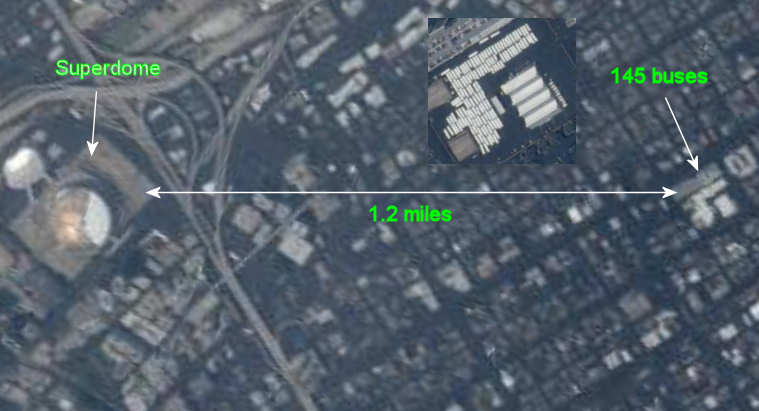
Here are the 100's of school buses that could have been of great service before and after the hurricane. Instead they were left to be flooded with their valuable diesel fuel leaking away to contaminate the area further.

bus2.jpg


bus1.jpg


DomeBuses.jpg


Corrections of misinfo regarding levee completeness and funding.

http://www.usace.army.mil/PA-09-01.pdf
 
Did they have the fuel to run the buses? I'm not arguing, because I don't know. Most fuel tanks here in California are underground. I don't know what happens when you put a couple of feet of water over an underground tank. I suspect you might get the fuel contaminated with water. Did they have manual pumps or a generator backup to get even uncontaminated fuel out? I'm pretty sure the electricity was out.
Fueling trucks from the airport would probably be able to fill the buses, since they generally pump from a power takeoff of the engine, but I don't know that they can fill themselves.
You could probably run a diesel bus on Jet-A, but the injector pumps might take a beating.
 
TjW said:
Did they have the fuel to run the buses? I'm not arguing, because I don't know. Most fuel tanks here in California are underground. I don't know what happens when you put a couple of feet of water over an underground tank. I suspect you might get the fuel contaminated with water. Did they have manual pumps or a generator backup to get even uncontaminated fuel out? I'm pretty sure the electricity was out.
Fueling trucks from the airport would probably be able to fill the buses, since they generally pump from a power takeoff of the engine, but I don't know that they can fill themselves.
You could probably run a diesel bus on Jet-A, but the injector pumps might take a beating.

Well... with a little thought, they could have topped off the tanks before the storm hit and they lost electricity. Those buses could have loaded up and moved people far enough out of the storm damaged area to make further fueling possible. Even after that, diesel can be brought in by the barrel and hand-pumped.

Both you and LT make good points; first, that the buses existed for logistical use, but were not, and second, it would be foolish to underestimate the logistics of using the buses regardless.

Good posts, both of you - thanks. :)
 
Well, the buses should have been taking people out of the area before the hurricane hit. When the hurricane got near, the buses could have been used to take people to the superdome.

Some of the buses could have been parked nearby, but out of the flood bowl. Some could have been taken 100 miles North or West, to be brought into use again as soon as possible after the storm abated.

Before being driven out of the area, the buses could have been loaded with food and water, which would then be used when the buses were driven back into the area after the storm.

Quite a bit of this stuff is in the plan the local and state officials were supposed to follow.

It was really over the top to hear Mayor Nagin hollering that he needed buses.......

I think the coming Katrina commission is going to place most of the blame on the Mayor and the Governor, with some on FEMA's tardiness.
 
Just a few questions:

How long was it after the hurricane hit that the levees failed?

What was the delay between the event and the actual flooding?

Is it possible that some of the slowness to respond was due to failure to realize the scope of the damage?

I'm not trying to mitigate onus on anybody's behalf. Just looking for lessons to be learned. I remember reading that in 1975 when cyclone Tracy wiped out the city of Darwin, Australia, three days went by before the rest of the country even realized what had happened. Everybody knew the storm was coming and they knew when it hit but they must have assumed that no news was good news. Nobody reckoned on there being no infrastructure or communications with which to call for help.

I know that aerial surveillance and cellphones make this an entirely different situation but I got the impression that the seriousness of the situation seemed to take a day or two to become apparent for some reason.
 
Maybe - but I suspect it will be mostly State and Federal taking the blame for a number of reasons.

First, this was a multi-state disaster; while we have focused on N.O. as the worst situation, it's hardly the only area devastated... a disaster of this size requires the resources of the national government to address.

Second, it's clear from the extent of the destruction that even if 100% of New Orleans had been evacuated, relocation, care and feeding of the displaced would still have been a logistical and tactical nightmare on a scale that - once again - requires the resources of a national government. The actual events that transpired only heighten the need, rather than allieviate it.

Lastly, when local government collapses into anarchy and State government fails to intervene, the Federal government is responsible for imposing order. In my opinion, all three levels of government failed to meet their obligations in a timely manner. Of the three, I hold the one with the fewest resources least accountable.
 
Blondin said:
Just a few questions:

How long was it after the hurricane hit that the levees failed?

What was the delay between the event and the actual flooding?

Is it possible that some of the slowness to respond was due to failure to realize the scope of the damage?

I'm not trying to mitigate onus on anybody's behalf. Just looking for lessons to be learned. I remember reading that in 1975 when cyclone Tracy wiped out the city of Darwin, Australia, three days went by before the rest of the country even realized what had happened. Everybody knew the storm was coming and they knew when it hit but they must have assumed that no news was good news. Nobody reckoned on there being no infrastructure or communications with which to call for help.

I know that aerial surveillance and cellphones make this an entirely different situation but I got the impression that the seriousness of the situation seemed to take a day or two to become apparent for some reason.

Most of the disaster was carried live on multiple major networks while it happened. People could not only see examples of how bad things were, but were also provided information about reports of the levee breaking and flooding as they came in. Sadly, the national news networks were better informed than the rule(8) governments were.
 
Blondin said:
Just a few questions:

How long was it after the hurricane hit that the levees failed?

According to the timeline in the OP--"Monday 8/29: As the hurricane hit the coast, news reports were sparse. First reports that came in reported that since the storm was downgraded to a category 4 storm damage was expect to be less than was feared. Levees broke in the late morning but much of the city remained unflooded. "

What was the delay between the event and the actual flooding?

"Tuesday 8/30:But overnight one of its protective levees buckled beneath the weight of water from nearby Lake Pontchartrain and broke open in two places." On Tuesday, President Bush delivered a speech on the 60th anniversary of V-J Day and mainly talked about the need to "stay the course" in Iraq. "

Is it possible that some of the slowness to respond was due to failure to realize the scope of the damage?

"Wedneday 8/31:Mayor Ray Nagin said pumps were being overwhelmed and warned that a new deluge would bury the city in up to 15 feet of water. With solid water from the lake to the French Quarter"

By Wednesday they certainly knew it was a major disaster.
 
And while I understand that the government can't act on news reports, the stuff I saw on the air the day Katrina hit should have goosed them into action.

It was obvious to me that New Orleans was in serious trouble pretty darned quickly.
 
(mild derail)

There's something about the question of preparedness (or lack of) that I've been curious about.

One of the problems was that the pumps to be used to dewater the city were (are?) installed under the flood level. My immediate reaction when hearing this was, "So what?" The German navy learned how to operate diesels underwater in WW2; the technology is 60+ years old.

Am I missing something?
 
Lisa Simpson said:
"Wedneday 8/31:Mayor Ray Nagin said pumps were being overwhelmed and warned that a new deluge would bury the city in up to 15 feet of water. With solid water from the lake to the French Quarter"
Solid water? French Quarter?

When hell freezes over!

Sorry, I couldn't resist. Thanks for the timeline - I was confused about that as well. I just recall the reports from Monday, that the big news was that there were holes in the roof of the Superdome leaking. At that time, I mentally filed the hurricane under "no big deal." Then the news started coming in about the damage in Mississippi, and it became a bigger deal.

So are there estimates of the numbers killed in Mississippi?

And of the people killed in Louisiana, how many were killed by the violence of the storm itself, and how many by being trapped by rising waters? Yesterday the number 10,000 came out, which seems *way* high for either portion.
 
CurtC said:
Solid water? French Quarter?

When hell freezes over!


If you want to go to hell
You should take a trip
To the Soddom and Gommorah on the Mississipp!
New Orleans!

Sorry, I couldn't resist, either.
 

Back
Top Bottom