Hard drives in WTC rubble?

1337m4n

Alphanumeric Anonymous Stick Man
Joined
May 10, 2007
Messages
3,510
Check out this thread from a Facebook debate group:

Chris said:
Poor hypothesis for these reasons:

1) Hard drives were recovered from the rubble of the WTC
2) Thousands of bits of paper were left all over downtown NYC for anyone to pick up and read

As has been said, a paper shredder and 'right click, delete' seem a better idea than conducting a bigger demolition than has been achieved before, entirely in secret, in a fully occupied office block.

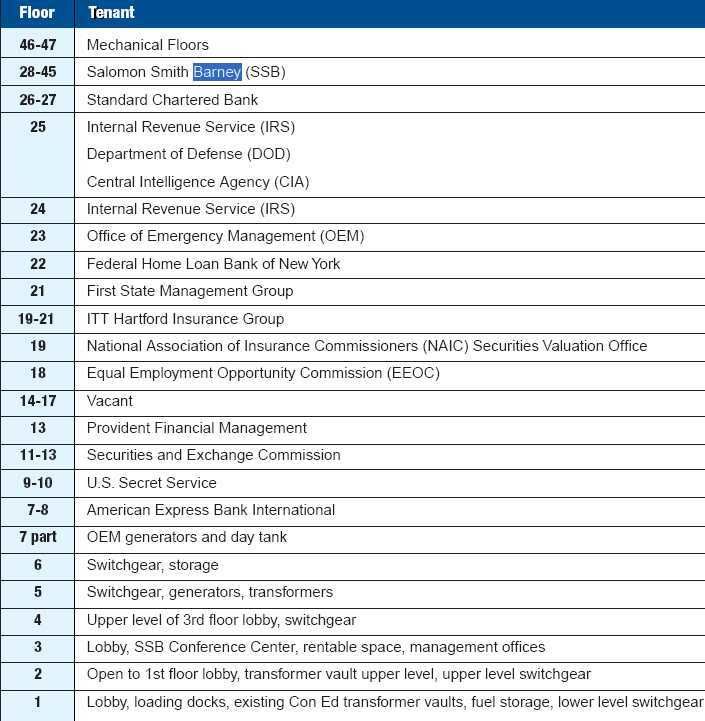
Far and away the biggest tenant of WTC7 were Solomon Smith-Barney who had some 40 floors of the structure. The CIA were a relatively minor tenant.

Does anyone have any evidence to confirm this statement?

I'd love to see it. It would prove that there is no conceivable motive for demolishing WTC7.
 
wtc7t.jpg

Is this about the disk drives?
 
I don't know. Truthers claim that WTC7 was demolished to destroy vital data. If it's true that anything was found in the rubble, that alleged motive is kaput, along with the Truthers' case.
 
Does anyone have any evidence to confirm this statement?


I don't do facebook so I can't read the link but I think that it might be referring to reports that a German company had successfully recovered data from dozens of hard drives found in the rubble of the WTC and was hopeful about recovering further data from more (hundreds more). I tried to follow up on those reports several years ago but, unfortunately, didn't really get anywhere. The company was, purportedly, Convar Systeme Deutschland GmbH (or, in English, Convar Systems. The GmbH is the equivalent to Inc. or Corp. in North America)
 
Last edited:
A number of hard drives were indeed recovered from the WTC in the clean-up. A German data recovery company called Convar was even able to recover some of the data for companies and firms wanting to retrieve their lost records. I'm not sure whether any of the hard drives were recovered from WTC7, though


You can see some pictures of the hard drives and videos (in German) about the data retrieval here.
 
Aren't there systems in place to destroy data instantly, in, for example, military compounds? I would have expected so, and see no reason the CIA couldn't use them if needed.

I've heard of intelligence operatives having fireproof bins in their offices with specific instructions to burn certain documents if security is compromised - I can't source that, but see no reason to think it untrue.

Surely the same would apply to hard drives? You'd just have one specifically designed to be capable of wiping itself completely, leaving no 'ghost' bits. I'm not suggesting they're in common use, but I'd be shocked if nobody had invented such a thing.
 
Aren't there systems in place to destroy data instantly, in, for example, military compounds? I would have expected so, and see no reason the CIA couldn't use them if needed.

Sure, the technical term for that system is known as a big freaking HAMMER!

I've heard of intelligence operatives having fireproof bins in their offices with specific instructions to burn certain documents if security is compromised - I can't source that, but see no reason to think it untrue.

Sure, they do, they are known as metal trash cans.

Surely the same would apply to hard drives? You'd just have one specifically designed to be capable of wiping itself completely, leaving no 'ghost' bits. I'm not suggesting they're in common use, but I'd be shocked if nobody had invented such a thing.

There is software approved for this purpose, but it must be RUN ON THE HD (multiple times). That takes time and with a big fire scorching your behind it's difficult to concentrate on that type of task. CLASSIFIED material is kept on removable HD's, so those likely would have been removed.

There is no such thing as instant destruction of a HD ala Mission Impossible. When Govt. computers are upgraded or changed the HD's are destroyed, even unclassified ones. There are several approved methods of destruction, but the most common is a big hammer. There are some software programs which wipe them, but that takes time, lots of time.

I dare say there was not time to destroy much in WTC 7. Perhaps a few of the most critical documents were removed or destroyed and since CLASSIFIED material is kept on REMOVABLE HD's I doubt there was classified material on HD's left in WTC 7. However, I would guess there were multiple unclassified HD's in the rubble.

ETA: All Classified material is kept in fireproof safes to include the removable HD's. If there was not time to take the material out of the building it should have been in the safes in the rubble.
 
Last edited:
Is there no physical way - even with minutely sensitive instruments and lots of time - to extract information from a hard drive platter once its been smashed?

Do they really use hammers? Sounds crazy - my assumption was that they'd use a big old magnetic field or something. But if hammers work, hammers work.
 
Heck, they recovered a hard drive from the Space Shuttle Columbia! Phil Plait blogged about it yesterday:
http://www.badastronomy.com/bablog/2008/05/06/now-thats-a-hard-drive/

It had experimental data on it, and the resulting scientific paper was just published:
http://www.sciam.com/article.cfm?id=hard-drive-recovered-from-columbia&sc=rss (PHOTO of the drive here)

If that's possible, I think it is certainly possible that hard drives with recoverable data existed in the rubble pile. There are companies like Ontrack Data Recovery that do nothing but recover data from trashed drives.
 
Last edited:
Is there no physical way - even with minutely sensitive instruments and lots of time - to extract information from a hard drive platter once its been smashed?

Do they really use hammers? Sounds crazy - my assumption was that they'd use a big old magnetic field or something. But if hammers work, hammers work.

Well, you COULD map the field on bits of a drive and might get something from it. Were you the CIA and were the drive fragments essential to national security, you could try.

But generally once its not flat none of the tricks the drive recovery people use would apply and you would have to invent some means of moving the sensor over the uneven surface.

Also, striking any ferrous metal with a hammer tends to induce a magnetic field as the atoms align themselves with the Earth's field, so I would expect something like that to go on.
 
.......Do they really use hammers? Sounds crazy - my assumption was that they'd use a big old magnetic field or something. But if hammers work, hammers work.

Yes, hammers are really used to smash the platters. It's very efficient!

To my knowledge no magnetic field devices have been approved (maybe someone has later information I'm not aware of) even tho' that would probably work. If you stop to think about it, those devices times thousands of them would be rather expensive. Hammers to smash and software to write 1's and 0's multiple times are, in comparison, reasonably inexpensive.

ETA: I don't known of a way data could be recovered from a smashed platter. It needs to spin to be read. I dare say it's been researched and determined nothing can be recovered as it is an approved method of destruction.
 
Last edited:
Thanks - very interesting. I suppose the error in my assumption may have stemmed from instinctive comparison with floppy diskettes. Hard drive platters are rigid, aren't they, so I suppose if you whack one it might well shatter to the point that you lose - as in actually physically lose - enough of the bits that you simply can't reconstitute the information, even if you can manage to piece the thing back together (and of course then there's reading it - I have a hunch the problem is that the read heads float so phenomenally close to the platter that the signal is actually tiny, and a rebuilt platter could never get a head anywhere near it).

When I was thinking of electromagnetics I wasn't thinking so much of a portable device as some kind of room - maybe like an MRI machine - for destroying hard drives en mass. But sometimes the old ways are the best ways :)
 
Last edited:
Actually, for most non-secure DoD facilities (commercial tenets), TS data is encrypted on the fly when stored to hard drive. Lower classification hard drive data is destroyed as hardware (see below)

Hardware is smashed using the "duty sledge" (a sledgehammer built to precise mil-spec standards such that it identically resembles sledgehammers found in hardware stores everywhere). People are pre-assigned to perform this task should the need arise.

Paper/floppy is burned in a metal trashcan sitting inside another metal trashcan (also built to mil-spec standards). People are pre-assigned to perform this task should the need arise.
 
On magnetic destruction: Now, perhaps a little surprisingly, it requires a very strong magnet field to destroy the tiny magnetic "charges" on a HD. The reason is that those small bits of surface were magnetized by an electromagnet in the writing head that is not particularly strong, but very VERY close! So, at a distance of half an inch or so (on the outside of the drive), you'd need a whopping big field to totally erase it: Since the non-magnetized bits are just next to it, and you don't want to just shift the bias level (special equipment could still read the data like a breeze), you would need to drive the whole layer, magnetized and non-magnetized bits alike, well into magnetic saturation.

So, to apply a magnet effectively, you would really need to take apart the drive and apply it directly to the platter, .... at which time, ye good olde hammer would do just as well, in a fraction of the time, at a fraction of the investment, not to mention a good deal more fun.

Hans
 
...
Paper/floppy is burned in a metal trashcan sitting inside another metal trashcan (also built to mil-spec standards). People are pre-assigned to perform this task should the need arise.

And the Neuralizer is kept behind one of those "Break glass in emergency" panes, although the deterrent provided by the penalty for improper use has been rendered largely ineffectual by significant gaps in witness testimony.
 
Last edited:
On magnetic destruction: Now, perhaps a little surprisingly, it requires a very strong magnet field to destroy the tiny magnetic "charges" on a HD. The reason is that those small bits of surface were magnetized by an electromagnet in the writing head that is not particularly strong, but very VERY close! So, at a distance of half an inch or so (on the outside of the drive), you'd need a whopping big field to totally erase it: Since the non-magnetized bits are just next to it, and you don't want to just shift the bias level (special equipment could still read the data like a breeze), you would need to drive the whole layer, magnetized and non-magnetized bits alike, well into magnetic saturation.

So, to apply a magnet effectively, you would really need to take apart the drive and apply it directly to the platter, .... at which time, ye good olde hammer would do just as well, in a fraction of the time, at a fraction of the investment, not to mention a good deal more fun.

Hans
we have a degausser at my office, we use it for tapes and floppies, but the label says you can use it for hard drives too, im assumign that would get the job done (although we can only run it for about 5 minutes before it overheats and needs to cool down for an hour, lol)
 
In the 70s there was this stuff called something like revealing fluid or disclosing fluid. Presumably it was some kind of suspension of very fine paramagnetic particles in a fast-evaporating liquid. You could brush it on a magnetic tape or disk surface, and the magnetic domains (the bits, as it were) would become visible.

It was mostly used for diagnosing hardware problems that were causing incorrect (e.g. misaligned) writing onto the medium. Using it for data recovery would have been a tedious process at best, even then.

Of course, that was when each bit was at least 1,000,000 times bigger than today. Splashing magnetic particles onto a present-day disk surface would probably, itself, damage the data. Or even if not, it would be exceedingly difficult to read.

Still, given the existence of scanning tunneling microscopes, I can imagine the possibility of devices that could scan and map the surviving data in all the broken pieces of a platter (which would have gaps) and then attempt to extract information (especially text) from it. That's the kind of thing you'd only have to worry about if you're a member of a vast conspiracy trying to keep your most valuable secrets hidden from another, different vast conspiracy. It would be very slow (weeks? months?) and not guaranteed to be able to piece together anything useful.

(However, I'd be surprised if the CSI people -- the TV show, that is -- don't have such a device, that works in seconds, and then immediately displays exactly the information you were looking for.)

Respectfully,
Myriad
 
The controlled demolition of WTC 7 certainly made one heckuva powerful hammer!

MM
EHr, no. That was sort of the point, if you cared to read the details. It's a little like the proverbial dropping concert piano. Drop it on a man, and he'll be flat as a penny, but drop it on a mouse, and it may survive in one of the nooks that will not happen to touch the ground.

Now, since hard drives have been known to survive the most surprising disasters and be readable, one would hardly plan to get rid of sensitive hard drives by demolishing the building they were in. Especially as simpler and more efficient measures are available. And especially as ANY agency or company that works with sensitive material has a procedure for destroying it.

Hans
 

Back
Top Bottom