• Quick note - the problem with Youtube videos not embedding on the forum appears to have been fixed, thanks to ZiprHead. If you do still see problems let me know.

Cont: Global warming discussion V

lobosrul5

Philosopher
Joined
Nov 1, 2017
Messages
8,076
Location
The Land of Blue Crystal
The scope of this thread is like its predecessor, but dealing with both polar regions. Bear that in mind when posting here.

To date both sea ice areas (Arctic and Antarctic) are the second smaller ones on record. Only during this day of the year (16of365) in 2017 there were less sea ice in the polar regions.

Its cold in much of the USA, therefore global warming is fake. Haven't you heard? Just in case: yes that was sarcasm, but I've heard it said in earnest a few times this year already.

This is a continuation of the Global warming discussion IV thread.
Replying to this modbox in thread will be off topic  Posted By: novaphile
 
Last edited by a moderator:
Earth's surface will almost certainly not warm up four or five degrees Celsius by 2100, according to a study released Wednesday which, if correct, voids worst-case UN climate change predictions.

A revised calculation of how greenhouse gases drive up the planet's temperature reduces the range of possible end-of-century outcomes by more than half, researchers said in the report, published in the journal Nature.
 
Earth's surface will almost certainly not warm up four or five degrees Celsius by 2100, according to a study released Wednesday which, if correct, voids worst-case UN climate change predictions.

A revised calculation of how greenhouse gases drive up the planet's temperature reduces the range of possible end-of-century outcomes by more than half, researchers said in the report, published in the journal Nature.

What I have been telling all these years in the Global Warming thread. ...(Snip)...
 
Last edited by a moderator:
Earth's surface will almost certainly not warm up four or five degrees Celsius by 2100, according to a study released Wednesday which, if correct, voids worst-case UN climate change predictions.

A revised calculation of how greenhouse gases drive up the planet's temperature reduces the range of possible end-of-century outcomes by more than half, researchers said in the report, published in the journal Nature.

link or reference?
 
QUOTE=Pixel42;12152206]https://www.theguardian.com/science...bal-warming-scenarios-not-credible-says-study

They've narrowed the range of estimates for climate sensitivity, eliminating both best and worst case scenarios.[/QUOTE]


Interesting but it’s not going to change the generally accepted estimates of climate sensitivity. It’s actually fairly consistent with other estimates that don’t factor in long term feedback effects. It’s generally only after you start factoring in long term feedback effects that you start to see estimates above 3.5 Deg C / doubling of CO2.
A revised calculation of how greenhouse gases drive up the planet's temperature reduces the range of possible end-of-century outcomes by more than half, researchers said in the report, published in the journal Nature.
This wouldn’t change IPCC warming estimates. The IPCC estimates for warming under various emission scenarios are generated by an ensemble of climate models, and climate sensitivity is an output of climate models no an input. Furthermore, these models already estimate climate sensitivity to be ~3, which is similar to what this paper reported. At best it could help narrow the range of possible outcomes but IPCC climate model ensembles omit several long term feedbacks so they already tend to report climate sensitivities near 3. (IOW the IPCC isn’t including the impact long term feedbacks could have in their results).

Even if it does narrow the range of outcomes for each scenario, that isn’t necessarily good as the “best case” for each scenario would get worse. The like likely emission scenario’s ALL the l have best cases that are unacceptably bad:
RCP4.5 CO2 emissions fall rapidly but not until after 2050
RCP6.0 CO2 emissions grow slowly and begin to decline slowly around 2075
RPC8.5 CO2 emissions continue to grow and plateau near the end of the century
 
https://www.theguardian.com/science...bal-warming-scenarios-not-credible-says-study

They've narrowed the range of estimates for climate sensitivity, eliminating both best and worst case scenarios.


Interesting but it’s not going to change the generally accepted estimates of climate sensitivity. It’s actually fairly consistent with other estimates that don’t factor in long term feedback effects. It’s generally only after you start factoring in long term feedback effects that you start to see estimates above 3.5 Deg C / doubling of CO2.

Yes, remember this study is still undergoing broader review within the field, passing publication peer review is only a publication issue, not a broad scientific adoption of the study's findings. This paper doesn't only not look at longer term effects and impacts (fat tail issues), it also does not attempt to include or analyze shorter term tipping point issues, and generally ignores Methane releases, permafrost melt, and the broader issues of adding more moisture to the atmosphere, deforestation, ocean acidification, etc., and how these all shape and change climate. Always good to more information, but I don't see that it changes much at all with regard to general mainstream understandings and projections, much less the dangers and problems already associated with climate change issues.
 
I think the only relatively safe bet is that it won't be under 2C above pre-industrial at 2100 unless active CO2 removal gets moving right quick.

A few glimmers but not much.

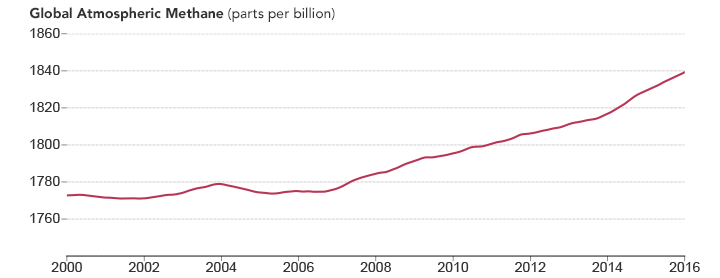
and there is always methane rising as well..

The concentration of methane in the atmosphere has risen sharply—by about 25 teragrams per year — since 2006. In recent years, different research teams have come up with viable but conflicting explanations for the increase

methane_plot_2016.png


https://earthobservatory.nasa.gov/IOTD/view.php?id=91564

interesting times indeed.
One encouraging aspect is the rapid pace of EV tech but that's not going to address the existing levels.
 
Methane has basically 3 potential pathways for removal. Rapid oxidation, slow oxidation, biotic oxidation.

Rapid oxidation is burning. Methane is essentially Natural gas and vice versa and will burn if exposed to an ignition source and concentrated enough.

Slow oxidation can be highly simplified into: Oxidation of methane ——> formaldehyde ——> carbon monoxide ——> carbon dioxide. [1] Sunlight triggers this reaction.

Biotic oxidation is accomplished by methanotrophs which are bacteria that eat methane as their only source of carbon and energy, which is then incorporated into organic compounds via the serine pathway or the ribulose monophosphate pathway. [2] Of all the natural methane sources and sinks, the biotic oxidation is the most responsive to variation in human activities. [3] It can be improved by proper management of upland oxic soils by proper grassland/savanna/open woodland management in agriculture. Essentially the healthy grassland soils are an overall net sink for methane, while closed canopy forests, wetlands, and degraded soils are generally not. [4]

So to lower atmospheric methane:

1) Reduce the leakage of Natural gas from wells and pipelines and inefficient incomplete burning. Collect the methane from landfills and other manmade concentrated sources, so it can be burned as an energy source. (rapid oxidation)

2) Change agricultural production methods to take advantage of biotic oxidation. Agriculture as it is most widely practised now is both reducing the natural processes that remove methane, and in some cases increasing methane emissions. So the net component of increasing atmospheric methane that agriculture is responsible for is dramatically rising due to the effect agriculture has on both sides of the methane cycle.

You asked how can we “remove” methane? Well starting with wetlands emissions, the primary agricultural component to that portion of the methane cycle is paddy rice production. So in the case of rice, a shift to SRI would be a significant improvement.

• Reduced greenhouse gas (GHG) emissions from paddy soils

o Methane (CH4) is reduced by between 22%
and 64%, as soils are maintained under mostly
aerobic conditions [10,11,3]
o Nitrous oxide (N2O) is only slightly increased
or sometimes reduced as use of N fertilizers is
reduced; N20 increases do not offset CH4
reductions, so GWP is reduced [9,10,11,12]
oTotal global warming potential (GWP) from
flooded rice paddies is reduced 20-30%
[10,12,3], even up to 73% [11]

The System of Rice Intensification (SRI)… … is climate-smart rice production

SRI has over 700 published journal articles which can be found here: JOURNAL ARTICLES ABOUT THE SYSTEM OF RICE INTENSIFICATION (SRI)

Please note that yields per hectare are increased at the same time as the methane is reduced. You will also find that many of the outliers mentioned in the above quote are also the same outliers in yields too. In other words, the farmers that reduce emissions the most are also the same farmers yielding the most. (and the farmers sequestering the most carbon in the soil) And the farmers producing the record yields have little to no impact on AGW any longer at all. It can not be emphasized enough how important this breakthrough is, as the methane signature from rice cultivation goes back thousands of years according to the Ruddiman Early Anthropocene Hypothesis .

The next biggest agricultural component to methane increases is related to the way we currently practice animal husbandry. This component is primarily driven by reducing the natural processes that remove methane from the atmosphere. Since ruminants and other animals have been passing gas since the beginning of time, it is less an emissions problem but rather a symptom of soil degradation caused by the way we currently raise grains (largely to feed animals in confinement).

In my opinion methane is an animal husbandry problem primarily because of CAFO's. It is not a problem in a properly managed grassland/savanna biome. After all those biomes supported many millions and millions of grazers who were extirpated. The methane levels before they were extirpated were actually lower than now! According to the following studies those biomes actually reduce atmospheric methane due to the action of Methanotrophic microorganisms that use methane as their only source of energy and carbon. Even more carbon being pumped into the soil! Nitrogen too, as they are also free living nitrogen fixers.

Grasslands and their soils can be considered sinks for atmospheric CO2, CH4, and water vapor, and their Cenozoic evolution a contribution to long-term global climatic cooling. Cenozoic Expansion of Grasslands and Climatic Cooling
The subsurface location of methanotrophs means that energy
requirements for maintenance and growth are obtained from
CH4 concentrations that are lower than atmospheric. Soil Microorganisms as Controllers of Atmospheric Trace Gases
(H2, CO, CH4, OCS, N2O, and NO)

Upland (i.e., well-drained, oxic) soils are a net sink for atmospheric methane; as methane diffuses from the atmosphere into these soils, methane consuming (i.e., methanotrophic) bacteria oxidize it. IMPACT OF METHANOTROPH ECOLOGY ON UPLAND METHANE BIOGEOCHEMISTRY IN GRASSLAND SOILS


Nevertheless, no CH4 was released when soil surface CH4 fluxes were measured simultaneously. The results thus demonstrate the high CH4 oxidation potential of the thin aerobic topsoil horizon in a non-aquatic ecosystem. Methane fluxes from differentially managed grassland study plots: the important role of CH4 oxidation in grassland with a high potential for CH4 production.

Of all the CH4 sources and sinks, the biotic sink strength is the most responsive to variation in human activities. Environmental impacts on the diversity of methane-cycling microbes and their resultant function
The CH4 uptake rate was only 20% of that in the woodland in an adjacent area that had been uncultivated for the same period but kept as rough grassland by the annual removal of trees and shrubs and, since 1960, grazed during the summer by sheep. It is suggested that the continuous input of urea through animal excreta was mainly responsible for this difference. Another undisturbed woodland area with an acidic soil reaction (pH 4.1) did not oxidize any CH4. Methane oxidation in soil as affected by land use, soil pH and N fertilization

I pulled a few quotes out to make my case, but I highly recommend you read the sources in their entirety and even find further educational materials, since this is a highly complex subject.

The main summary being, the current system used to raise animals in confinement has removed them from the farmland, where when managed properly their methane emissions are part of a larger agricultural system that oxidizes more methane than the animals emit. Since this biological oxidation of methane occurs below the soil surface where that carbon enters the soil food web, actually animals improve the BCCS systems even more than without them. This actually has been known for decades and is well vetted, but was never quantified for climate scientists. Sir Albert Howard, father of organic agriculture, noted this effect on soil biology (of removing farm animals from the land and replacing their impact with synthetic fertilizers) way back in the 1940s.
“As the small trickle of results grows into an avalanche — as is now happening overseas — it will soon be realized that the animal is our farming partner and no practice and no knowledge which ignores this fact will contribute anything to human welfare or indeed will have any chance either of usefulness or of survival.” Sir Albert Howard

In my honest opinion one reason for the recent spike in atmospheric methane is simply the fruition of Sir Albert Howard's prediction, since we continue to ignore this. Loss of soil carbon would be another impact of ignoring this.

The third major factor in increased emissions is from natural wetlands. I am less familiar with this portion of the methane cycle, but I can hypothesize that it could potentially be related in part to agricultural runoff causing anaerobic conditions (dead zones), since most decomposition under anaerobic conditions does produce large quantities of methane. Fertilizer Runoff Overwhelms Streams and Rivers--Creating Vast "Dead Zones" Ironically the "King Corn" lobby is so huge, that even though the above article from Scientific America admits the primary cause cropland runoff of synthetic nitrogen, they actually propose:

the only way to increase ethanol production from corn and reduce nitrogen runoff would be for Americans to stop eating meat, thereby freeing up corn used as livestock feed for other uses.

While also stating:

"That [also] means not utilizing all the land to grow crops."

Apparently they don't see the irony in these two statements. The solution of course is not to grow corn for ruminants at all and dramatically reduce its usage for other livestock. And not to use corn for ethanol production at all. (excepting a nice corn whiskey) There are other ways to feed animals and distill ethanol more efficiently than using "king corn" surpluses.

Grass Makes Better Ethanol than Corn Does

Soil Carbon Storage by Switchgrass Grown for Bioenergy

So step one is to stop subsidizing the over production of corn and soy and changing our production models to more efficient regenerative models of production that don't cause AGW. And ironically instead of agriculture contributing to the methane problem, we could use it to more rapidly oxidize methane coming from other sources too!

3) Whatever gets past the first two measures will be slow oxidized. It is about 10+/-years 1/2 life for this reaction.

 
Last edited:
..."That [also] means not utilizing all the land to grow crops."

Apparently they don't see the irony in these two statements. The solution of course is not to grow corn for ruminants at all and dramatically reduce its usage for other livestock. And not to use corn for ethanol production at all. (excepting a nice corn whiskey) There are other ways to feed animals and distill ethanol more efficiently than using "king corn" surpluses.

In my experience, corn doesn't even make the sipping whiskey good, most of the terpenes responsible for good sipping whiskey come from the minor ingredients and the barrels used to age the spirits in, then it's a matter of experience, luck and blending. Corn is primarily just a source of sugars/starches to produce the alcohol. We primarily produce fuel for farm equipment, so we distill to 96+% and then run it through desiccants to suck out the rest of the water. That makes good fuel (though we often mix in a touch of some lighter oils from our biodiesel production as it conditions the fuel to make it easier on the engines). If you wanted to turn it into good sipping whiskey you need to take the pure distillate and add the preferred terpene extractions (I'd prefer some rye and barley extractions and occasionally some fruit extractions, and of course some caramelized wood sugars to simulate barrel aging). Then its just a matter of settling, filtering, blending and adding about as much clean clear water as you have alcohol solution to yield a good sipping whiskey (most experienced whiskey sippers prefer the proof to be right around 100 - or at least, I do!, but then I can sip on 2 fingers in a pint jar for an hour or so,...unless it's a thirsty day :)

Grass Makes Better Ethanol than Corn Does...

I don't know that grass makes "better" ethanol, but it sure makes better tasting beef, milk and butter! And it certainly makes for much more sustainable farming.

Sorry for the extended aside, good to see you all again, I've been way too distracted by the real world for most of the last year.
 
I don't know that grass makes "better" ethanol, but it sure makes better tasting beef, milk and butter! And it certainly makes for much more sustainable farming.
So how do we sell it? We use grass to mitigate AGW? and have a side effect of better beef milk and butter? Or we sell it as better beef milk and butter, with an accidental side effect of mitigating AGW?
 
So how do we sell it? We use grass to mitigate AGW? and have a side effect of better beef milk and butter? Or we sell it as better beef milk and butter, with an accidental side effect of mitigating AGW?

The latter would probably result in less knee-jerk rejectionism, and is a ploy we've been engaged in for most of the last year with a variety products and practices! ;)
 
Yes, remember this study is still undergoing broader review within the field, passing publication peer review is only a publication issue, not a broad scientific adoption of the study's findings. This paper doesn't only not look at longer term effects and impacts (fat tail issues), it also does not attempt to include or analyze shorter term tipping point issues, and generally ignores Methane releases, permafrost melt, and the broader issues of adding more moisture to the atmosphere, deforestation, ocean acidification, etc., and how these all shape and change climate. Always good to more information, but I don't see that it changes much at all with regard to general mainstream understandings and projections, much less the dangers and problems already associated with climate change issues.
When I first started reading up on all this about 20 years ago the range of possible values for the increase in average surface temperature per doubling of the atmospheric concentration of CO2 was something like 1.5C to 5.5C, an enormous uncertainty. Calculating the actual forcing is apparently pretty straightforward, but calculating the total warming once natural positive feedbacks (ice albedo and increasing water/CO2 greenhouse effect) are included is much more problematic. As work has gone on to try to narrow the estimate the good news has been that most of it is pointing to a value nearer the lower end of that range than the higher, with a value of between 2.5C and 3C looking most likely. So yes, this latest study appears to be in line with that.

But as you say, this estimate is for the consequences of an increase in atmospheric CO2 only on average global temperatures. Other factors, e.g. increase in methane levels, are not included, and my impression is that these are even harder to estimate.
 
When I first started reading up on all this about 20 years ago the range of possible values for the increase in average surface temperature per doubling of the atmospheric concentration of CO2 was something like 1.5C to 5.5C, an enormous uncertainty. Calculating the actual forcing is apparently pretty straightforward, but calculating the total warming once natural positive feedbacks (ice albedo and increasing water/CO2 greenhouse effect) are included is much more problematic. As work has gone on to try to narrow the estimate the good news has been that most of it is pointing to a value nearer the lower end of that range than the higher, with a value of between 2.5C and 3C looking most likely. So yes, this latest study appears to be in line with that.

But as you say, this estimate is for the consequences of an increase in atmospheric CO2 only on average global temperatures. Other factors, e.g. increase in methane levels, are not included, and my impression is that these are even harder to estimate.

Fully agreed, I was offering more qualification rather than contesting your comments, Trump has made me sound, and feel, more reflexively defensive, I guess.
 
When I first started reading up on all this about 20 years ago the range of possible values for the increase in average surface temperature per doubling of the atmospheric concentration of CO2 was something like 1.5C to 5.5C, an enormous uncertainty. Calculating the actual forcing is apparently pretty straightforward, but calculating the total warming once natural positive feedbacks (ice albedo and increasing water/CO2 greenhouse effect) are included is much more problematic. As work has gone on to try to narrow the estimate the good news has been that most of it is pointing to a value nearer the lower end of that range than the higher, with a value of between 2.5C and 3C looking most likely. So yes, this latest study appears to be in line with that.

Estimates of climate sensitivity have been 3deg C +/- 1.5 deg C for a long time. Narrowing it may not even be possible because it’s not a constant. It will change due to specific climate conditions and time span being looked at. 3deg C is consistent with the climate models the IPCC uses in it’s projections.


Realclimate on climate sensitive from a couple years ago referencing posts and papers going back to 2012
http://www.realclimate.org/index.php/archives/2015/03/climate-sensitivity-week/

Here they talk about this specific paper and raise the same concern I did above, that is that the method inherently only looks at sensitivity with fast feedbacks which means it probably underestimates the true climate sensitive.

http://www.realclimate.org/index.ph...equilibrium-climate-sensitivity-is-premature/
 
You asked how can we “remove” methane?

I did not.....I mentioned active CO2 removal.

Reduce methane by eating kangaroo instead of beef
There are pretty decent low methane feeds in the works as well.

Fewer people is really the only solution in the long and aside from Japan that ain't happening much. Even if we disappeared in a wave of the wand we are in the Anthropocene anyways.....and we are dealing with those consequences.
 
Last edited:
Growth in atmospheric CO2 continues to accelerate.

https://tamino.wordpress.com/2018/01/20/is-co2-still-accelerating/

Given the political realities IMO the RPC8.5 scenario remains the most likely and that means 4 more Deg C, or ~5 deg warming over a mere 200 years. It took 5000 years to warm that much when the last glaciation ended.

Even the RPC6 scenario would be bad and I see very little hope for sticking to any of the lower emission scenarios at this point :(
 
This was a good post from that link

smallbluemike | January 20, 2018 at 7:34 pm | Reply

One thing to consider about CO2 accumulation in the atmosphere is that accumulation is not just calculating fossil fuel emissions, the accumulation in the atmosphere is affected by changes in natural carbon sinks and natural carbon sources. A warmed and warming planet means that we can’t be certain how the accumulation in atmosphere will proceed because we will have to watch and learn how the natural sources and sinks function in changed world. The bottom line: don’t get excited about headlines about falling emissions unless they fall so much that we start seeing significant changes in atmospheric accumulation. As Henrik alluded, our progress, or lack thereof, to slow global warming means should only be evaluated by atmospheric accumulation. This is the number that is driving the sixth great extinction.

There is potential that we are in a climate regime that despite our efforts the change in the entire carbon balance globally is on it's own course....all we will do is slow it.
Removal MIGHT reverse the autopilot setting but no guarantees.

When is the next Milankovitch minimum ??
 

Back
Top Bottom