• Quick note - the problem with Youtube videos not embedding on the forum appears to have been fixed, thanks to ZiprHead. If you do still see problems let me know.

Does the Shroud of Turin Show Expected Elongation of the Head in 2D?"

abstract78

Student
Joined
Jan 27, 2025
Messages
27
Location
UK
If the cloth were draped over the body starting from the feet, running up the front, over the head, and down the back, the head should appear stretched due to its three-dimensional shape. While we do see a space (marked in red), does it appear stretched enough? The fabric would need to cover the top of the head, which would cause elongation when the cloth is flattened. Unfortunately, I couldn’t find any professional images or measurements to confirm whether the Shroud matches what we’d expect. However, I’ve hand-drawn the head (in blue), the back of the head (in orange), and the area where we’d expect to see the top of the head elongated (in red). What do you think—does the Shroud display the expected elongation we’d anticipate from a 3D image being flattened into a 2D one?


Screenshot 2025-01-27 101145.jpg
 
If the cloth were draped over the body starting from the feet, running up the front, over the head, and down the back, the head should appear stretched due to its three-dimensional shape. While we do see a space (marked in red), does it appear stretched enough? The fabric would need to cover the top of the head, which would cause elongation when the cloth is flattened. Unfortunately, I couldn’t find any professional images or measurements to confirm whether the Shroud matches what we’d expect. However, I’ve hand-drawn the head (in blue), the back of the head (in orange), and the area where we’d expect to see the top of the head elongated (in red). What do you think—does the Shroud display the expected elongation we’d anticipate from a 3D image being flattened into a 2D one?


View attachment 58708
It seems academic -
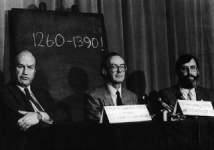
"In 1988, scientists used radiocarbon dating to determine that the Shroud of Turin was made between 1260 and 1390 AD,"
 
There are many useful posts discussing the Shroud of Turin in this thread (and in the four associated continuation threads): https://www1.internationalskeptics....cle-of-the-shroud-blood-on-the-shroud.226761/

My memory is that the possibility of the cloth being draped over a human body and whether the result would resemble the SoT was thoroughly discussed, but as search isn't currently working I can't point you to particular posts at the moment.

Happy reading!
 
Also, if contact with the body was supposed to be burning an image into the cloth, why wasn't there a blotchy burned area all across that top of head area?
 
The draping of the Shroud never made sense to me. The portion with the back image could plausibly have been spread or even stretched over a flat smooth surface like a fitted sheet on a bed, underneath the body. But why and how would the top portion be similarly taut?

Of course, real burial shrouds are more tightly wrapped, in the present day and almost certainly in ancient times as well.

Sure, divine miracle yada yada, but I remember a lot of speculation before the dating, about the cloth being like photographic film capturing a holographic image from the laser-like holy resurrection beams or whatever. Which could only work if the two ends of the shroud were stretched completely flat both above and beneath the body.
 
Doesn't matter. It's a fake.
I agree. The only reason I was asking was because I read scientists in Italy used a new X-ray technique to calculate that the cloth could be around 2,000 years old, which contradicts the carbon dating in the 1980s. So, I thought there must be something else which is clearly and obviously fake, hence, the distortion on the head question.
 
There are many useful posts discussing the Shroud of Turin in this thread (and in the four associated continuation threads): https://www1.internationalskeptics....cle-of-the-shroud-blood-on-the-shroud.226761/

My memory is that the possibility of the cloth being draped over a human body and whether the result would resemble the SoT was thoroughly discussed, but as search isn't currently working I can't point you to particular posts at the moment.

Happy reading!
Thank you, I've had a rummage around and also on different forums but, oddly, I can't find anyone who has spoken clearly about the head distortion. I am very tempted to put a cloth over a few of my friends heads and see where sort of space is left between the face and back of head.
 
The draping of the Shroud never made sense to me. The portion with the back image could plausibly have been spread or even stretched over a flat smooth surface like a fitted sheet on a bed, underneath the body. But why and how would the top portion be similarly taut?

Of course, real burial shrouds are more tightly wrapped, in the present day and almost certainly in ancient times as well.

Sure, divine miracle yada yada, but I remember a lot of speculation before the dating, about the cloth being like photographic film capturing a holographic image from the laser-like holy resurrection beams or whatever. Which could only work if the two ends of the shroud were stretched completely flat both above and beneath the body.
Yup. I used to work with a bloke who thought it was real, so we got a big sheet of A3 paper, wrapped it around his head and drew in outlines of his eyes, mouth, nose and ears. When the paper was flattened out the ears were way out to the side. Comical! He had to think about it ...
 
It seems academic -
"In 1988, scientists used radiocarbon dating to determine that the Shroud of Turin was made between 1260 and 1390 AD,"
I read scientists in Italy used a new X-ray technique and over turned or disputed this?
 
It seems academic -
"In 1988, scientists used radiocarbon dating to determine that the Shroud of Turin was made between 1260 and 1390 AD,"
Indeed. But as we established previously that is only one element, albeit an utterly decisive one, in showing the "shroud" is a medieval fake.
Doesn't matter. It's a fake.
Exactly.
 
Also, if contact with the body was supposed to be burning an image into the cloth, why wasn't there a blotchy burned area all across that top of head area?
I think because the supposed crown of thorns should have raised the cloth up. That is another odd thing actually, don't you think the people burying Jesus would have removed the thorns?
 
Yup. I used to work with a bloke who thought it was real, so we got a big sheet of A3 paper, wrapped it around his head and drew in outlines of his eyes, mouth, nose and ears. When the paper was flattened out the ears were way out to the side. Comical! He had to think about it ...
That's correct, but the Jesus image doesn't show the ears - it is as thought the cloth was not wrapped around his face, but simply laid on top of it, running over the top of his head and down the back. It's for this reason I chose to focus on the top of the head because if the cloth was wrapped over his head, we should see the 3D image elongated when flattened out.
 
I think because the supposed crown of thorns should have raised the cloth up. That is another odd thing actually, don't you think the people burying Jesus would have removed the thorns?
That would surely have distorted all the images around the brow, though, wouldn't it?

And I'm fairly confident that during a Jewish burial, they would have removed accessories which Roman soldiers used to mock him.
 
That's correct, but the Jesus image doesn't show the ears - it is as thought the cloth was not wrapped around his face, but simply laid on top of it, running over the top of his head and down the back. It's for this reason I chose to focus on the top of the head because if the cloth was wrapped over his head, we should see the 3D image elongated when flattened out.

The hair down the side of his head then? His ears are directly below the front line of hair, near as dammit.
 
So, as this nonsense has been resurrected let's look at the facts.

The evidence against the authenticity of the shroud:

1. Historical:
a) the lack of evidence for the shroud's existence prior to the mid fourteenth century
b) it's emergence during the 'holy relic' craze (along with about forty other such burial shrouds)
c) lack of mention of a miraculously imaged Shroud in any early Christian writings
d) the distinct changes in the shroud, fading of colour, since its first exposure

2. Physiological:
e) the lack of resemblance of the shroud image to an actual human body;
f) likewise the position of the body with hands folded across the genitals which simply isn't possible for a body lying flat (the arms aren't long enough)

3. Textile:
g) the weave pattern of the shroud does not match anything known from first century Mid East
h) the weave pattern matches medieval Europe well;
i) no example of the complex herringbone twill weave has even been shown to come from the first century Mid East

4. Testimony:
j) the d'Arcis Memo indicates the shroud was created around 1354 and was a known fake

5. Artistic:
k) the face of the image resembles medieval Byzantine style, with Gothic elements;
l) the unnaturally elongated body shape and extremities are typical of the elongated style the Late Medieval/High Gothic period

6. Reproducibility:
m) contrary to the claims of shroudies the image can and has been reproduced using medieval methods

7. Analytic:
n) microscopic examination, (including non-visible, polarised light and electron microscopy) shows the shroud is composed of common artistic pigments of the period of its origin
o) chemical testing shows the same
p) radiocarbon testing, carried out under highly controlled conditions by three laboratories. showed the cloth to originate between 1260 and 1390AD (>95 per cent confidence) and between 1000 and 1500AD (>99.9 per cent confidence)

8. Cultural:
q) the shroud does not match with what is documented and known of first century Jewish burial practices
r) nor does the shroud match the only extant sample of such burial cloths;
s) neither does the shroud match the biblical accounts of the burial cloths;
t) there are no demonstrated artefacts of the putative Jesus extant today
u) the supposed historical background does not suggest that such a cloth would have been preserved, certainly without publicity prior, to ~1355

9. Serological:
v) a minor point (as blood probably wouldn't survive this long anyway) but despite the best attempts of (and much lying and pseudoscience by) shroudies, there is no evidence for blood residue

Radiocarbon dating.
And a quick summary of the radiocarbon dating.
1. under heavy supervision a sample of the shroud were removed on 21APR1988 by Riggi; the strip came from a single site on the main body of the shroud away from any patches or charred areas and was split into three pieces and sealed into containers by Ballestrero and Tite.
2. the samples were subjected to a dating technique called accelerator mass spectroscopy, selected because it required less sample material than earlier techniques; three labs, Oxford, Arizona and Zürich were selected to carry out the testing
3. cleaning was done with expert input (including Proctor & Gamble), this removed ~30% of the sample mass. Each laboratory used slightly different methods; hot ether, ultrasonic bath, vacuum pipette, repeated acid and alkali baths with intermediate washing, detergents, ethanol, bleach
4. the three laboratories analysed shroud samples in conjunction with three other supplied sample of known provenance
5. all three analyses agreed, the shroud dates from 1260 and 1390AD (>95 per cent confidence) and between 1000 and 1500AD (>99.9 per cent confidence)
6. the results were formally published in Nature in February 1989:
“These results therefore provide conclusive evidence that the linen of the shroud of Turin is medieval”
7. accusations from believers began almost immediately accusing scientists of faking the tests or substituting samples.
8. later various claims of mysterious contaminants or patching were invoked to justify non-acceptance of the dating results

And finally more than any shroudie ever wanted to know about decontamination of the shroud samples.
Each laboratory (Zürich, Oxford and Arizona) carried out a comprehensive, multi-stage, cleaning of their sample. Firstly by microscopic examination and removal of gross contaminants, followed by preliminary cleaning using a mix of ultrasonic bathing, vacuum pipetting and/or hot ether soaking.
After this the samples were split and more stringent methods were used.

Zürich.
The Zürich group split each ultrasonically cleansed sample in half; the first half of the original sample was again split into three parts and these [one sixth portions] were subjected to different tratments:
1. soaking in room temperature baths of 0.5% hydrochloric acid, 0.25% sodium hydroxide and then acid again; samples were rinsed with purified water between each course.
2. no further treatment
3. soaking in hot (80°C) 5% hydrochloric acid, 2.5% sodium hydroxide and then acid again; samples were rinsed with purified water between each course.

The second batch of samples were retained until after the first radiocarbon dating run was completed. As this showed no evidence of contamination, the second set was split into two portions, to which the weak and strong chemical treatments were applied.

Arizona.
The Arizona group split the shroud sample into four subsamples.
1. one pair of subsamples was treated by soaking in dilute hydrochloric acid, dilute sodium hydroxide and again acid, with purified water rinsing in between baths.
2. the second pair of subsamples was treated with two commercial detergents (with advice supplied by Proctor & Gamble), distilled water and 0.1% hydrochloric acid; after this the samples were then submitted to a Soxhlet extraction with ethanol for an hour, followed by further washing with distilled water at 70°C in an ultrasonic bath.

Oxford.
The Oxford group divided their pre-cleaned sample into three parts.
1. all three parts were bathed in 1 molar hydrochloric acid at 80°C for two hours followed by 1 molar sodium hydroxide at 80°C for two hours and again in acid, with rinsing in between.
2. two of the three samples were then bleached in 2.5% sodium oxychloride [bleach] for thirty minutes.

Each laboratory used the same techniques on the four cloth samples provided, the shroud and the three controls with one exception; one of the control samples used at Zürich disintegrated while being cleaned and so it was additionally centrifuged to retain the material.

As a result of this overwhelming evidence it is reasonable to assume that:

The "Shroud" is a medieval fake.
thum_162724fbe8b99a1548.png
 

Back
Top Bottom
