
• Quick note - the problem with Youtube videos not embedding on the forum appears to have been fixed, thanks to ZiprHead. If you do still see problems let me know.

DNA Code...Proof of a Divine Creator?

SweatyYeti

Master Poster
Joined
Dec 1, 2006
Messages
2,919
The subject of this thread is whether the DNA molecules, in a living cell, function as a Code....in the same way that the Binary Code in a computer functions....(or any code, for that matter)....carrying intelligently encoded information....or, if DNA functions purely as a simple, straight-forward chemical reaction.


Any Code requires a Code-Maker....a Designer, for it to be able to function, and transfer meaningful information.

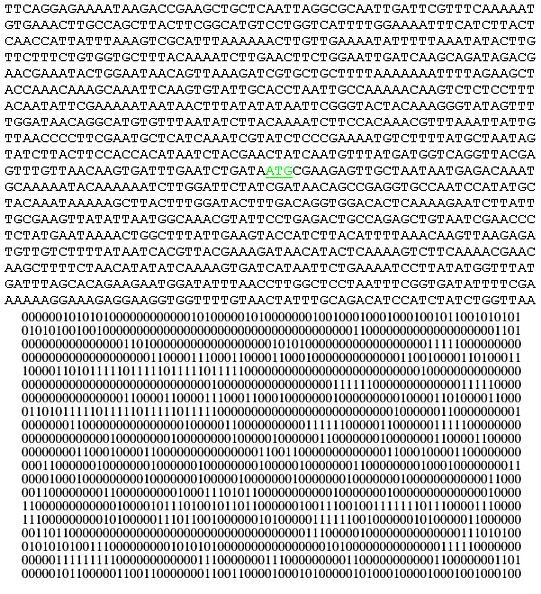
Here are samples of DNA Code and Binary Code sequences...looking quite similar...

DNABinaryCode1.jpg


Now...looking first at Binary Code...

This chart shows how Binary Code is set-up....the two digits (1 and 0) are assigned...(by the Code-Maker)...certain numerical values...(i.e...given meaning)...


binarycodechart2.jpg


An important aspect of the Code is that...in order for the digits to have any meaning (carry/transfer information), they must be read in certain...and precise....groupings.


Individually.....the digits carry no meaning, at all.


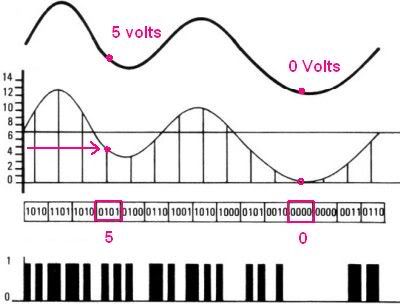
This graphic shows the digits in groupings of 4...(I highlighted 2 voltage levels on the analog signal)....and how an analog signal is converted into a digital signal...

AnalogDigital1.jpg


If the string of 1's and 0's were to be read in any other way than in the precise grouping shown, the information encoded would be 'lost'...the string of digits would have no meaning.


As an everyday example....if a music cd...(which contains analog music, en-coded within a long string of binary digits)...were to be read by sampling the binary digits in random groupings...all that would be heard would be random noises...no meaningful information/music.


Now...looking at DNA Code...

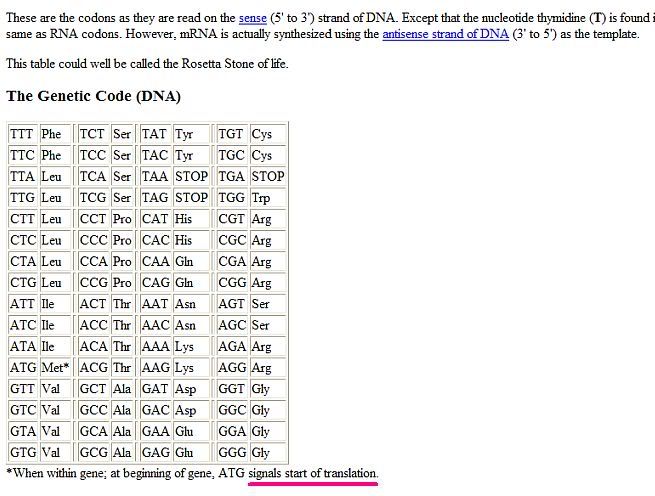
Here is a chart showing the nucleotide bases (A,G,T,C) in groupings of three...or, 'triplets'.....known as 'Codons'...

DNACodeChart2.jpg


Link to the webpage it came from...

http://users.rcn.com/jkimball.ma.ultranet/BiologyPages/C/Codons.html


These groupings are another similarity between DNA Code, and Binary Code.


Here is a link to an article, written by a computer programmer, in which he explains the similarities he sees, between the two Codes...

http://ds9a.nl/amazing-dna/


Here's just one excerpt from it, for now....(another similarity)...


Position Independent Code...

Dynamically linked libraries (.so under Unix, .dll on Microsoft) code cannot use static addresses internally because the code may appear in different places in memory in different situations.
DNA has this too, where it is called 'transposing code':
Nearly half of the human genome is composed of transposable elements or jumping DNA. First recognized in the 1940s by Dr. Barbara McClintock in studies of peculiar inheritance patterns found in the colors of Indian corn, jumping DNA refers to the idea that some stretches of DNA are unstable and "transposable," ie., they can move around -- on and between chromosomes.

http://www.ornl.gov/hgmis/resource/people.html


More to come...:)...
 
Last edited:
The subject of this thread is whether the DNA molecules, in a living cell, function as a Code....in the same way that the Binary Code in a computer functions....(or any code, for that matter)....carrying intelligently encoded information....or, if DNA functions purely as a simple, straight-forward chemical reaction.


Any Code requires a Code-Maker....a Designer, for it to be able to function, and transfer meaningful information.

I think we can stop right there. Forget the "transfer meaningful information"; all biochemical processes do that if they are functional; if not, they disappear. DNA surely functions like a code, but what is a code? It is just an example of a procedure, a method of getting from here to there. The idea is to create proteins, made up of strings of amino acids, of which twenty or so are actually used by Earth life (out of the many more that are chemically possible). Given that, it is possible that life may have done it with DNA that is fashioned out of ten base pairs rather than two. It might have used a base four encoding rather than base three, and if I knew more about biochemistry I'm sure I could have come up with many other schemes. That it happened on this scheme does not have to be explained by magic.

How does a protein work? How does insulin do it's job? are there other possibilities than the insulin we use in our bodies (I know the answer to that one is yes)? Why did it choose the one it actually uses? How come cows can use a different one, and yet theirs works in us as well?

I know the analogy: "Codes" are only produced by intelligence. If we can then prove that DNA is a "code", then it has to be intelligently designed. If you call it a sequence instead, then it doesn't have the cache a code has. But if it is non-unique (there are other ways of performing the task), what makes it a code? Will this argument, bent on the semantics of that word, even work in a different language? Now, there's a question.

The mechanism that DNA uses was developed over some 2 billion years of time through the standard methods of evolution. Eventually one eukaryote got it right, and DNA was so useful, with the right amount of ability to mutate without mutating too much that it out-competed all it's rivals world wide and became THE way to prosper. What is so hard to understand about that? No need for an intelligence to drive it; it's just another biochemical procedure honed to good, though not perfect, function.
 
The subject of this thread is whether the DNA molecules, in a living cell, function as a Code....in the same way that the Binary Code in a computer functions....(or any code, for that matter)....carrying intelligently encoded information....or, if DNA functions purely as a simple, straight-forward chemical reaction.

Firstly, it's not my intention to dissuade you from studying human DNA, or as you refer to it, 'the DNA Code'. Studying is always good.

However, I should point out that most of your post was quite unnecessary. It has a lot of images, a lot of links, but most of it doesn't actually address the topic - whether or not DNA is proof of a 'divine creator'. It's unnecessary for you to include explanations of what DNA or binary code consist of - that information is available elsewhere, and since you're not an expert in either field, you're likely to make some mistakes in your presentation.

The actual arguments you're making are more or less contained in your first few paragraphs:

Any Code requires a Code-Maker....a Designer, for it to be able to function, and transfer meaningful information.

This is your main assertion. It, however, makes several assumptions:

1) DNA is a 'code' - how do you define a 'code', here?
2) A code requires a designer - what's your basis for claiming this?
3) A code 'functions' somehow - one could argue that a code, itself, does nothing, although it is often 'read' by something else
4) There's such a thing as 'meaningful' (and presumably non-meaningful) information. How does one tell the difference?

Before posting more high school science on DNA, you should try and provide basis for these assumptions. Otherwise, you won't be able to satisfactorily prove anything.

Here are samples of DNA Code and Binary Code sequences...looking quite similar...

And this is another problem in your argumentation. It's not that DNA and a computer hard drive looks similar. Their representations, both made by humans, look similar. There's a big difference that you appear to be missing.

The words 'phone' and 'bone' look quite similar. Do you consider this evidence that there must be some fundamental similarity between bones and phones? Your 'similarity' between DNA and binary is no different.


More to come...:)...

Great. However, I strongly recommend you address the points I mentioned before moving into new areas.
 
DNA Code...Proof of a Divine Creator?

Wow. Superman may be able to leap tall buildings in a single bound, but that's nothing compared to the leap you're making there.

Anyone else notice that all these god arguments always seem to come down to the whole "god of the gaps" thing? That and lots and lots of strawmans.
 
Last edited:
The problem with the comparison revolves around meaning. A pattern that is read 'out of order' isn't random at all. But it doesn't capture the meaning intended by the original programmer (or designer). Without knowing ahead of time, I cannot say whether a sequence of binary digits has 'meaning' or not. It may be some sequence that I just do not understand, but in some context is quite important and consequential.

Without imputing meaning into DNA sequences, we are left with the same type of guesswork. It is no good to say that what DNA seems to be doing is what is intended, no more than you could know whether this next sequence is random and only appears meaningful or is actually meaningful: 3,6,9, 12
Is that some mathematical sequence? The start of my phone number? The number of Ts that happen to fall between Gs in some codon? You can't tell without knowing quite a bit about context.

Meaning cannot be derived by simple observation alone. You have to know something about how the process works in practice and why. I have seen clouds that look like rabbits (and dolphins!) but I know how clouds form, so I am not fooled into thinking they are other than random groups that happen to appear non-random. Without knowing how clouds form, I could not make this statement at all.

It's a good question though, worth considering. But like many good questions, the easy answer is probably the wrong one. You have to look deeper.
 
Even if DNA suggested it had been created by an intelligent being (it doesn't), what suggests that being is a god?
 
Any Code requires a Code-Maker....a Designer, for it to be able to function, and transfer meaningful information.

Sorry, but you'll need to provide evidence for that.

All man-made codes may require a creator but if DNA is a code and is not man-made there is no requirement for a code-maker or designer as far as I can see.

This is just 'all things require a creator' dressed up in some nonsense.
 
Humans desribe DNA in this form because it is easier to understand how the system works.

To be exact DNA is not a code, it is a molecule. The basic elements of this molecule form extremely readily under the right conditions. If anything, the existence of DNA and the ease of it's production are strong arguments against a divine creator.
 
Please, DNA is not even slightly comparable to a binary code. The genetic code is 4 bases, grouped in clusters of 3 to translate DNA to protein.
And this code is nowhere near as static as you seem to think. The codon usage between eukaryotes, prokaryotes and archae differs, and even within eukaryotes there is a difference in the codon usage between the main genome and the genomes of mitochondria and chlorplasts. The rest of the DNA functions without directly 'coding' for anything.

Furthermore, there is a very good line of evidence for DNA and proteins being a later graft on a simpler RNA based organism, with the current complexity the result of billions of years of evolution, which also explains why its such an jumbled mess rather than a streamlined code.
The more we learn about genetics, the less it indicates design.
 
The subject of this thread is whether the DNA molecules, in a living cell, function as a Code....in the same way that the Binary Code in a computer functions....(or any code, for that matter)....carrying intelligently encoded information....or, if DNA functions purely as a simple, straight-forward chemical reaction.


...

More to come...:)...

Not really, or at least you have made an analogy, a similie a metaphor.

No evidence of intelligence behind DnA
 
Last edited:
SweatyYeti said:
Position Independent Code...

Dynamically linked libraries (.so under Unix, .dll on Microsoft) code cannot use static addresses internally because the code may appear in different places in memory in different situations.
DNA has this too, where it is called 'transposing code':
Nearly half of the human genome is composed of transposable elements or jumping DNA. First recognized in the 1940s by Dr. Barbara McClintock in studies of peculiar inheritance patterns found in the colors of Indian corn, jumping DNA refers to the idea that some stretches of DNA are unstable and "transposable," ie., they can move around -- on and between chromosomes.

http://www.ornl.gov/hgmis/resource/people.html


Um in short, no.

TransposonWP
Transposons are sequences of DNA that can move around to different positions within the genome of a single cell, a process called transposition. In the process, they can cause mutations and change the amount of DNA in the genome. Transposons were also once called jumping genes, and are examples of mobile genetic elements. They were discovered by Barbara McClintock early in her career[1], for which she was awarded a Nobel prize in 1983.

.dll
A dynamic-link library (DLL) is a module that contains functions and data that can be used by another module (application or DLL).

A DLL can define two kinds of functions: exported and internal. The exported functions are intended to be called by other modules, as well as from within the DLL where they are defined. Internal functions are typically intended to be called only from within the DLL where they are defined. Although a DLL can export data, its data is generally used only by its functions. However, there is nothing to prevent another module from reading or writing that address.
 
Also, if you replace a single bit in a binary code the code falls apart (ask any programmer)
If you replace a bit of DNA odds are nothing truly bad will happen
 
I printed up the sequence from above and taped it to a Ouija board. It worked just as well as a Ouija board, but you have to limit your questions to:
What was my favorite childhood game? TAG
What was Ethan Hawke"s best film? GATTACA
 

Back
Top Bottom