• Quick note - the problem with Youtube videos not embedding on the forum appears to have been fixed, thanks to ZiprHead. If you do still see problems let me know.

Depth Perception

JesFine

Critical Thinker
Joined
Jun 5, 2002
Messages
449
According to the latest commentary:
Distance is judged by three major means: first, through binocular convergence, second, by occultation of or by other objects, and third by comparative experience with similar objects. Briefly, to give examples of these three methods: for the first of these, our "stereo" visual system works by an automatic convergence of the two individual images — left and right — that we perceive with our two eyes, and the feedback from the muscles that rotate our eyeballs in order the bring those images into convergence, provides data that tells us how far away the object is. At about ten meters distance, this method provides minimal information to us. Also, at moderate distances, the focusing of the eye relays a distance factor to us. For the second method, we determine that an object of interest blocked out by another object is further from us than the "blocking" object, just as we learn that the object of interest is closer that an object that it occults. Third, our real-life-experience equips us with memories of "standard" objects: a broom can only be between certain limits of size, as with a pencil and a sunflower.
It is true we judge distance using these means, however, there are several other depth cues that we use, any of which can take precedence over any other depending on circumstances:

1)Shading -- we usually assume that light comes from above. This creates a distinct pattern of shadow which can make something appear to either stick out or sink in.

2)Aerial Perspective -- light scattering caused by particles in the air makes distant objects appear bluer and hazier than closer objects. The amount can vary greatly depending on geographical location, weather, and other factors.

3)Linear Perspective -- this is pretty well-known and may be considered an extension of the "comparative experience with similar objects" phenomenon. It just says that physically parallel lines appear to converge in the distance.

4)Texture Gradients -- this is a combination of linear perspective and relative size. On a uniformly textured surface, the density of the texture elements increases and the size decreases as the distance increases. That sounds more complicated than it really is. Look at these pictures.

5)Height in the Plane -- the closer an object is to the "horizon line" in a picture, the further away it appears to be.

6)Motion Parallax -- the strongest example of this is when looking out the window of a car or bus, you can see that the more distant objects move slower relative to the closer objects.

Hm... there might be more. Anyway, no biggie, I just like to be pedantic every now and then.
 
JesFine said:
5)Height in the Plane -- the closer an object is to the "horizon line"...... the further away it appears to be.
Except that the moon on the horizon appears to be closer than when it is overhead.

BillyJoe
(I still do not know whether this has been properly explained)
 
BillyJoe I don't know either but here's a wild speculation you may find amusing. Took me all of 2 seconds to come up with after reading your post.

The reason the moon looks closer when it is on the horizon than when it is overhead has to do with light, and how the shape of the earth causes light to bend when the moon and the Earth are at various positions relative to each other. It causes a change in our visual perception and the Moon being on the outside of the Earth has an opposite effect than what an object within Earth has on our visual perception based on the differences in the way the Earth is shaped (curved) from the outside as opposed to the inside.
 
Re: Re: Depth Perception

BillyJoe said:
Except that the moon on the horizon appears to be closer than when it is overhead.

BillyJoe
(I still do not know whether this has been properly explained)
Yes it has been explained. When it is up in the sky, there is nothing to compare it to. When it is in the horizon, you have trees, buildings, etc to compare it to. If you actually measured the angular size of the moon in various positions, it would be the same.
 
but....but....that explanation is boring. I liked mine better lol

I demand brownie points for creativity !! *smirk*
 
From Our Very Own Phil Plait, Bad As(s)tronomer's book "Bad Astronomy":

moon.gif


Buy it here. It's less than 12 bucks for a fantastic book.

(This is actually weird...just this evening, I was discussing this with a friend, while observing the full moon rising....is this a conspiracy thingie??? :D)
 
It's not a trick. The moon really does appear bigger when it's close to the horizon. It's because in that position there's a lot more atmosphere refracting the moonlight and changing our perception of the size.

OK, I don't have a book to quite on that, but go on, prove me wrong.

Rolfe.
 
http://www.lhup.edu/~dsimanek/3d/moonillu.htm

We know that this phenomenon is not a physical or atmospheric effect, as may be easily demonstrated by photographing the moon in the sky at various elevations and comparing its size on the negatives. The moon's angular size is nearly constant as it moves across the sky, the moon subtending about 0.5 degree in the sky. One may also verify this with sighting instruments.
...
Some people suppose the moon illusion to be due to atmospheric refraction. Refraction effects can be measured with instruments or cameras, and we find that refraction actually makes the moon's disk subtend a smaller angle in the sky than it would have if the atmosphere were not present. These refraction effects make the moon's apparent horizontal angular diameter still smaller (by about 1.7 percent) when the moon is near the horizon! These physical effects can be confirmed with telescopes and cameras.
 
Regarding the moon:

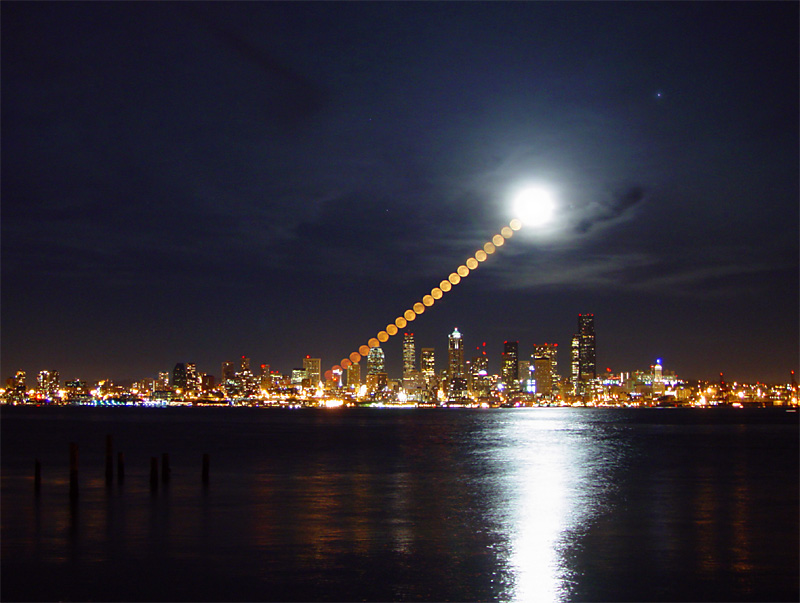
Gee, what a coincidence! Saturday's APOD (Astronomy Picture Of the Day) was:

seattlemoon_stephens_big.jpg


Check out the link here for an explanation of the Photo. here
 
Re: Re: Re: Depth Perception

arcticpenguin said:
Yes it has been explained. When it is up in the sky, there is nothing to compare it to. When it is in the horizon, you have trees, buildings, etc to compare it to.
Yes, I remember now. If you look at the horizon moon through a long tube to remove the surroundings, the moon's size no longer appears to be larger than the zenith moon.

arcticpenguin said:
If you actually measured the angular size of the moon in various positions, it would be the same.
Yes, it's coming back. It only "appears" to be larger. The image on your retina of the horizon moon is the same for the zenith moon.

BillyJoe
 
CFLarsen said:
From Our Very Own Phil Plait, Bad As(s)tronomer's book "Bad Astronomy:
Three questions....
Firstly, why do we see the sky as a bowl rather than as a sphere?
Secondly, why should the moon size be the size of the intercept on this imaginary bowl??
Thirdly, why doesn't the zenith moon look closer than the horizon moon???

CFLarsen said:
(This is actually weird...just this evening, I was discussing this with a friend, while observing the full moon rising....is this a conspiracy thingie??? :D)
So we have three coincidences.... My post, your discussion and the Picture of the Day. :eek:
 
Billy Joe, your brain interprets that the Moon is closer when it's at its zenith, and farther near the horizon. Then it applies scaling, knowing at a subconscious level that something far away must be really big to take up a whole half-degree of your vision. So your brain sees the Moon as bigger on the horizon, not closer.

It a good question why we perceive the sky to be bowl-shaped. If I recall reading Phil's book correctly, it's similar to the looking down direction. You know that when you look straight down, stuff is close to you, and as you move your vision towards the horizon, things get farther away. It's the same effect, flipped over.
 
CurtC,

I've heard this explanation before and never understood it....

CurtC said:
Billy Joe, your brain interprets that the Moon is closer when it's at its zenith, and farther near the horizon.
I don't know about you but I definitely see the HORIZON MOON as CLOSER. Hence the explanations that follow on from this don't make sense to me.

CurtC said:
Then it applies scaling, knowing at a subconscious level that something far away must be really big to take up a whole half-degree of your vision. So your brain sees the Moon as bigger on the horizon, not closer.
But this explanation just doesn't make sense.

We know that the moon doesn't actually change size as it moves from zenith to horizon, therefore if it appears LARGER, we would assume that it is CLOSER. The larger horizon moon should look closer than the zenith moon. As it does to me.

BillyJoe
 
Re: Re: Re: Depth Perception

arcticpenguin said:

Yes it has been explained. When it is up in the sky, there is nothing to compare it to. When it is in the horizon, you have trees, buildings, etc to compare it to. If you actually measured the angular size of the moon in various positions, it would be the same.
What about when there are no " trees, buildings, etc to compare it to ", like when one is at sea, or in a desert? It still looks bigger near the horizon..

It would seem that the BA's explanation takes care of everything...
 
Re: Re: Re: Re: Depth Perception

Diogenes said:
What about when there are no " trees, buildings, etc to compare it to ", like when one is at sea, or in a desert? It still looks bigger near the horizon..
There is still the sea and the desert to compare it to.
One thing I have observed on many occasions is when I'm driving along in a car, the horizon moon looks larger when there are many objects in the middle distance in close proximity (visually) to the moon.

Diogenes said:
It would seem that the BA's explanation takes care of everything...
Who is BA and what is his explanation?
 

Back
Top Bottom