• Quick note - the problem with Youtube videos not embedding on the forum appears to have been fixed, thanks to ZiprHead. If you do still see problems let me know.

Can pressure be negative?

Reality Check

Penultimate Amazing
Joined
Mar 2, 2008
Messages
28,521
Location
New Zealand
The discussion of whether pressure can be negative has come up again in the forum.
I have started this thread for people to present the evidence either way.

My understanding is that pressure can be negative.
Let us start with a defintion of pressure (wiki):
Conjugate variables
of thermodynamics
PressureVolume(Stress)(Strain)TemperatureEntropyChemical potentialParticle number
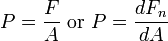
Mathematically:
51c1e96f5b03dceb3635b9e62170d57a.png
where:

P is the pressure,F is the normal force,A is the area.
Using the normal force means that a replusive force (towards the surface) wil give a positive value for pressure. The inverse is true: An attractive force will produce a negative pressure.

An example of negative pressure is the pressure exerted by the Casimir effect:

  • h bar is positive.
  • c is positive.
  • pi is positive.
  • pi squared is definitely positive!
  • 240 is positive.
  • a is the separation (positive again!)
  • a to the fourth power is definitely positive!
There is a negative sign in front of multiplying and dividing these positive quantities. Theerfore the pressure is negative.

Negative pressures are also measured, e.g. Tests of new physics from precise measurements of the Casimir pressure between two gold-coated plates

There is also the definition of pressure as P=-dE/dV (E = energy, V - volume) which often appears in cosmology. It is simple to show that a cosmological constant in GR results in a negative pressure.
 
Hydraulic or Pneumatic, no. Absolute pressure is always positive. If you see a negative number, it is likely gauge pressure--compared to atmospheric, or some other reference. Since such pressures are the result of the presence of something, the complete absence of that something gives zero pressure.
The only negative presence I know about comes from psychics...
 
Yes, negative pressure can only be below some other value above zero.
Space is a pretty good zero level of pressure.
Suction is negative pressure, but relative to some higher pressure.
It's what makes the coke go up the straw, when you make "negative pressure" in your mouth.
That might be a tenth of a psi less than the static pressure on the surface of the liquid.
 
Hydraulic or Pneumatic, no. Absolute pressure is always positive. If you see a negative number, it is likely gauge pressure--compared to atmospheric, or some other reference. Since such pressures are the result of the presence of something, the complete absence of that something gives zero pressure.
The only negative presence I know about comes from psychics...
This is pressure from gases which by definition (repulsive forces) is always positive. So a negative pressure is always wrong for gases.
 
Pressure is never negative. It's always positive, but can be written as negative when it's less than a greater positive pressure to make math simpler.

Slightly related, I would often switch between writing the gravitational force as positive or negative based on the other numbers I had and what outcome was asked for.
 
Hydraulic or Pneumatic, no. Absolute pressure is always positive. If you see a negative number, it is likely gauge pressure--compared to atmospheric, or some other reference. Since such pressures are the result of the presence of something, the complete absence of that something gives zero pressure.
The only negative presence I know about comes from psychics...


This. Some lab gauges measure vacuum in negative numbers based on atmospheric pressure being considered zero.
 
Last edited:
Sure, pressure can be negative in ordinary practical circumstances. Squeeze a solid object and it feels an internal pressure. Pull on it (in a stretching sense) and it's got a negative internal pressure. I've been to a physics colloquium which talked about interesting phases that occurred on the negative-pressure side of the phase diagram.

And there's the totally standard and uncontroversial use of "negative pressure" to denote the effect, in GR, of vacuum energy density.
 
I suggest a reading comprehension course.
That is what I said.
I was pointing out that you were restricting yourself to a case (pressure from gases) where pressure is always positive (relative to zero pressure).
The values of gaseous pressure measured in various scales will differ and can be negative, e.g.see John Jones comment.

IMO the scientific scale for pressure is from absolute zero pressure, just like the scientific scale for temperature (Kelvin) is from absolute zero temperature.
 
IMO the scientific scale for pressure is from absolute zero pressure, just like the scientific scale for temperature (Kelvin) is from absolute zero temperature.

To be sure I understand the above, are you saying that there can be no absolute negative pressure, just as there can be no absolute negative temperature (a temperature below absolute zero)?
 
Working in the hospital environment, we have "negative pressure isolation rooms" where we put patients with TB, for example.

I'm assuming it's negative relative to the pressure outside the room (and that's the only reason it's "negative"), and outside the room we have a digital reading which lets us know whether or not the room is operating correctly. There is also a simple test (quick and dirty so to speak) of dropping a kleenex slightly beyond the threshold and watching it "suck" into the room.

I know the question the OP is asking is mathematical in nature, but I thought I would throw this anecdote in there just for it's novelty value perhaps ...
 
To be sure I understand the above, are you saying that there can be no absolute negative pressure, just as there can be no absolute negative temperature (a temperature below absolute zero)?
I am saying that there is a "absolute zero pressure" analogously to the absolute zero temperture. It might be defined as the pressure of a gas at absolute zero.

A bit of interesting physics: There can be systems with temperatures below absolute zero. How to create temperatures below absolute zero
 
I was pointing out that you were restricting yourself to a case (pressure from gases) where pressure is always positive (relative to zero pressure).
The values of gaseous pressure measured in various scales will differ and can be negative, e.g.see John Jones comment.

IMO the scientific scale for pressure is from absolute zero pressure, just like the scientific scale for temperature (Kelvin) is from absolute zero temperature.
No-but other than gasses, other forms of "pressure"-hydraulic and stress, for instance are due to something other than molecular energy--gravity, or other applied load. In solids, "pressure' can be either tensile or compressive, for which we engineers use a sign convention to differentiate the two, because it is important to know which is which. Compressive stress is considered to be "negative", while tensile stress is "positive"- a matter of convention, and convenience. They are both positive values, however.
In a liquid, hydrostatic pressure is matter of applied load, and is always normal to whatever surface you are dealing with.
for a gas, P*V=n*R*T, where n is the molar amount, R is a gas constant, and T is measured from absolute zero.
Lab tricks and semantics aside, if heat flows from the hotter to the colder, the "negative temperature" system described in the above link is still at a temperature above 0 absolute.
Perhaps you have found a new state of matter?
 
No.
Negative pressure is a standard bit of physics. Read the OP.

Rwguinn is using engineering parlance, where pressure is hydraulic or pneumatic. Fc/A in a solid object is referred to as stress, and this Casimir Effect is voodoo.
 
Rwguinn is using engineering parlance, where pressure is hydraulic or pneumatic. Fc/A in a solid object is referred to as stress, and this Casimir Effect is voodoo.
I know a couple of extremely good electrical engineers who used to insist that a Boolean algebra could involve only two values, true and false. For all I know, they still insist upon that.

The current Wikipedia article starts out by affirming their perspective, but does get around to acknowledging the more general notion of a Boolean algebra, albeit confusingly:
Wikipedia said:
More generally Boolean algebra is the algebra of values from any Boolean algebra as a model of the laws of Boolean algebra....Boolean logic as the subject matter of this article is independent of the choice of Boolean algebra (the same equations hold of every nontrivial Boolean algebra); hence, there is no need here to consider any Boolean algebra other than the two-element one. The article on Boolean algebra (structure) treats Boolean algebras themselves.
In other words, Wikipedia settled the semantic controversy by creating a second article on exactly the same subject, but written from the mathematicians' point of view.

Yes, that's relevant to this thread.
 

Back
Top Bottom