
You are using an out of date browser. It may not display this or other websites correctly.
You should upgrade or use an alternative browser.
You should upgrade or use an alternative browser.
A scientific fact/tidbit you recently learned that you thought was interesting
- Thread starter bigred
- Start date
Andy_Ross
Penultimate Amazing

- Joined
- Jun 2, 2010
- Messages
- 66,818
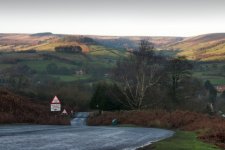
We also have those over the North Yorkshire Moors but the Dales are better known for them., U-shaped valleys with meandering rivers on their flat floors.
Farndale and Rosedale are our best examples, they are smaller and more friendly.
Rolfe
Adult human female

Yes 12,000 years ago
That would place it in the Loch Lomond stadial, then, not the main Ice Age. Fascinating.
Rolfe
Adult human female
We also have those over the North Yorkshire Moors but the Dales are better known for them.
Farndale and Rosedale are our best examples, they are smaller and more friendly.
View attachment 66057
Pretty. There's an absolute cracker just about five miles from where I live, and I like to cycle there and just look at it.
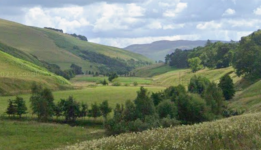
It's odd how difficult it is to get even a half-decent view of it from Google Streetview. It's much better in real life. Maybe I should stop and take a photo sometime.
Last edited:
Rolfe
Adult human female
A few loose ends. What about Loch Treig and Coire Làire to the south of Glen Spean? While the 260-metre shoreline is quite clear at the entrances to these glens (and was apparently clearer before the forestry plantation, as evidenced by some interesting engravings from that time), that entire area is believed to have been under the ice cap, with Loch Treig (currently at 250 metres) being entirely glaciated. Thus the shoreline only shows at the foot of the glens, where they open into Glen Spean, which was the edge of the ice cap. The Great Glen was also filled with ice, and there is reference to a glacier in Loch Arkaig, which explains the absence of shorelines there too - there was no shore, just a whole heap of ice.
Caol Lairig, on the west side of Beinn a' Mhonicag (Bohuntine Hill) from the main run of Glen Roy, is interesting, because it has four shorelines, not three. Count them.
View attachment 66015
The 260-metre shore is visible on both sides of the burn on the bottom left-hand part of the snip. That would have formed when there was still a flow of water southwards out of that side-glen, into the lower part of Glen Roy. The 325-metre and 350-metre lines are visible on the east side of the glen towards the top right-hand corner, although only the 325-metre one can be seen on the west side. But what else is there? A very clear 300-metre line on both sides of the burn, a level not seen anywhere else.
Here's a wider view.
View attachment 66014
I think Lauder may have got this part (the geologists call this "Collarig", which is screamingly annoying - these names mean something, and shouldn't be mangled like this), but I haven't seen it explained in any of the modern treatments of the phenomenon. This can be explained by an intermediate stage in the shore formation. First the entrance to Glen Roy was blocked well south of Beinn a' Mhonicag, so that the side glen of Caol Lairig was still draining south into Glen Roy. However, as the ice advanced, it blocked this outflow even though the main outflow from Glen Roy to Glen Spean was still patent. Thus, for a period of time while Loch Roy was still at 260 metres and draining into Glen Spean to the south, "Loch Lairig" was at 300 metres and draining north of Beinn a' Mhonicag into Loch Roy. Here you go, col marked as 299 metres. (The col heights are marked almost obsessively around here, in stark contrast to practice elsewhere in the country - I really think the OS has a thing for this story.)
View attachment 66020
(Incidentally, how did the early proponents of the "roads" interpretation explain the damn things circling Beinn a' Mhonicag and going precisely nowhere? You can also see similar "roads" encircling other small hills which must have been islands at the time.)
A bigger puzzle is at the top of the glen where it bends eastwards, with Glen Turret coming in from the west to form a T-shape. Look at the map where the "roads" are running east-west on that very steep south-facing slope. The 350-metre shoreline is marked. Below it, the 325-metre shoreline is marked. But in between there is a third one, at 335 metres.
View attachment 66016
I believe I read somewhere that this was one of Darwin's objections to the lake-shore theory as well, that there wasn't a 335-metre spillway. There doesn't appear to be, and even if there were, why would this shore appear only on this one part of the hillside. On the other hand, this intermediate shore doesn't appear on my older map, which only shows 1,068 and 1,149 "roads". I wonder when and why they were added? I also wonder who is hallucinating, Darwin and the OS, or me and my camera? This is a zoom in on the relevant part of my own photo of that hillside which I posted above. (I was only trying to get a nice view, I had only read the bare bones of the "roads" saga on a tourist information display about six miles back down the glen and hadn't got beyond "wow that's amazing!")
View attachment 66017
The 260-metre shore is irrelevant here, I was standing at about 260 metres. How many lines? Two, I believe. Two which match the 325 and 350 lines as they appear elsewhere in the glen. Do you see anything in between them? No, me neither. There might be some marks above them, but I swear there's nothing at 335 metres. I don't get this at all. I hope to take another trip up there in the spring to look a bit more closely.
And finally. Glen Spean again.
View attachment 66018
Yes, we have the expected 260-metre shoreline (plotted at 261 metres) on both sides of the river. And then what? A "road" at 400 metres up a very steep hill, again with no counterpart anywhere, and obviously no possible explanation in terms of spillways.
Go home, Ordnance Survey, you're drunk.
Again I think I remember this was part of Darwin's objections, what's that doing there. I suppose I should read it all again. But is it there? I don't know, and I am sure as hell not climbing up a slope like that to find out. It might be possible to get a look from the road level I suppose and see if aything is visible. Unfortunately there's no access to the opposite slope, and what appears to be a footpath is actually a "dismantled tramway". A drone might come in handy...
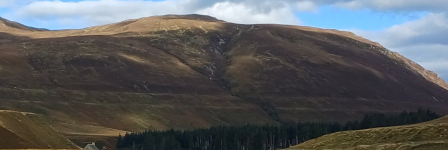
I've been looking again at the question of the alleged 335-metre shoreline up above the Turret Bridge, and I really can't see it. Here's an even closer zoom in to the snapshot I took with my phone.
And here's the relevant part of the OS map, at the 1:25,000 resolution.
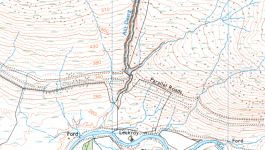
The deep ravine of the Allt Dearg (the red burn) is clearly visible in the middle of the photo. According to the OS map, this 335-metre shore should be visible to the left of the ravine, but not to the right. I can't see a dicky-bird. (Try to ignore the fence lines on the map - someone seems to have built a fence along the 325-metre shore on the left, then to the right of the Allt Dearg it's on the 350-metre shore for a bit.)
It may be that it's clearer even further to the left, which is cut off the photo by the huge bank of gravel that was swept down the Allt a' Chòmhlain at the time when "Loch Gloy" was draining down that into the headwaters of the 260-metre "Loch Roy". I'm going to go back in the spring, leave the car at the viewpoint to save cycling the boring bit up from Roybridge again (I might even camp at the viewpoint, although it's windy) and cycle back up there to get a better look at it. I'll try to cross the Turret Bridge and go on as far as the Luib Chonnal where the track ends, if possible. I'll also go the other way, round the end of the gravel bank and towards Glen Turret, which should give a much better view of the face of the hill where the 335-metre shore is marked most clearly.
If I can camp at the viewpoint for two or three nights I could try the climb up at least to the 260-metre shoreline above it, and maybe even to the 325-metre one as suggested by the field trip. I just find the whole thing completely fascinating.

You got it from usLoch Lochy. And I thought we Australians were great at naming things.
alfaniner
Penultimate Amazing

Less of a "tidbit" -- more like a seven-course meal. Nice work, though.
Rolfe
Adult human female
I've had a closer look at the figures in the Palmer et al (2020) paper I reproduced above, and I think I have the chronology figured out now.
The figures are a little odd in that the authors are mainly concerned with the ice movements, and haven't shown the water flows consistently. Although all three principle cols (260 metres at Glen Pattack/the Pass of Muckul, 325 metres at Gleann Glas Dhoire and 350 metres at the Roy/Spey watershed) are shown, at no point is any water actually depicted as flowing over either the 260-metre col or the 350-metre one, though obviously it must have. Anyway, leaving that aside, this is how it goes.
The lowest 260-metre shore of Loch Roy only existed on the way down, for 79 years. In contrast the middle shore existed both on the way up (104 years) and on the way down (108 years). I don't know if the first shoreline would have been obliterated by the rising water or not. Maybe not entirely, because the highest level only existed for 35 years before the loch dropped back to 325 metres again. And yet, from a distance, all three shorelines look about even-stevens as far as their definition goes. I haven't seen the shore in Glen Gloy, which was there for 326 years, to see if it looks any better defined. Nor have I looked at the shoreline in Glen Spean, which was there for the full 513 years. However it's not that far above the floor of the glen and has been subjected to a lot of human interference. The A86 is actually built on it along the side of Loch Laggan, so it really is a "road" there.
The paper doesn't deal with the Caol Lairig at all, the authors don't seem interested in that 300-metre shore. I think this must only have formed on the way down. Initially Loch Roy filled to 325 metres, so Beinn a' Mhonicag was immediately turned into an island in the loch, with water at 325 metres on either side. Then it rose to 350 metres, of course, and back down. But when the main channel of Glen Roy opened up into Loch Spean and Loch Roy fell to 260 metres, there has been a period early on when the southern outflow from Caol Lairig was still blocked. This has led to the temporary formation of a small Loch Lairig at 300 metres, draining into Loch Roy down what is now the Allt Bruachan.
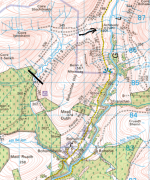
Hey, I managed to draw on a map! (Rather badly.) So the main channel where the River Roy runs at present was open, allowing Loch Roy to become contiguous with the 260-metre Loch Spean, but the ice was still blocking the Allt Iondrainn, which runs south out of Caol Lairig, at about the level of the black line (which joins the ends of the 300-metre shores as marked). So there was a 300-metre loch in there which was draining down the Allt Bruachan (arrow) into the now 260-metre Loch Roy, and that would have existed until the ice cleared from the Allt Iondrainn channel, allowing the water level to drop down to the common 260 metres, so that Beinn a' Mhonicag was simply an island in a 260-metre loch again, as it had been an island in the 325 and 350-metre lochs. It's an interesting wrinkle, although I've not seen it discussed.
One final thing. I have changed my mind about that heap of gravel just above the Turret Bridge. (Darwin thought it was shingle!).
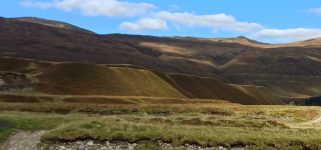
It's not in the right place to be formed from the run-off from Glen Gloy, and there's too much of it anyway. I think it's a proper moraine left from the time when Glen Roy was properly glaciated during the main Ice Age. I haven't seen any discussion about this, but it's the only thing that makes sense.
So that's the eighth course, I think, and I probably understand it all as well as I care to. I look forward to going back for a closer look, though I doubt if I'll go into the Caol Lairig, as the only practical way would seem to be to climb up to the 325-metre shore from the viewpoint and then walk north along it round Beinn a' Mhonicag for a mile or so. I'll see.
The figures are a little odd in that the authors are mainly concerned with the ice movements, and haven't shown the water flows consistently. Although all three principle cols (260 metres at Glen Pattack/the Pass of Muckul, 325 metres at Gleann Glas Dhoire and 350 metres at the Roy/Spey watershed) are shown, at no point is any water actually depicted as flowing over either the 260-metre col or the 350-metre one, though obviously it must have. Anyway, leaving that aside, this is how it goes.
- The first 260 metre loch was only Loch Spean, and Glen Roy and Glen Gloy continued to drain towards Loch Lochy as before with no loch formation. This is because Glen Spean was blocked by the "Làire/Treig" glacier, when it advanced northwards out of the mouths of Glen Treig and the Coire Làire, upstream of the confluence of the rivers Roy and Spean (at the present Roybridge). This period lasted for 187 years.
- More ice advanced to fill in lower Glen Spean right up to the mouth of Glen Gloy, damming both Glen Roy and Glen Gloy. The Gleann Glas Dhoire col remained patent as a spillway to Loch Spean, already established for 187 years by then. So at this stage Lake Roy first formed, and filled right up to the 325-metre mark with its outflow going down the Fèith Shìol (the channel where the fish spawn?) into Loch Spean at Roughburn. Meanwhile Loch Gloy formed, filling right up to the 355-metre mark with its outflow going down the Allt a' Chòmhlan into the headwaters of the new Loch Roy. Later in that phase the ice advanced further up both Glen Gloy and Glen Roy, but didn't alter the water flow patterns. This period lasted for 104 years.
- At the ice maximum (jokulhaup?) the spillway through Gleann Glas Dhoire was blocked, forcing Loch Roy to rise another 25 metres to drain over the col into the headwaters of the River Spey. At this point it was nearly as high as Loch Gloy, and the spillway over the Allt a' Chòmhlain was barely a kilometre long and fell only five metres. This period lasted a mere 35 years.
- As the ice began to retreat the Gleann Glas Dhoire spillway opened up again and Loch Roy fell to 325 metres again. The Allt a' Chòmhlann spillway was now somewhat longer and falling 30 metres again, as it had during stage 2. This period lasted for 108 years.
- Further retreat of the ice opened up the main channel from Loch Roy into Loch Spean, that is where the present River Roy flows into the Spean at Roybridge. This allowed the Gleann Glas Dhoire spillway to dry up, and the 260-metre Loch Roy to appear for the first time. The Làire/Treig glacier was no longer blocking Glen Spean so Loch Spean was contiguous all the way from Glen Pattack to the present Spean Bridge, where the 260-metre shoreline visible today ends. Lower Glen Spean was still blocked by ice (as it had not been in stage 1), so that Loch Roy (now at 260 metres) and Loch Gloy remained in existence. This is the period where the Allt a' Chòmhlain took the water from Loch Gloy all the way down to the headwaters of Loch Roy at the level of Turret Bridge, when I presume that huge bank of gravel formed. This period lasted for 79 years before the ice retreated sufficiently to let the water escape westwards again. It's not quite clear how catastrophic this was, but it is said to have occurred 11,618 years ago. (Presumably 11,623 years ago, now!) It looks however as if the water was still heading for the North Sea across the Great Glen, towards Inverness, as that glen was still iced up from about the south-west end of Loch Lochy.
The lowest 260-metre shore of Loch Roy only existed on the way down, for 79 years. In contrast the middle shore existed both on the way up (104 years) and on the way down (108 years). I don't know if the first shoreline would have been obliterated by the rising water or not. Maybe not entirely, because the highest level only existed for 35 years before the loch dropped back to 325 metres again. And yet, from a distance, all three shorelines look about even-stevens as far as their definition goes. I haven't seen the shore in Glen Gloy, which was there for 326 years, to see if it looks any better defined. Nor have I looked at the shoreline in Glen Spean, which was there for the full 513 years. However it's not that far above the floor of the glen and has been subjected to a lot of human interference. The A86 is actually built on it along the side of Loch Laggan, so it really is a "road" there.
The paper doesn't deal with the Caol Lairig at all, the authors don't seem interested in that 300-metre shore. I think this must only have formed on the way down. Initially Loch Roy filled to 325 metres, so Beinn a' Mhonicag was immediately turned into an island in the loch, with water at 325 metres on either side. Then it rose to 350 metres, of course, and back down. But when the main channel of Glen Roy opened up into Loch Spean and Loch Roy fell to 260 metres, there has been a period early on when the southern outflow from Caol Lairig was still blocked. This has led to the temporary formation of a small Loch Lairig at 300 metres, draining into Loch Roy down what is now the Allt Bruachan.
Hey, I managed to draw on a map! (Rather badly.) So the main channel where the River Roy runs at present was open, allowing Loch Roy to become contiguous with the 260-metre Loch Spean, but the ice was still blocking the Allt Iondrainn, which runs south out of Caol Lairig, at about the level of the black line (which joins the ends of the 300-metre shores as marked). So there was a 300-metre loch in there which was draining down the Allt Bruachan (arrow) into the now 260-metre Loch Roy, and that would have existed until the ice cleared from the Allt Iondrainn channel, allowing the water level to drop down to the common 260 metres, so that Beinn a' Mhonicag was simply an island in a 260-metre loch again, as it had been an island in the 325 and 350-metre lochs. It's an interesting wrinkle, although I've not seen it discussed.
One final thing. I have changed my mind about that heap of gravel just above the Turret Bridge. (Darwin thought it was shingle!).
It's not in the right place to be formed from the run-off from Glen Gloy, and there's too much of it anyway. I think it's a proper moraine left from the time when Glen Roy was properly glaciated during the main Ice Age. I haven't seen any discussion about this, but it's the only thing that makes sense.
So that's the eighth course, I think, and I probably understand it all as well as I care to. I look forward to going back for a closer look, though I doubt if I'll go into the Caol Lairig, as the only practical way would seem to be to climb up to the 325-metre shore from the viewpoint and then walk north along it round Beinn a' Mhonicag for a mile or so. I'll see.
Last edited:
Blue Mountain
Resident Skeptical Hobbit

Lochy McLochface?Loch Lochy. And I thought we Australians were great at naming things.
Rolfe
Adult human female
You're going to regret bringing this up, I promise you...
This is a point I have been slightly interested in for a while, and I haven't found a satisfactory explanation. Here's a map of the "Lochy" area we've been talking about so far. Note Loch Lochy, but also the River Lochy flowing out of it down to its confluence with Loch Linnhe. The town at that confluence used to be called Inverlochy (now An Gearasdan, with the Inverlochy name being given to a suburb), and you can see Inverlochy Castle marked (it's now a hotel).
(ETA: you can see what I mean about Gairlochy and "short loch" on that map.)
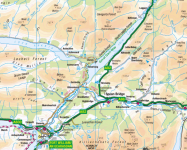
Here is somewhere else entirely. It's not actually all that far away, probably about forty miles as the crow (fithich) flies, but certainly not connected to the district shown above.
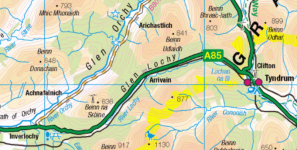
Here we have a Glen Lochy (which genuinely could be translated as the Lochy Gorge) and another River Lochy, and another Inverlochy, at the confluence where the River Lochy flows into the River Orchy. But no actual loch. The only loch involved there is a broadening of the river called the Lochan na Bì. Not Loch(an) Lochy.
It's one of these names that recurs in the Scottish landscape, like Tarbe(r)t and Gairloch and S(t)rone (there's actually a Strone on both of these maps too, it's Gaelic for nose, and describes a nose-shaped hill). I'm sure it must be topographical, referring to some common feature of the landscape that has been fixed on to name the features, but I don't know what it is. I'm wildly sceptical of this "ban-dia dhorcha" thing - why would ban-dia dhorcha come out sounding like Lochy? Even dhorcha (dark, pronounced in its lenited - feminine adjective - form as yorcha) on its own doesn't really fly. Which goddess anyway? Which goddess would it be in the Argyll occurrence? The absence of any loch in the Argyllshire Glen Lochy suggests to me it's not actually referring to a loch but to something else that has become transcribed as Lochaidh. Damned if I know what though.
This is a point I have been slightly interested in for a while, and I haven't found a satisfactory explanation. Here's a map of the "Lochy" area we've been talking about so far. Note Loch Lochy, but also the River Lochy flowing out of it down to its confluence with Loch Linnhe. The town at that confluence used to be called Inverlochy (now An Gearasdan, with the Inverlochy name being given to a suburb), and you can see Inverlochy Castle marked (it's now a hotel).
(ETA: you can see what I mean about Gairlochy and "short loch" on that map.)
Here is somewhere else entirely. It's not actually all that far away, probably about forty miles as the crow (fithich) flies, but certainly not connected to the district shown above.
Here we have a Glen Lochy (which genuinely could be translated as the Lochy Gorge) and another River Lochy, and another Inverlochy, at the confluence where the River Lochy flows into the River Orchy. But no actual loch. The only loch involved there is a broadening of the river called the Lochan na Bì. Not Loch(an) Lochy.
It's one of these names that recurs in the Scottish landscape, like Tarbe(r)t and Gairloch and S(t)rone (there's actually a Strone on both of these maps too, it's Gaelic for nose, and describes a nose-shaped hill). I'm sure it must be topographical, referring to some common feature of the landscape that has been fixed on to name the features, but I don't know what it is. I'm wildly sceptical of this "ban-dia dhorcha" thing - why would ban-dia dhorcha come out sounding like Lochy? Even dhorcha (dark, pronounced in its lenited - feminine adjective - form as yorcha) on its own doesn't really fly. Which goddess anyway? Which goddess would it be in the Argyll occurrence? The absence of any loch in the Argyllshire Glen Lochy suggests to me it's not actually referring to a loch but to something else that has become transcribed as Lochaidh. Damned if I know what though.
Last edited:
Rolfe
Adult human female
Ooh, lucky you. I was standing by the flight of locks in Kilchuimen for a while, watching the cruise boats go by, and getting ideas. I even photographed the web addresses on one or two for future reference.
Wudang
BOFH

A discussion of "Lochy" placenames https://www.snsbi.org.uk/Nomina_articles/Nomina_28_King.pdf
Andy_Ross
Penultimate Amazing
- Joined
- Jun 2, 2010
- Messages
- 66,818
Up the east coast to Inverness then through the canal. Shortcut to the Hebrides.Ooh, lucky you. I was standing by the flight of locks in Kilchuimen for a while, watching the cruise boats go by, and getting ideas. I even photographed the web addresses on one or two for future reference.
We would go up one year then overwintered the boat on the west coast to continue sailing the next year before retracing our course.
Rolfe
Adult human female
A discussion of "Lochy" placenames https://www.snsbi.org.uk/Nomina_articles/Nomina_28_King.pdf
Thank you, I hadn't seen that. Seems an awful lot of speculation without any solid evidence to link "nigra dea" with the Lochaidh placenames in the first place. Or at least as far as I got. I did run out of steam after a bit. I see Gairlochy now means (according to this paper) "the roar of the Lochy". Clearly this is way beyond my pay grade. Just...
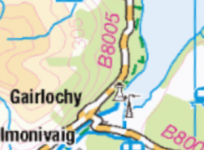
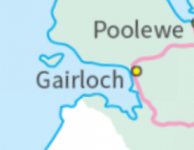
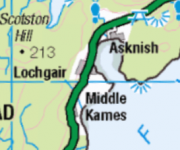
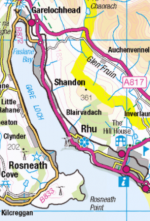
Notice anything similar about these locations, that might just possibly relate to the fact that the word geàrr in Gaelic means "short"? Obviously this is all too subtle and academic for me. As is how we get from nigra dea to ban-dia dhorcha, and how that relates to the word Lochy either which way. I get it that the paper seems to discuss this and I suppose he's right, but it seems awfully tendentious to me.
arthwollipot
Observer of Phenomena, Pronouns: he/him

The largest black hole in the observable universe is the supermassive black hole TON 618. It has an estimated 66 billion times the mass of our sun. it is also 18.2 billion light years away from us which means that we are seeing it as it was 18.2 billion years ago. Though the concept of "now" is weird in general relativity, it is fascinating to speculate what TON 618 would look like 18.2 billion years later in its own timeline, ie, "now" for us. Is it even more massive?
Last edited:
shemp
a flimsy character...perfidious and despised

Christ, how big is your kid???The largest black hole in the observable universe is the supermassive black hole TON 618. It has an estimated 66 billion times the mass of our son. it is also 18.2 billion light years away from us which means that we are seeing it as it was 18.2 billion years ago. Though the concept of "now" is weird in general relativity, it is fascinating to speculate what TON 618 would look like 18.2 billion years later in its own timeline, ie, "now" for us. Is it even more massive?
arthwollipot
Observer of Phenomena, Pronouns: he/him
Thanks for amusingly pointing out my typo. I've fixed it.Christ, how big is your kid???

alfaniner
Penultimate Amazing
I thought the universe was only about 14 billion years old? Well, according to The Big Bang Theory, anyway....The largest black hole in the observable universe is the supermassive black hole TON 618. It has an estimated 66 billion times the mass of our sun. it is also 18.2 billion light years away from us which means that
we are seeing it as it was 18.2 billion years ago. Though the concept of "now" is weird in general relativity, it is fascinating to speculate what TON 618 would look like 18.2 billion years later in its own timeline, ie, "now" for us. Is it even more massive?
3point14
Pi

- Joined
- Nov 4, 2005
- Messages
- 23,069
The largest black hole in the observable universe is the supermassive black hole TON 618. It has an estimated 66 billion times the mass of our sun. it is also 18.2 billion light years away from us which means that we are seeing it as it was 18.2 billion years ago. Though the concept of "now" is weird in general relativity, it is fascinating to speculate what TON 618 would look like 18.2 billion years later in its own timeline, ie, "now" for us. Is it even more massive?
My understanding is that 'now' is not really something that works over interstellar distances?